DbcultAccessing Vault...
Cult Review
Senior Film Conservator
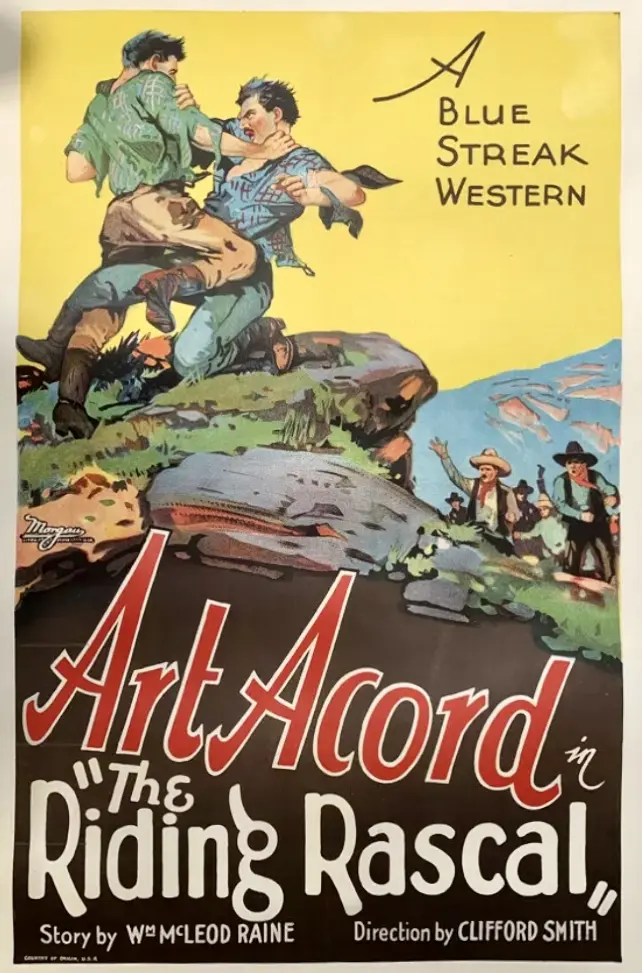
Is 'The Riding Rascal' a silent Western worth dusting off today? Short answer: yes, but with significant caveats that demand a specific taste for early cinematic history.
This film is a fascinating artifact for enthusiasts of 1920s Westerns and silent film completionists, yet it will likely test the patience of casual viewers expecting modern narrative pacing or nuanced character arcs.
This film works because of its raw, untamed energy and Art Acord's charismatic screen presence, which elevates even the most rudimentary action sequences.
This film fails because its narrative predictability and paper-thin character motivations prevent it from transcending its genre conventions, leaving little lasting impact beyond historical curiosity.
You should watch it if you have a deep appreciation for the foundational tropes of the Western genre, are keen to observe the early development of cinematic storytelling, or simply enjoy a straightforward tale of justice in the Old West.
Directed by Harrison Jacobs and released in 1926, 'The Riding Rascal' plunges viewers into a classic tale of mistaken identity, frontier justice, and burgeoning romance. At its heart is Larrabie Keller (Art Acord), a homesteader whose quiet life is upended by accusations of cattle rustling, a charge that carries severe implications in the unforgiving Old West.
The film swiftly establishes Keller's moral compass, contrasting his calm demeanor with the volatile temperament of figures like Bill Healy (Dudley Hendricks). A pivotal moment sees Keller, unwilling to fight Phil Sanderson (William Steele) — whose sister Phyllis (Olive Hasbrouck) has caught his eye — endure a public insult from Healy.
Keller’s subsequent, brutal drubbing of Healy sets the stage for a simmering feud that drives much of the narrative. This early display of physical prowess, while satisfying in a primal sense, also complicates Keller’s image in the eyes of Phyllis, who later discovers him by a branding fire, cementing her suspicion of his guilt.
The plot, while straightforward, manages to weave in elements of suspense and misdirection. Keller's revelation to Yeager (C.E. Anderson) that he is, in fact, a Texas Ranger working undercover, provides a crucial turning point, reframing all prior events through a lens of duty and deception. This twist, though conventional for the genre, injects a layer of intrigue into what might otherwise be a simple revenge story.
The climax involves a jailbreak, a posse chase, and a dramatic confrontation between Keller and Healy, ending with Healy’s fatal plunge. It’s a sequence designed for maximum impact, showcasing the era’s penchant for grand, if somewhat predictable, action set pieces. The film concludes with the inevitable rounding up of the rustlers and Keller’s redemption, a tidy resolution that reinforces the genre’s inherent moral clarity.
Art Acord, a legitimate rodeo champion and stunt rider, brings an undeniable authenticity to the role of Larrabie Keller. His physicality is the film's most compelling asset. Watching him in action, whether delivering a swift punch or expertly handling a horse, is to witness a performer utterly at home in the saddle and in the brawl.
Acord’s silent acting style, characterized by a stoic gaze and deliberate movements, perfectly embodies the archetype of the strong, silent Western hero. He communicates much through his presence, particularly in moments of quiet determination or righteous anger. The scene where he administers the 'severe drubbing' to Bill Healy is particularly impactful, not just for the action itself, but for the controlled fury Acord projects.
However, Acord, while a master of physical action, often relied on a single, broad stroke of stoicism, which, while effective for the era, feels underdeveloped when viewed through a modern lens. His Keller is more an emblem of justice than a deeply explored character, a common trait in early Westerns.
Olive Hasbrouck, as Phyllis Sanderson, delivers a performance typical of the period's heroines. Her character arc, moving from suspicion to belief and ultimately aid, is conveyed through expressive gestures and wide-eyed reactions. She embodies the damsel-in-distress who finds her own agency, albeit within the confines of the narrative's demands. Her decision to free Keller from jail is a moment of genuine initiative, a refreshing break from passive femininity.
Dudley Hendricks' Bill Healy is the quintessential villain—scowling, aggressive, and entirely unrepentant. Hendricks leans into the caricature, providing a clear antagonist for Acord's hero. While lacking nuance, his performance is effective in generating the necessary conflict and tension, making his eventual demise feel earned within the film's moral framework.
Perhaps the most unconventional observation is that the true stars of 'The Riding Rascal' aren't always the humans. Rex the Dog and Raven the Horse often convey more genuine emotion and narrative urgency through their expertly captured performances than some of their two-legged counterparts. Their presence grounds the film in a subtle reality, reminding us of the vital bond between man and animal on the frontier.
Harrison Jacobs’ direction in 'The Riding Rascal' is functional and efficient, prioritizing clear storytelling and action over stylistic flourishes. This isn't a film that aims for artistic grandeur; it's a brisk, no-nonsense Western designed to entertain. Jacobs demonstrates a solid understanding of how to stage chase sequences and fistfights, ensuring they are comprehensible and dynamic, even by today's standards.
The cinematography, while not groundbreaking, effectively captures the vastness and rugged beauty of the Western landscape. Wide shots of riders traversing open plains are plentiful, emphasizing the isolation and the scale of the frontier. These scenes are crucial in establishing the film's setting and tone, making the environment itself a character in the drama.
Close-ups are used sparingly but effectively, primarily to highlight emotional reactions or key plot details, such as Phyllis's suspicious gaze or Keller's determined expression. The lighting, typical of silent films, often relies on natural sunlight for exteriors, lending an authentic, if sometimes harsh, quality to the visuals.
One could argue that the film misses opportunities for more evocative visual storytelling. The silent era was capable of stunning visual poetry, as seen in films like The Trap or The Wonderful Chance, but 'The Riding Rascal' largely sticks to a pragmatic approach. It’s a directorial style that serves the story well enough but rarely elevates it to something truly memorable.
"The film's visual language is that of straightforward action, prioritizing clarity over artistic complexity, a choice that makes it accessible but not profound."
The pacing of 'The Riding Rascal' is remarkably brisk for a silent film, particularly during its action sequences. The film moves with a purpose, quickly transitioning between plot points and confrontations. This keeps the narrative engaging, preventing it from feeling drawn out or stagnant.
The initial accusations against Keller, the public insult, and the subsequent fight unfold rapidly, establishing the core conflict without excessive exposition. Later, the jailbreak and the climactic chase are handled with an urgency that maintains viewer interest, even without synchronized sound.
However, this briskness sometimes comes at the expense of character development and emotional depth. Relationships, particularly the burgeoning romance between Keller and Phyllis, feel rushed, built more on convenient plot turns than on genuine connection. The transition of Phyllis from accuser to accomplice happens with surprising speed, requiring a generous suspension of disbelief.
The tone is classic Western: a clear distinction between good and evil, with justice ultimately prevailing. There are moments of tension and danger, but these are always counterbalanced by the hero's unwavering moral fortitude. The film rarely delves into moral ambiguities, presenting a world where heroes are noble and villains are unambiguously wicked.
The film’s resolution, where forgiveness is granted almost too easily, undercuts any real sense of earned redemption, opting for convenience over character growth. This straightforwardness, while characteristic of the era, can feel simplistic to a contemporary audience accustomed to more complex narrative structures.
Yes, 'The Riding Rascal' is worth watching if you are a dedicated fan of silent Westerns or an academic interested in the genre's evolution.
It offers a concise example of early cinematic storytelling.
However, casual viewers might find its conventions dated.
Its primary value lies in its historical context and Art Acord's authentic performance.
Expect a straightforward plot and broad characterizations.
Beyond the main players, the supporting cast, including C.E. Anderson as Yeager and William Steele as Phil Sanderson, fulfill their roles adequately, providing the necessary narrative support. Yeager, in particular, serves as a grounded confidante for Keller, offering a moment of respite and explanation.
The screenwriters, Isadore Bernstein, William MacLeod Raine, and Harrison Jacobs, crafted a story that adheres faithfully to the established tropes of the Western genre. While not revolutionary, their script is competent, delivering a coherent narrative that moves from conflict to resolution with minimal fuss.
The film’s technical aspects, from editing to set design, are functional rather than flashy. The editing ensures a smooth flow between scenes, and the sets, largely consisting of natural outdoor locations and simple interior builds, are convincing enough for the period. There’s a raw, unpolished charm to the production that speaks to the rapid-fire filmmaking of the 1920s.
It works. But it’s flawed. The film doesn't attempt to redefine the Western; rather, it comfortably inhabits its well-worn path, offering a familiar ride for those who appreciate the genre's foundational elements. It's an example of how efficiently stories could be told with limited resources and emerging cinematic language.
'The Riding Rascal' is a quintessential example of the early Western, replete with themes that would become genre staples. The notion of the lone hero, operating outside conventional law to uphold a higher justice, is central to Keller's character. His undercover identity as a Texas Ranger reinforces this, adding a layer of official, yet hidden, authority to his actions.
The film also explores the precariousness of reputation and the swiftness with which it can be tarnished on the frontier. Keller's initial accusation of rustling highlights the constant threat of false judgment and the need for individuals to prove their innocence, often through direct action rather than legal process.
The dynamic between the homesteaders and the rustlers represents a broader conflict between order and chaos, civilization and lawlessness, a recurring motif in countless Westerns. The film clearly champions the industrious homesteader, portraying the rustlers as destructive forces that must be purged for the community to thrive.
While the film's moral framework is simplistic by modern standards, it reflects the values and anxieties of its era. It's a world where good triumphs over evil, and individual heroism is the primary catalyst for change. It lacks the intricate character work seen in later Westerns like The Ridin' Kid from Powder River or the psychological depth found in more contemporary takes on the genre.
For those interested in the evolution of cinematic archetypes, 'The Riding Rascal' offers a clear, if unsophisticated, blueprint for the Western hero and villain. It's a historical document as much as it is entertainment, showing us where the genre began before it splintered into countless sub-genres and complex narratives.
'The Riding Rascal' is a serviceable silent Western that delivers exactly what its era expected: a clear hero, a dastardly villain, and plenty of action against a scenic backdrop. It's a film that succeeds on the strength of Art Acord's physical charisma and Harrison Jacobs' efficient direction, making it an engaging watch for those with a specific appreciation for the genre's formative years.
However, it struggles to transcend its conventional trappings. The narrative, while functional, rarely surprises, and the characters, while archetypal, seldom offer genuine emotional resonance. It’s a foundational piece, a stepping stone in cinematic history, but not a towering achievement.
For the uninitiated, it might feel like a quaint curiosity rather than a compelling drama. But for the discerning fan of early cinema, it offers a solid, if unsophisticated, ride through the Wild West. It’s a film that earns its place in the archives, even if it doesn't demand a place in your regular viewing rotation. Approach it as a historical artifact with a pulse, and you’ll find some enjoyment in its unpretentious charm.
IMDb 6.2
1929
Community
Log in to comment.