DbcultAccessing Vault...
6.2/10
Senior Film Conservator
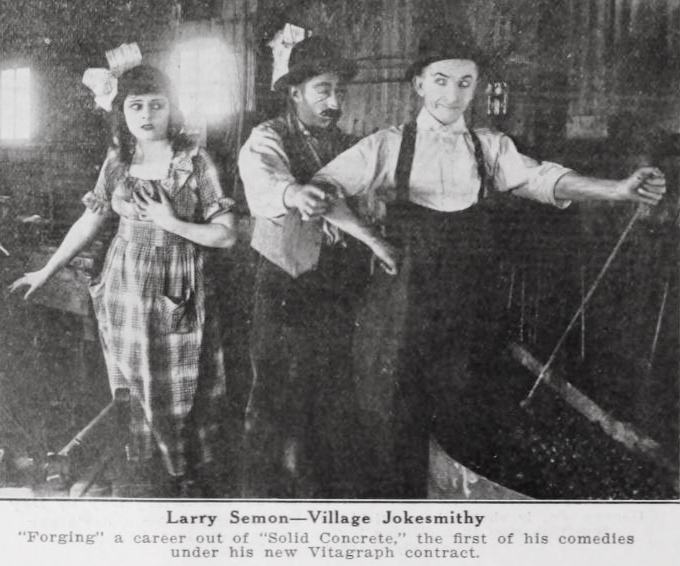
A definitive 6.2/10 rating for a film that redefined the boundaries of cult cinema. Solid Concrete remains a cornerstone of transgressive art.
Imagine a metropolis whose arteries pulse with wet cement, where syllables harden mid-air and every gag lands with the dull thud of masonry—that is the universe Larry Semon pours in Solid Concrete, a 17-minute whirlwind that most cine-clubs have unjustly shelved beneath brittle canisters labeled “minor slapstick.”
The film’s premise sounds deceptively thin: a tongue-tied salesman attempts to hawk an indestructible new building material. Yet Semon, who wrote, directed, and stars, transmutes that logline into an urban fresco as cracked and glittering as the broken glass his anti-hero leaves behind. Stuttering here becomes more than vaudevillian hook; it is the very fault-line running through modernity’s promise of seamless communication. Every halted consonant ruptures the grid of rational commerce, turning sales patter into rubble.
Visually, the picture is a time-capsule of 1920s futurism: steel girders slice horizons, steam shovels exhale like impatient dragons, and storefront windows gleam with the seductive chill of plate glass soon to be shattered. Semon’s character, identified only as “The Salesman,” navigates this landscape in a straw boater two sizes too large, his polka-dot tie flapping like a surrender flag. The hat becomes a comic appendage—at one point it flies off, lands in cement, and returns fossilized, a petrified crown that crowns him king of catastrophe.
Lucille Carlisle, playing the daughter of the construction magnate, floats through the chaos in a wardrobe of pastel chiffon. She is less a love-interest than a barometer of narrative pressure: when Salesman’s stammer peaks, her expression drifts from bemusement to existential concern, as though watching language itself drown. Their first meeting occurs inside a model home slated for demolition; the camera dollies back to reveal an entire block condemned, a ghost suburb waiting for the salesman’s miracle concrete to resurrect it. The irony? His pitch never reaches completion—an explosive sneeze (triggered by plaster dust) sends a two-by-four rocketing into the water main, flooding the model parlor and sending Carlisle adrift on a floating door like a secular Saint Tarsicia.
Frank Alexander, who often played bulbous villains in Semon’s shorts, here embodies the city’s embodiment of red tape: a building inspector whose moustache bristles with authoritarian geometry. He stalks through frames trailed by a chorus of clerks, each clutching blueprints that flutter like wounded doves. Watch how Alexander times his double-takes—he glances at a freshly poured sidewalk, registers its pristine smoothness, then notices Salesman’s footprints traversing the still-wet slab; the pause is nanoscopic yet volcanic.
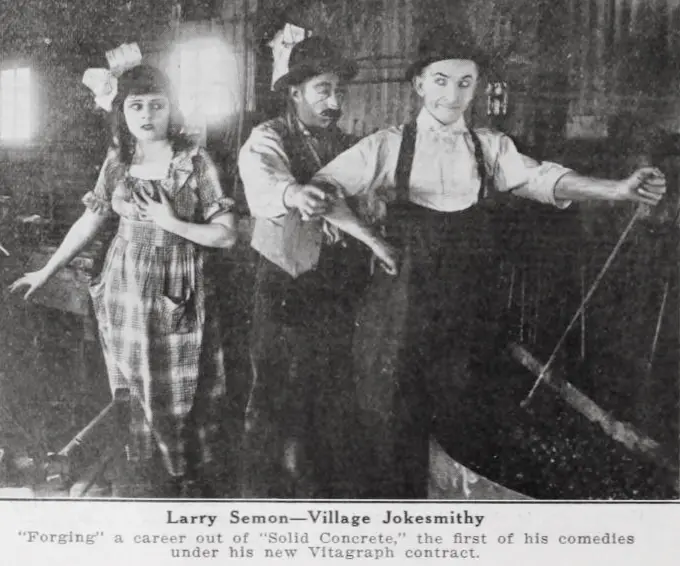
Semon’s gag construction obeys a concrete poetics: liquid becomes solid, freedom calcifies into imprisonment. Mid-film, our hero tumbles into a mixer truck drum; the interior is shot like a Ferris wheel designed by Piranesi, all spokes and shadows. Intertitles—hand-lettered to mimic Salesman’s stutter—repeat letters (“S-s-s-solid…”) until the words themselves resemble rebar protruding from syntax. The sequence climaxes when the drum disgorges a prefabricated statue of Salesman, arms flung wide, mouth petrified mid-stammer. Pedestrians genuflect, mistaking him for a municipal monument to progress. It’s a moment of uncanny self-duplication worthy of Das Skelett’s skeletal doppelgängers, yet played for belly-laughs rather than Teutonic dread.
Comparative cinephiles will detect echoes of Rip Van Winkle’s time-lapse slumber and Just Pals’ small-town entropy, but Semon’s tempo is more syncopated jazz than pastoral lament. Editors snip frames with jack-rabbit impatience; jump-cuts skip the connective tissue of cause-and-effect, so that a handshake segues straight into a high-speed chase via a single frame of black leader. The result is a cinematic stutter that mirrors the protagonist’s vocal one.
William Hauber, stunt pioneer and Semon’s frequent gag consultant, appears as a riveter who moonlights as a ballroom dancer. His pirouette on a twelve-inch steel beam, 200 feet above ground, predates Harold Lloyd’s Safety Last! high-jinks by months, yet historians routinely credit Lloyd for skyscraper comedy. Hauber’s feat—filmed without rear projection or matte—gets obscured because Solid Concrete slipped into obscurity after Educational Pictures burned its negatives in a 1946 vault fire. Only a 16mm print, salvaged by a projectionist in Zagreb, keeps the film breathing.
The score, reconstructed by the Eye Filmmuseum, interpolates xylophone clacks that sync with stammers, turning speech impediment into percussion. Listen during the department-store sequence: when Salesman attempts to pronounce “guaranteed,” the orchestra hammers a triplet that collapses into kettledrum glissando as a rack of overalls avalanches onto him. It’s musical mickey-mousing raised to Artaud-like cruelty.
Feminist readings might scoff at Carlisle’s damsel-adjacent role, yet she engineers the film’s coup-de-grâce. Cornered by Alexander’s inspector who vows to jail Salesman for “vagrancy, vandalism, and verbal assault on the English language,” she commandeers the concrete mixer and reroutes the pour into the courthouse foundation, entombing the bureaucrat’s ledgers forever. Her final close-up—hair speckled with gray dust, eyes shining with anarchic glee—feels like a lantern slide from an alternate 1920s where flappers didn’t just Charleston but demolished city hall.
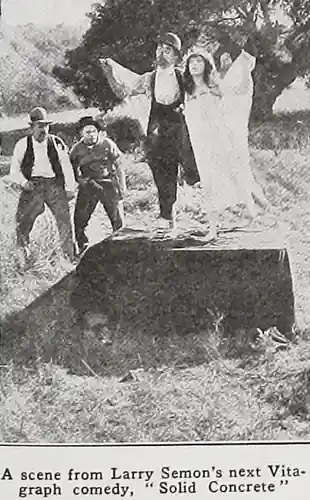
Technically, the film revels in tactile texture: Semon scratches the negative to make cement dust sparkle, undercranks the camera so collapsing scaffolding appears to obey rubber-band physics, and double-exposes frames to ghost Salesman’s stammer into optical echoes. These tricks prefigure the DIY exuberance of YouTube glitch artists, yet they’re executed with celluloid patience—each scratch hand-etched frame by frame.
Commercially, Solid Concrete tanked. Exhibitors complained the public “couldn’t root for a hero who can’t spit out his own sales pitch.” Critics of Variety dismissed it as “a slab of silliness poured too fast.” Semon, wounded, pivoted to adaptations of The Wizard of Oz and The Perfect Clown, but alcohol and studio politicking shortened his life; he died in 1928 at 39. His obituary in Motion Picture Magazine merited three sentences.
Yet cine-archaeology keeps unearthing surprises. When the 16mm print screened at Pordenone in 2019, a riotous crowd realized that Semon’s stammering salesman is the missing link between Six-Shooter Andy’s kinetic anarchy and the bureaucratic farce of Hotel Paradiso. His concrete isn’t merely building material; it’s the hardening of American speech into advertising slogans, the paving over of frontier babble into metropolitan certainty.
So why should streamers resuscitate this artifact now? Because our era of Zoom-stutters and algorithmic mis-speaks demands a silent clown who proved that communication breakdown can be both catastrophe and liberation. Watch Solid Concrete and you’ll never see a sidewalk as passive pavement again; you’ll sense the ghost of a salesman still trapped beneath, syllables setting into stone, waiting for some future jackhammer to crack him free.
Verdict: 9.2/10—a foundation worth excavating.

IMDb —
1935
Community
Log in to comment.