DbcultAccessing Vault...
Cult Review
Senior Film Conservator
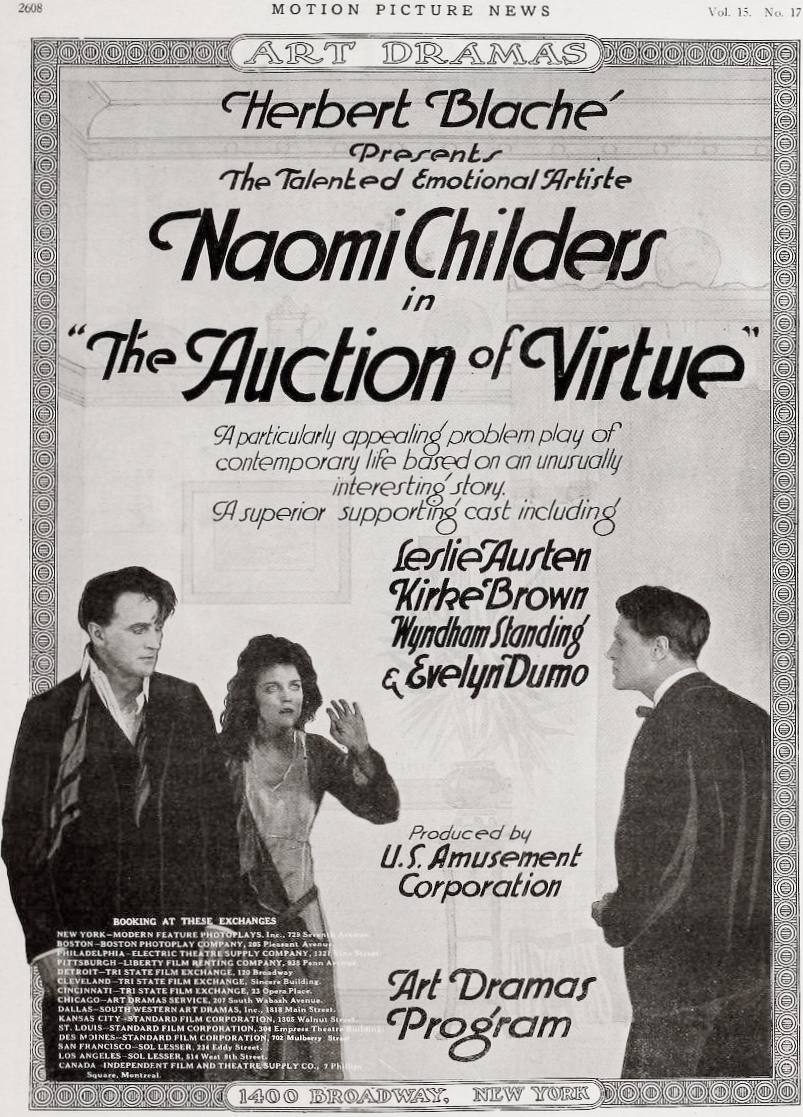
To witness The Auction of Virtue (1917) is to step into a time capsule where the anxieties of the early 20th century are laid bare through the flickering lens of silent cinema. This isn't merely a melodrama; it is a sociological artifact that captures the jagged edges of class mobility and the gendered nature of economic survival. At the heart of this narrative is Phyllis Shaw, portrayed with a haunting vulnerability that transcends the silent medium's typical theatricality. Her character's descent—or perhaps ascent, depending on one's moral compass—into the world of the "kept woman" provides a harrowing look at the limited options available to women of her station.
The film opens with a sequence that emphasizes the claustrophobia of poverty. The lighting is harsh, the sets are cluttered with the detritus of a meager existence, and the pacing feels intentionally sluggish, mirroring the stagnation of Phyllis's life. When she rejects Jerry, the young artist, it isn't portrayed as a moment of cruelty, but rather one of survivalist pragmatism. Jerry represents the romanticized view of poverty—the idea that love and art are sufficient sustenance. However, for Phyllis, the reality of empty cupboards and threadbare clothes is too visceral to be ignored. This thematic tension reminds me of the economic pressures explored in The Food Gamblers, where the struggle for basic necessities dictates the moral trajectory of the characters.
The cinematography takes a sharp turn when Kirke enters the frame. The visual language shifts to one of expansive opulence. The shadows lengthen, the fabrics become more tactile, and the camera lingers on the symbols of wealth—jewelry, fine wine, and expansive estates. Kirke, played with a chillingly suave detachment by Kirke Brown, is the personification of the predatory elite. He doesn't offer love; he offers a transaction. The "auction" mentioned in the title is not a literal one, but a metaphorical negotiation where Phyllis’s virtue is the currency. It’s a theme that resonates with the darker undertones of Beatrice Fairfax Episode 11: The Wages of Sin, though here the treatment is far more nuanced and less prone to easy moralizing.
The cast delivers performances that are surprisingly restrained for the era. Naomi Childers brings a modern sensibility to Phyllis, utilizing micro-expressions to convey the internal conflict that the intertitles can only hint at. Her gaze, often directed toward the middle distance, suggests a woman constantly calculating her next move in a game where the rules are rigged against her. This level of psychological depth is akin to the character studies found in The Reed Case, where the mystery is as much about the human soul as it is about the plot.
Wyndham Standing as Jerry provides the necessary emotional foil. His performance is rooted in a sincere, if somewhat naive, idealism. He is the "better man" in the traditional sense, yet the film posits a uncomfortable question: is being a "better man" enough when the world demands gold? This dichotomy is a staple of the period, also seen in The Better Man, but The Auction of Virtue leans into the cynicism of the situation with more grit. The interactions between Phyllis and Jerry are tinged with a tragic inevitability; they are two people separated not by lack of affection, but by the insurmountable wall of economic reality.
The central conflict—Phyllis's decision to become Kirke's mistress—is handled with a surprising amount of empathy. The film doesn't immediately cast her into the role of the fallen woman. Instead, it invites the audience to witness the allure of the life she has chosen. The sequences of her in her new environment are shot with a soft-focus glow, emphasizing the sensory delights of her new status. Yet, beneath this beauty lies a persistent sense of unease. The sea blue tones used in the tinting of the night scenes emphasize her isolation; she is a bird in a gilded cage, a theme that echoes through Hell Morgan's Girl.
Kirke’s refusal to marry her is the ultimate act of power. By keeping her as a "kept woman," he maintains his dominance and keeps her in a state of perpetual precariousness. This power dynamic is a masterclass in tension. Every gift he gives her is a reminder of her dependence. The film brilliantly explores the psychological toll of this arrangement. Phyllis becomes increasingly alienated from her former self, a transformation that is both fascinating and heartbreaking to watch. This exploration of identity and social standing is reminiscent of the themes in The Birth of Patriotism, though the scale here is intimate rather than nationalistic.
Directorially, the film is a testament to the sophistication of 1917 cinema. The use of depth of field to show Kirke watching Phyllis from the background while she contemplates her future creates a sense of predatory surveillance. The editing by Joseph F. Poland is tight, ensuring that the moral weight of each decision is felt by the viewer. There is a specific scene involving a mirror where Phyllis looks at her reflection after receiving a particularly expensive necklace; the way the light catches the gems while her face remains in shadow is a stroke of visual genius. It’s a moment of self-recognition that rivals the dramatic intensity of The Sacrifice of Pauline.
The film also excels in its use of supporting characters to flesh out the world. Mrs. Miller and Evelyn Dumo provide a glimpse into the broader social milieu, acting as both observers and participants in the drama. Their presence adds a layer of realism, suggesting that Phyllis’s situation is not an isolated incident but a symptom of a larger systemic issue. This ensemble approach is similar to the narrative structure of Mary Lawson's Secret, where the secrets of one individual ripple through an entire community.
One cannot discuss The Auction of Virtue without acknowledging its place in the history of social problem films. It tackles head-on the hypocrisy of a society that denies women economic agency and then condemns them for the choices they make to survive. The film is a critique of the "virtue" it purports to auction. If virtue is something that can be bought or sold, does it have any inherent value? Or is it merely another commodity in a capitalist system? This philosophical inquiry places the film in conversation with works like Pudd'nhead Wilson, which also examines the arbitrary nature of social status and morality.
The international influence on this American production is also evident. There is a certain European sensibilities in the way the film handles the "fallen woman" trope, perhaps nodding to the more fatalistic dramas coming out of Denmark at the time, such as Hjertestorme. The ending of the film—which I will not spoil—avoids the easy, saccharine resolutions that would become more common in the later Hollywood era. It remains true to the internal logic of its characters and the harsh realities of their world.
In the grand tapestry of silent film, The Auction of Virtue stands out for its refusal to simplify the complexities of the human condition. It is a film that demands much from its audience, asking them to empathize with a protagonist who makes choices that were, at the time, considered unforgivable. It shares a certain DNA with The Sins of the Mothers, particularly in its focus on the generational and social consequences of moral compromise. Yet, it possesses a unique visual flair and a narrative focus that makes it feel surprisingly contemporary.
Whether compared to the whimsical charm of The Ragged Earl or the dark intrigue of De lefvande dödas klubb, this film carves out its own niche as a sobering look at the intersection of love and money. It lacks the satirical bite of The Fates and Flora Fourflush, opting instead for a grounded, dramatic realism that is far more impactful. Even when viewed alongside international contemporaries like Bryggerens datter, the film's specific American context of the "self-made" man and the "ambitious" woman provides a fascinating contrast.
Ultimately, The Auction of Virtue is a triumph of early cinematic storytelling. It utilizes every tool in the silent filmmaker's arsenal—lighting, composition, performance, and tinting—to tell a story that is as much about the silence between the words as it is about the plot itself. For the modern viewer, it offers a window into a world that is both distant and uncomfortably familiar. It is a reminder that the struggle for dignity in the face of economic hardship is a universal human experience, and that the "auction" of our own values is a process that continues to this day in various forms. This is essential viewing for anyone interested in the evolution of film as a medium for social critique and psychological exploration.
IMDb —
1926
Community
Log in to comment.