DbcultAccessing Vault...
Cult Review
Senior Film Conservator
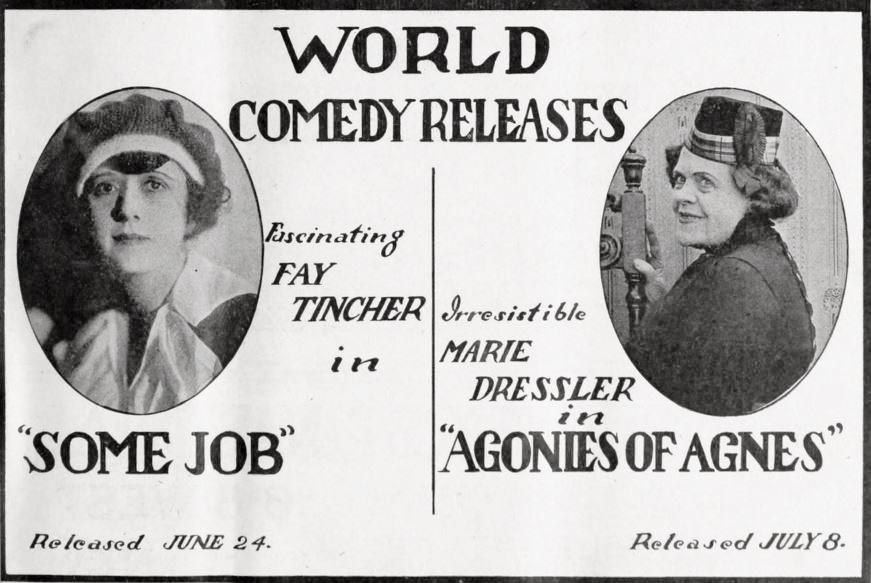
In the annals of early cinema, particularly amidst the fervent backdrop of the First World War, many films served as both entertainment and a reflection of societal anxieties. Among these, the unassuming title of 'Some Job' emerges, a silent film from 1917 that thrusts the delightful Fay Tincher into the unlikely role of an espionage investigator. While the grand narratives of global conflict often focus on battlefields and political machinations, 'Some Job' grounds its tension in the most accessible and everyday of settings: a small-town hotel. This choice immediately elevates the film beyond a mere genre exercise, transforming it into a microcosm of national vigilance where the ordinary becomes extraordinary, and the mundane holds the key to uncovering a hidden threat.
Fay Tincher, a name perhaps less universally recognized today than some of her contemporaries, was a performer of considerable charm and subtle expressive power. In 'Some Job,' she embodies a waitress whose daily routine—serving meals, cleaning tables, observing guests—becomes her greatest asset. This portrayal is crucial; it’s not a glamorous spy clad in trench coats and fedoras, but a working-class woman whose perceptiveness is sharpened by necessity. Her character, often underestimated by the very individuals she observes, represents a powerful archetype prevalent in wartime narratives: the citizen hero. Tincher's performance, reliant entirely on pantomime and facial nuance, would have conveyed a spectrum of emotions from initial suspicion to determined resolve, making her quiet intensity a compelling anchor for the unfolding drama.
The brilliance of casting Tincher in such a role lies in her ability to project an approachable innocence that belies a sharp intellect. Her interactions with the hotel's clientele, which would undoubtedly include the nefarious German spies, must have been masterclasses in understated observation. Imagine the subtle glances, the slight hesitation in serving a particular patron, the almost imperceptible shift in posture as she processes a snippet of conversation. These are the tools of silent acting, and Tincher, known for her comedic timing and dramatic depth, would have wielded them with precision. Her character's journey from an unassuming server to a critical operative is a testament to the film's faith in the common person's capacity for heroism, a theme that resonated deeply with audiences of the era.
The setting of a small-town hotel is remarkably effective for this particular narrative. It is a transient space, a crossroads for strangers, where identities can be shed and assumed with relative ease. Yet, it also operates under a veneer of domesticity and hospitality, making it an ideal cover for clandestine activities. The film leverages this dichotomy, presenting a seemingly safe haven that harbors a dangerous secret. The confined environment allows for intense character interactions and a heightened sense of claustrophobic tension. Every corridor, every dining room table, every guest room potentially becomes a stage for espionage. The hotel’s staff, particularly the observant waitress, are privy to the comings and goings, the whispered conversations, and the unusual habits of their guests in a way that outsiders are not.
Think of the visual opportunities this presents: the flickering gaslight in a dimly lit lobby, casting long shadows that conceal furtive exchanges; the clinking of cutlery in the dining room masking hushed plans; the discreet passing of notes under a table. These are classic silent film tropes, but rendered potent by the specific context of wartime paranoia. The film would have meticulously built an atmosphere of simmering unease, where the audience, like Tincher's character, is constantly scanning the periphery for signs of the enemy. This domestic setting also serves to make the threat feel more immediate and personal, bringing the global conflict directly into the lives of ordinary Americans, emphasizing that vigilance was not just for soldiers on the front lines, but for everyone on the home front.
Without spoken dialogue, silent films relied heavily on visual storytelling, intertitles, and the actors' exaggerated (yet often nuanced) expressions and gestures to convey plot and emotion. In 'Some Job,' the unfolding of the spy ring's discovery would have been a masterclass in visual suspense. The narrative likely begins with subtle hints: an unusual guest, a misplaced item, a coded message inadvertently glimpsed. Tincher's character, initially perhaps dismissive, slowly pieces together these disparate fragments, her growing understanding mirrored in her increasingly serious demeanor.
The film's pacing would have been critical. Early scenes might establish the routine of the hotel and the seemingly innocuous presence of the future antagonists. As the waitress’s suspicions mount, the pace would accelerate, employing techniques like cross-cutting between her investigations and the spies' plotting. The climax would likely involve a tense confrontation or a daring act of revelation, where the waitress, perhaps at great personal risk, exposes the ring to the authorities. The visual language of pursuit, escape, and capture would be paramount, culminating in a satisfying resolution that affirms the triumph of good over insidious evil. This kind of narrative structure, while simple in premise, demands a sophisticated execution in silent cinema to maintain audience engagement without the crutch of dialogue.
'Some Job' emerged during a period saturated with patriotic fervor and anxieties about foreign threats, both real and imagined. Films like The Fall of a Nation (1916), for instance, explored explicit invasion scenarios and served as powerful propaganda, albeit often with a heavy hand. 'Some Job,' however, takes a more nuanced approach, focusing on the internal threat, the enemy within. This makes it more akin to psychological thrillers, even if rudimentary, than overt war epics. The film’s exploration of vigilance on the home front echoes the sentiments promoted by government campaigns, urging citizens to be watchful for saboteurs and spies.
Comparing Tincher's resourceful waitress to other strong female characters of the era further highlights her significance. One might draw parallels to characters like those in The Active Life of Dolly of the Dailies, where the protagonist is an independent, capable woman navigating a male-dominated world, using her wits to overcome challenges. While Dolly's adventures are more journalistic, the underlying theme of female agency and intelligence in solving problems resonates strongly with 'Some Job.' Both films showcase women who are not passive damsels but active participants in their own narratives and, by extension, in the larger social fabric.
Even beyond American shores, the fascination with espionage was global. German cinema, during and after the war, also delved into similar themes, albeit from a different perspective. Films like Das Geheimnis von Chateau Richmond (The Secret of Chateau Richmond), for example, explored spy narratives, demonstrating a shared international intrigue with the genre, even if the protagonists and antagonists were inverted. Such comparisons underscore the universal appeal of the spy narrative, irrespective of national allegiances, and how cinema quickly adapted to reflect contemporary geopolitical tensions.
The challenge for silent film directors in crafting a spy thriller was immense. Without dialogue, exposition had to be conveyed through intertitles, and emotional depth through physical performance. 'Some Job' would have relied heavily on visual cues: the suspicious way a character holds a newspaper, the furtive exchange of a document, a coded message scrawled on a napkin. The use of close-ups would have been pivotal, drawing the audience's attention to a character's eyes, a twitch of a mouth, or a significant prop. The film would have expertly employed dramatic irony, allowing the audience to be privy to information that Fay Tincher’s character is not, or vice versa, thereby ratcheting up the tension.
Furthermore, the visual contrast between the seemingly innocuous hotel environment and the sinister activities within would have been a key stylistic element. Bright, well-lit scenes of daily hotel life could suddenly transition to darker, more foreboding sequences where the spies conduct their business, perhaps utilizing expressionistic lighting if the director was inclined towards more artistic flourishes common in the era. The very architecture of the hotel—its many rooms, secret passages (if any), and public spaces—could be utilized to create a labyrinthine setting for intrigue and pursuit, reminiscent of the elaborate stage designs of the time.
While 'Some Job' might not be as widely discussed as some other silent era masterpieces, its historical and thematic significance remains potent. It is a snapshot of American society grappling with an unprecedented global conflict, filtered through the lens of a popular entertainment medium. It showcases the versatility of silent film to tackle contemporary issues with both suspense and patriotic fervor. Fay Tincher's performance, even without the benefit of sound, would have undoubtedly left an impression, cementing her as an actress capable of portraying both lightness and gravitas.
The film's exploration of the 'enemy within' is a theme that continues to resonate in cinema today, proving its timeless appeal. The idea that threats can emerge from the most unexpected places, often camouflaged by normalcy, is a powerful and enduring narrative device. 'Some Job' thus stands as a fascinating artifact, not just of silent cinema, but of a specific cultural moment, offering insights into the fears and hopes of a nation at war. Its focus on an ordinary person achieving extraordinary feats is a universal motif that transcends the limitations of its period and medium, making it a compelling piece of cinematic history deserving of rediscovery and appreciation for its subtle yet impactful contribution to the spy genre.
In conclusion, 'Some Job' is more than just a historical curiosity; it is a testament to the ingenuity of early filmmakers and the enduring power of a well-crafted story. It reminds us that heroism isn't always found on the grandest stages, but often in the quiet determination of individuals like Fay Tincher's observant waitress, who, with little more than her wits and keen senses, manages to safeguard her community and her nation from unseen dangers. It’s a compelling argument for the silent film’s capacity to deliver intricate plots and deep character studies, all without uttering a single word, leaving a lasting impression through visual poetry and compelling performances. Its unassuming title belies a narrative rich in tension, patriotism, and the quiet triumph of the vigilant spirit.
IMDb 6.4
1936
Community
Log in to comment.