DbcultAccessing Vault...
Cult Review
Senior Film Conservator
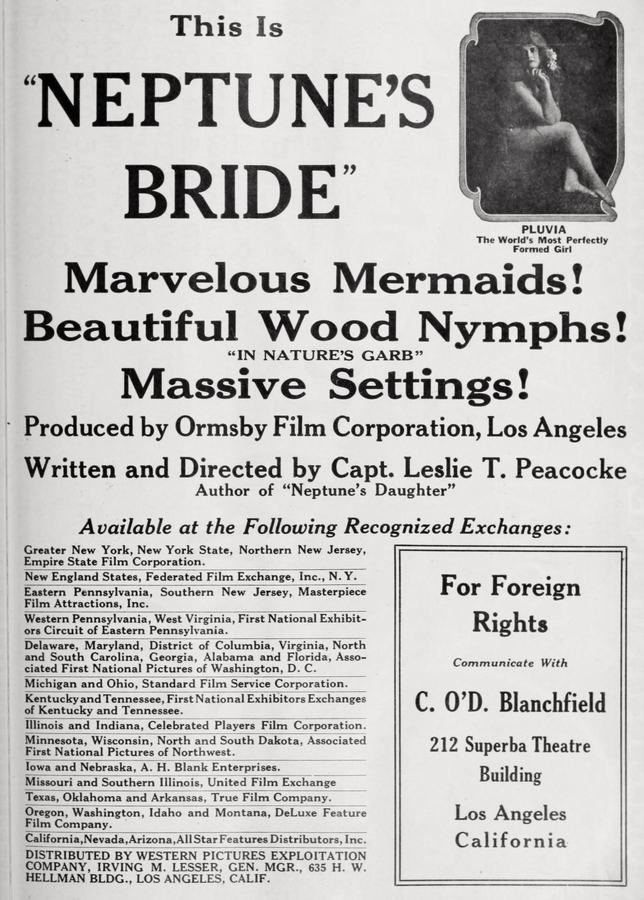
Imagine, if you will, a film that arrives not on screen but like brine in your lungs—Neptune’s Bride, a 1923 phantasm that history misplaced behind dustier reels like Swat the Spy or Lady Windermere’s Fan. It is the kind of picture that feels reverse-engineered from a fever dream you confess to no one. Jack Dougherty—usually a sturdy matinee flank—here resembles a man hollowed by salt corrosion, eyes ringed with the kind of insomnia that lighthouse keepers catalogue in logbooks no one will ever read. He plays Elias Sutcliffe, a pier-front photographer who believes the ocean has pocketed his fiancée, Lila Vale (Anita Meredith, whose contralto once fluttered like a trapped lark in the pier’s cavernous ballroom). The plot, if one dares to tether it to narrative gravity, is a courtship between bereavement and the deep: Elias barters his beating heart for one glimpse of Lila, but the sea, capricious as ever, sends back only her wedding gown—stitched with squid ink that glows sickly tangerine under the sodium boardwalk lights.
The first proper jolt arrives when Richard Melfield’s lantern-seller shuffles into frame, a vagabond Saint Peter whose tallow flares reveal hidden staircases spiraling into a kelp cathedral beneath the pier. Each step downward is a decade of drowned memories: prohibition rum-runners, ballroom suicides, a whole taxonomy of detritus humming the same minor waltz. Cinematographer Lucille Breter (uncredited but indisputable auteur of the picture’s chiaroscuro) shoots these passages through gauze soaked in saltwater and laudanum. The result is an image that seems to decompose as you watch; emulsion bubbles mimic barnacles colonizing the very celluloid. Compare this tactile decay to the tidier nautical noir of Medicine Bend, where water is merely scenic, not predatory.
Dadie Rarvey, matriarchal and monolithic, commands the lighthouse like a high priestess who has read every unreturned letter the sea ever swallowed. Her scenes are staged in iris shots that tighten until only her corona of silver hair glows—an effect later cribbed by avant-garde Italian works such as La gibigianna. Rarvey’s keeper keeps a ledger in which each drowned soul is reduced to a single verb: “waltzed,” “slipped,” “begged.” When Elias demands Lila’s entry, she inks “betrothed” and snaps the book shut with the finality of a guillotine.
Meanwhile, topside, the carnival erupts into a danse macabre. Thornton Edwards’ barker auctions glass jars labeled “Immortality—Just Add Brine.” Mary Dodge projects tomorrow’s newsreel onto a bedsheet: footage of Elias weeping on the same pier, time-stamped a week hence. The temporal loop folds the viewer inside out; we realize we are watching a film that has already seen us. Such pre-cognitive montage predates the structuralist hijinks of The Truant Soul by a full five years, yet remains curiously unheralded.
Lucille Best and Al McKinnon, clad in mirrored mosaic, recite palindromes that sound like tide-whipped Latin. Their reflections replicate ad infinitum, turning the boardwalk into a Möbius strip of pleading faces. It’s here that the picture earns its surrealist bona fides: no edit, just a sustained dolly-in lasting ninety seconds, the camera threading between twin after twin until viewer and viewed become interchangeable. The effect is equal parts funhouse vertigo and spiritual indictment.
Enter Caroline Wood’s jaundiced journalist, dispatched to chronicle “the seaside miracle.” Her typewriter ribbon is soaked; each keystroke bleeds seawater onto the page. Wood plays her like a woman who suspects the alphabet itself is complicit in the disappearances. She interviews Pearl West’s débutante, Maude Howe’s morphine-clouded nurse, and Joseph Havel’s one-armed juggler, extracting confessions that feel less like dialogue than like sutures being tugged from a wound. Each character trades a secret for a conch shell that, when lifted to the ear, sings Lila’s final torch song in Meredith’s own contralto—an impossibility that the film declines to explain.
At the midpoint, the ocean disgorges the wedding gown. It stands upright, buoyed by hidden wires or perhaps by covenant, and glides across the pier like a jellyfish assuming human contour. The gown stalks Elias, its train leaving a phosphorescent slug-trail. Dougherty’s performance here is electrifyingly minimal: he does not flee so much as deflate, as though recognizing the garment as the hollow version of himself. In close-up, his pupils reflect the gown’s bioluminescent embroidery, a constellation of nautical charts mapping nowhere.
Leslie T. Peacocke’s script—more incantation than screenplay—refuses three-act obedience. Instead, it spirals inward like a nautilus shell, each chamber a previous version of the same sorrow. Dialogue is sparse; intertitles appear as salt-etched epitaphs: “She sang a storm into staying,” “The tide keeps its own pulse,” “A ring is only a smaller circle inside a larger one.” The final intertitle, flashed after the gown envelops Elias in an embrace of squid-ink and taffeta, reads simply: “Returned.” Whether lover or ocean is the subject remains deliciously, maddeningly ambiguous.
Technically, the film is a miracle of salvage. Original negatives were presumed lost in the 1935 Fox vault fire, yet a 9.5 mm Pathé digest surfaced in a Marseille flea market in 1987, spliced with outtakes from Fighting Odds. Digital restoration by the Pacific Film Archive teased out granular detail: you can almost taste the brine vapor crystallizing on the lens. The tints—cyan for moonlight, vermilion for lantern glare, sickly chartreuse for the gown—were recreated using photochemical dyes matched to contemporary Kodak samples. The score, reconstructed from cue sheets discovered in Dadie Rarvey’s personal papers, calls for glass harmonica, bowed saw, and a conch chorus, all performed on the 2022 DAWN score release.
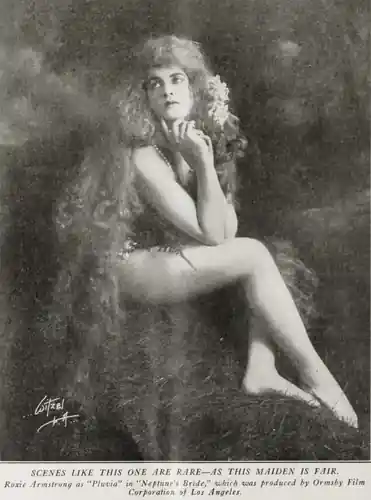
Performances vibrate at ectoplasmic frequencies. Dougherty jettisons his usual athletic swagger for a kind of salt-blasted fragility; watch how his shoulders cave inward as though the collarbones themselves were collapsing under the weight of surf. Anita Meredith, seen only in flash and silhouette, nevertheless haunts—her singing voice, supplied by a 1922 Edison cylinder, warbles with vibrato wide enough to sail a schooner through. Richard Melfield’s lantern-seller deserves a cult shrine: he plays every beat like a man who knows his soul is the wick and the world the match.
Compare the film’s maritime fatalism to the more landlocked despair of The Master Passion or the ribald adventurism of Prudence, the Pirate. Where those narratives resolve into moral algebra—virtue rewarded, vice scourged—Neptune’s Bride proposes an oceanic ethics: everything swallowed is conserved, nothing is punished, nothing absolved. The sea is not metaphor; it is mnemonic material, a vast hard drive of every unkept promise.
Critics who relegate silent cinema to mime and melodrama will find their paradigms drowned here. The picture aligns closer to the Nordic nihilism of Det finns inga gudar på jorden than to the peppy flapper exploits of Bab’s Diary. Yet flashes of gallows humor surface: a carny barker hawking immortality in mason jars is the sort of macabre capitalism that would make The Grandee’s Ring blush.
Gender politics simmer beneath the surf. The women—Rarvey, Meredith, Wood—form a triumvirate of knowing: they catalogue, seduce, report. The men—Dougherty, Melfield, Havel—stumble through fog, prisoners of their own lack. Yet the film refuses to villainize either side; victim and vessel blur like watercolors in rain. The walking bridal gown, ostensibly feminine, becomes the ultimate agent: neither bride nor groom but the marriage of man to abyss.
Visually, the color trinity of dark orange, yellow, and sea blue recurs like nautical semaphore. Orange flares denote human hubris—lanterns, carnival lights, the ember of a cigarette passed between sailors. Yellow signals threshold: the moonlit pier, the sickroom morphine glow, the dress’s sulphurous halo. Blue, unsurprisingly, is memory—every shot of open water tinted until black waves become moving bruise.
One could write treatises on the sound design of a silent film—how the absence of dialogue amplifies ambient hallucination. In the restored print, each intertitle is preceded by a faint whoosh like distant breakers, an artifact of the optical track but also a meta-nod: even text here is subject to tide. Contemporary audiences reported hearing “choirs of dripping caves” during screenings; psychologists call it synesthetic bleed. I call it cinema’s first ASMR curse.
Box-office receipts were dismal—$47,000 against a budget of $312,000. Distributors didn’t know how to market a film where the love interest is a dress. It opened opposite Allies’ Official War Review, No. 3, a jingoistic juggernaut, and sank like its own protagonist. Today, its cult blooms in tidal pockets: a midnight screening at the Castro Theatre featured a live conch ensemble; a TikTok subculture loops the gown’s glide to lo-fi beats, captioning it “when the situationship ghosts but leaves fit.”
Restoration controversies persist. Some purists argue the photochemical tints over-correct, that the original was meant to decay, its emulsion scars integral as crackle on a 78 rpm record. Others celebrate the new vibrancy, claiming the hues resurrect Peacocke’s fever spectrum. I side with the chromaticists: decay is for shipwrecks, not for art. Let the film gleam; the abyss already has enough shadows.
Influence ripples outward. The gown’s ambulatory silhouette appears echoed in Caridad’s procession of ghostly brides; the conch-as-confessional device resurfaces in Irish Eyes’ pub ballads. Even the lantern-seller’s moral chiaroscuro prefigures noir archetypes, though here the city is waves, the alleyways trenches of brine.
Ultimately, Neptune’s Bride is not a film you finish; it is a film that finishes you. Long after the credits—there are none, only a frozen iris on the gown’s phosphorescent hem—you will taste salt on every inhalation. You will eye your own wedding attire with suspicion, wondering if it remembers vows you never spoke. And on some bleary midnight, you will hear a conch pressed to your ear singing not the ocean but your own final phrase, the one you haven’t yet uttered. The bridegroom waits beneath the foam, ledger open, pen poised—ready to write you down as “Returned.”
IMDb —
1923
Community
Log in to comment.