DbcultAccessing Vault...
7.8/10
Senior Film Conservator
A definitive 7.8/10 rating for a film that redefined the boundaries of cult cinema. Son premier film remains a cornerstone of transgressive art.
Is 'Son premier film' worth seeking out in the modern era of streaming and high-definition spectacles? Short answer: yes, but with significant caveats for contemporary viewers. This film is a fascinating glimpse into early French cinema and the nascent stages of comedic performance on screen, making it an essential watch for cinephiles and historians.
However, it is decidedly not for those seeking fast-paced narratives or modern comedic sensibilities. It caters primarily to audiences with an appreciation for silent film conventions, a keen interest in the evolution of performance, and a patience for pacing that reflects its era.
This film works because it offers an invaluable historical document of a pivotal period in entertainment, showcasing the transition of a legendary performer, Grock, from stage to screen. Its charm lies in its simplicity and the raw, unrefined energy of its performances.
This film fails because its narrative structure is rudimentary, often feeling more like a series of connected vignettes than a cohesive story. The comedic timing, while groundbreaking for its time, can feel sluggish and overly broad to a modern audience, lacking the subtlety and complexity we've come to expect.
You should watch it if you are a student of film history, a fan of early 20th-century European culture, or someone deeply interested in the origins of physical comedy and the silent era's unique storytelling methods. It's a foundational text, not a casual Friday night popcorn flick.
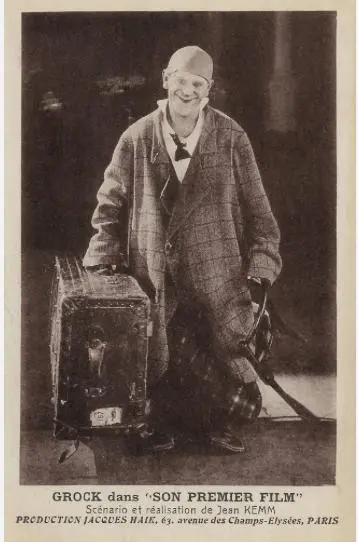
Jean Kemm's 1926 feature, 'Son premier film,' isn't merely a motion picture; it's an archaeological dig into the very foundations of cinematic celebrity. Starring the iconic clown Grock (born Charles Adrien Wettach), this silent French production attempts to weave a fictionalized origin story for a performer already famous across Europe. The film, in essence, is a meta-narrative, presenting Grock's 'first film' experience within the context of his character, Céleste Noménoé, a provincial actor stumbling into stardom. This conceit, while intriguing, is also the source of both its enduring appeal and its most glaring limitations.
From the outset, 'Son premier film' feels less like a tightly plotted drama and more like a celebratory showcase. The narrative, penned by Kemm himself, serves primarily as a vehicle for Grock's well-established stage persona. We follow Céleste Noménoé's arrival in Paris, an inheritance in hand, and his almost accidental entry into the world of film. This path quickly diverges, however, when shrewd music-hall impresarios recognize a unique spark in him, leading to his transformation into Grock and his subsequent rise to fame. The story, while linear, often feels episodic, a common trait in early silent films that sometimes struggled to translate theatrical pacing into cinematic rhythm.
The film's true value lies not in its narrative sophistication, which is minimal, but in its historical significance. It captures a moment when the lines between stage and screen were still blurring, and when the very idea of a 'film star' was taking shape. For anyone researching the evolution of performance, particularly the transition of vaudeville and music-hall acts to the silver screen, 'Son premier film' is an indispensable primary source. It shows us not just what early cinema looked like, but how it thought about itself and its burgeoning stars.
The gravitational center of 'Son premier film' is, unequivocally, Grock himself. As Céleste Noménoé, he embodies a blend of earnestness and latent comedic genius. His physical presence is undeniable, even through the grainy, flickering images of a century-old film. Grock's performance is a masterclass in silent-era physical comedy, relying on exaggerated gestures, expressive facial contortions, and a captivating stage presence that transcends the lack of dialogue. One particular scene, where Céleste first attempts a screen test, is illustrative: his initial awkwardness quickly gives way to flashes of the seasoned performer he is destined to become, a subtle nod to the meta-narrative at play.
It’s a performance that doesn't just entertain; it educates. Modern audiences, accustomed to the rapid-fire wit of contemporary comedy, might find Grock's deliberate pacing and broad strokes somewhat alien. Yet, watching him, one can trace the lineage of countless comedians. His ability to command attention with a simple glance or a well-timed stumble is a testament to his stagecraft. He is not merely acting; he is performing his legend into existence on screen.
The supporting cast, including Emile Roques, Pierrette Lugand, and Valentine Lugand, provide solid, if somewhat archetypal, portrayals. They serve primarily to facilitate Grock's journey, reacting to his antics and providing the emotional beats necessary for the plot to progress. Marguerite de Morlaye, as a society figure, adds a touch of Parisian elegance, contrasting nicely with Céleste's provincial origins. While their performances lack the depth we might expect from modern cinema, they are perfectly functional within the established conventions of silent film acting, often relying on clear, bold expressions to convey emotion without words.
The ensemble's energy, particularly in the music-hall sequences, is palpable. Even without sound, the vibrancy of these scenes comes through, demonstrating the infectious appeal of live performance that cinema was still learning to capture. It's in these moments that the film truly comes alive, hinting at the spectacle that was Grock's live act.
Jean Kemm's direction in 'Son premier film' is functional, prioritizing clarity and the showcasing of Grock's talent over stylistic innovation. Kemm, known for his prolific work in early French cinema, adopts a straightforward approach, utilizing static shots and simple cuts that were standard for the era. There are few flourishes or experimental techniques; the camera largely acts as an observer, allowing the performers to dictate the scene's energy.
The pacing, by today's standards, is leisurely. Scenes unfold deliberately, often with extended takes that allow Grock's physical comedy to fully register. This can be a challenge for viewers accustomed to the rapid editing of modern film. However, it also offers a unique opportunity to appreciate the nuances of silent performance, forcing the audience to pay closer attention to gesture and expression.
One debatable opinion: Kemm's decision to present Grock's story in such a conventional, almost documentary-like fashion, while perhaps limiting its artistic ambition, ultimately serves its historical purpose well. It provides an unvarnished look at the performer, rather than a heavily stylized interpretation. This choice, though perhaps unintentional, grants the film a certain authenticity that more 'artistic' silent films sometimes lacked. It feels like a direct window into the past.
The narrative flow, as mentioned, is episodic. The film progresses through key milestones in Céleste/Grock's journey: arriving in Paris, securing a film role, being discovered by music-hall managers, achieving fame, and finally, getting married. Each segment feels somewhat self-contained, a series of stepping stones rather than a flowing river. This structure, while perhaps not ideal for sustained dramatic tension, effectively highlights the various stages of Grock's career ascension.
The cinematography, while not attributed to a specific individual in the provided context, adheres to the visual grammar of 1920s silent cinema. Lighting is generally flat, designed to illuminate the actors and sets rather than create mood or depth. Close-ups are used sparingly, often reserved for crucial emotional beats or to emphasize Grock's comedic expressions. For instance, a close-up on Grock's face as he contemplates his new stage name 'Grock' effectively conveys his internal deliberation.
The film's tone is overwhelmingly lighthearted and celebratory. There are no deep dramatic conflicts or dark undertones; it’s a feel-good story about success and personal fulfillment. This consistent tone ensures that despite its slow pace, the film remains amiable and engaging for those willing to adjust their expectations.
Pacing, as is often the case with films of this era, is the biggest hurdle for modern audiences. Scenes are held longer than contemporary viewers are accustomed to, allowing performances to unfold in real-time without aggressive cutting. This deliberate rhythm is a double-edged sword: it allows for a deeper appreciation of the physical comedy and character work, but it also demands patience. Compared to more dynamically edited silent films like Buster Keaton's The General or Fritz Lang's Metropolis, 'Son premier film' feels decidedly more traditional in its construction.
An unconventional observation: the film inadvertently serves as a fascinating study in early marketing. By presenting a fictionalized 'first film' of an already famous performer, it blurs the lines between biography and publicity, a practice that would become commonplace in Hollywood. It's a celebrity origin story conceived not for historical accuracy, but for brand reinforcement.
'Son premier film' is not a film for everyone. It works. But it’s flawed. It stands as a vital piece of cinematic history, a testament to the enduring appeal of a legendary performer, Grock, and a fascinating artifact from the silent era. Its charm is undeniable for those who appreciate its context, offering a rare opportunity to witness the metamorphosis of a stage giant onto the silver screen. However, its narrative simplicity and deliberate pacing mean it demands a specific kind of engagement from its audience. It is less a grand cinematic achievement and more a precious historical record, a charming but somewhat rudimentary chronicle of fame's early stirrings.
For the dedicated film scholar or the curious enthusiast, 'Son premier film' is an enriching experience, a journey back to a time when cinema was still finding its voice. For the casual viewer, it might feel like a slow, silent echo from a distant past. Ultimately, its worth is not measured by its ability to compete with contemporary blockbusters, but by its unique contribution to the grand tapestry of film history. It's a film that asks you to meet it on its own terms, and if you do, it offers a rewarding, if somewhat sedate, experience.
Final Score: 6.5/10 - A historically significant and charming, albeit slow-paced, look at a comedic legend's cinematic debut.
IMDb 6.3
1925
Community
Log in to comment.