DbcultAccessing Vault...
Cult Review
Senior Film Conservator
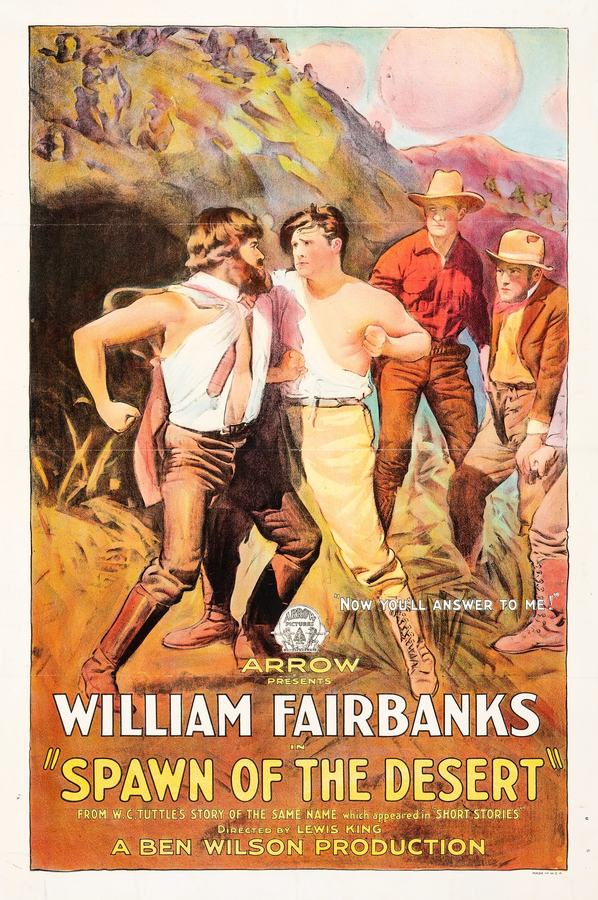
To witness Spawn of the Desert is to step into a time capsule that smells of gunpowder, dry sage, and the peculiar, melodramatic ozone of 1923. Directed with a surprisingly firm hand for the era, this film represents a pivotal moment where the Western genre began to shed its simplistic 'white hat vs. black hat' dichotomy in favor of something more psychologically grueling. While it shares some DNA with contemporary pieces like The Counterfeit Trail, there is a singular, parched desperation here that sets it apart from the more formulaic output of the early twenties.
The film opens not with grand vistas of triumph, but with the weary movement of covered wagons—a visual metaphor for the slow, grinding progress of civilization into a territory that actively rejects it. P. Dempsey Tabler, as Duke Steele, provides a grounded center to the film, but the true gravitational pull comes from William Fairbanks in the role of Sam Le Saint. Fairbanks delivers a performance that feels jagged; his eyes carry the weight of eighteen years of solitude. Unlike the polished heroes found in The Midnight Wedding, Fairbanks’ Le Saint is a man who has been hollowed out by the sun and the singular pursuit of a ghost.
The meeting between Steele and Le Saint is handled with a sparse, almost Hemingway-esque brevity. There is no need for excessive title cards to explain their bond; it is forged in the shared silence of the trail. This economy of storytelling is where Spawn of the Desert excels. It understands that the desert itself is a character—an indifferent witness to the petty squabbles of men. This thematic weight reminds one of the moral ambiguity present in The Power of Evil, where the environment serves as an amplifier for the characters' internal rot.
When the duo arrives at the mining camp, the film shifts from a survivalist tone to a gritty noir-western. The camp is a masterpiece of early set design—a claustrophobic jumble of wood and shadows that contrasts sharply with the open plains. Here we meet Al Hart as Silver Sleed. Hart plays the villain not as a mustache-twirling caricature, but as a man who has successfully commodified vice. His gambling den is the heartbeat of the camp, a place where fortunes are lost as quickly as lives. The corruption here feels visceral, echoing the social critiques found in The Almighty Dollar.
Into this den of vipers steps Florence Gilbert as Nola 'Luck' Sleed. Gilbert provides the film’s emotional pivot. As Duke Steele falls for her, the audience is forced to reconcile her innocence with the predatory nature of her father. The chemistry between Tabler and Gilbert is surprisingly modern; there is a genuine sense of mutual recognition between two souls trying to remain untainted in a tainted place. It lacks the saccharine artifice often found in A Lucky Dog's Day, opting instead for a quiet, desperate romance.
The screenplay by W.C. Tuttle and Daniel F. Whitcomb builds tension with the precision of a ticking clock. The revelation that Silver Sleed is the man Sam Le Saint has hunted for nearly two decades is handled with a brutal lack of sentimentality. There are no long-winded monologues. Instead, the film leans into the kinetic energy of the silent era. The final confrontation is a masterclass in editing for the time, using rapid cuts to convey the chaos of the struggle. It’s a sequence that rivals the tension in The Frozen North, though with a much darker, more tragic payoff.
As Sam Le Saint lies dying, having finally extinguished the man who ruined his life, the discovery of Nola’s true identity as his long-lost daughter hits with the force of a physical blow. It is a moment of profound irony: Sam has spent eighteen years looking for a baby, only to find a woman who is the product of his enemy’s upbringing. The tragedy is absolute. He dies knowing his daughter is alive, yet knowing he missed the entirety of her life. This narrative gut-punch is reminiscent of the structural complexities in The Unforseen or the dark family dynamics of Kinder der Finsternis - 2. Kämpfende Welten.
Technically, Spawn of the Desert is a fascinating study in early location shooting. The harsh sunlight of the desert often washes out the frame, creating a high-contrast look that feels intentional—a visual representation of the moral clarity (or lack thereof) in the characters' lives. The use of natural light here is far more sophisticated than in films like The Third String, where the lighting often feels flat and stagelike. Here, the shadows are deep and meaningful.
The film also manages to avoid the pitfalls of many silent Westerns that relied too heavily on slapstick or animal stunts. While it doesn't have the surrealist leanings of Pique Dame or the urban grit of Voices of the City, it occupies a middle ground of rugged realism. It treats its audience with respect, assuming they can follow the nuanced emotional beats of a man who has lost everything and finds it again only at the moment of his death. The pacing, though slower than modern standards, allows the atmosphere to seep into the viewer, much like the dust of the trail.
When comparing this to Bill's Baby, one sees a stark difference in how the 'lost child' trope is handled. Where Bill's Baby leans into the sentimental, Spawn of the Desert leans into the tragic. It is more akin to the high-stakes drama of The Marcellini Millions, where the pursuit of wealth and family leads to inevitable destruction. Even the floral metaphors of The Purple Lily seem dainty compared to the sun-baked grit of Tuttle's script. Even in the context of international cinema like Skazka mira, this film stands as a quintessentially American exploration of the frontier as a place of both rebirth and burial.
Ultimately, the film's power lies in its refusal to offer a purely happy ending. Duke and Nola may find a future together, but it is built on the ruins of two men's lives. The desert has claimed its toll. This level of maturity in a 1923 production is rare and deserves recognition. It isn't just a 'cowboy movie'; it's an existentialist poem written in the sand. The performances of Fairbanks and Hart, in particular, remain haunting long after the final iris-out. They represent the two sides of the frontier spirit: the one destroyed by the past, and the one that seeks to exploit the future. Between them stands Steele, the guide, who must navigate the wreckage they leave behind.
In the grand tapestry of silent cinema, Spawn of the Desert is a thread of dark, coarse wool. It lacks the shimmer of the high-society dramas of its day, but its strength is undeniable. It is a film that demands to be watched not as a relic, but as a living piece of art that still has the power to provoke thought about the nature of justice, the cost of revenge, and the fragile possibility of redemption in a world that offers no shade.
IMDb —
1917
Community
Log in to comment.