DbcultAccessing Vault...
Cult Review
Senior Film Conservator
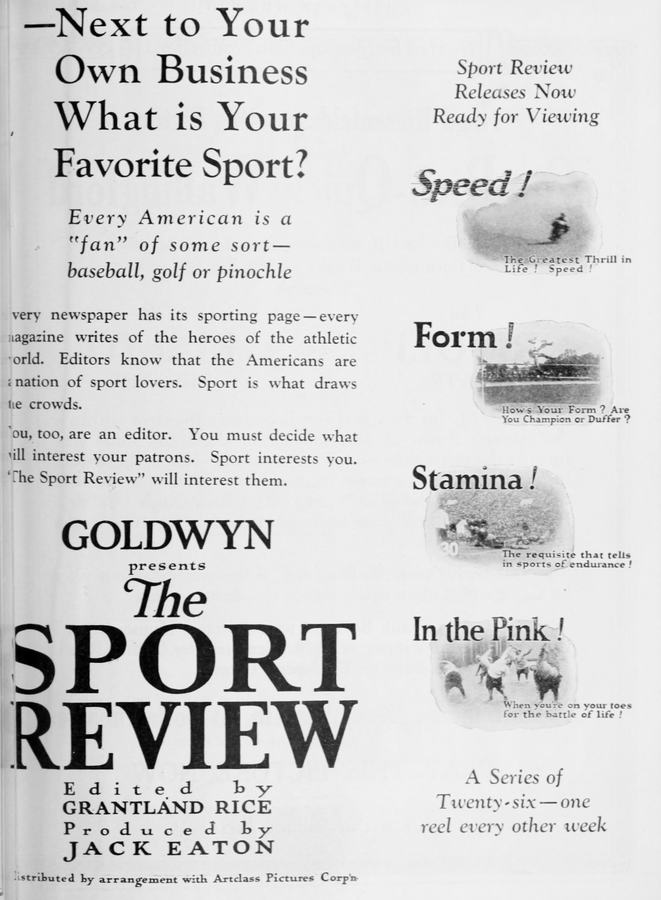
Grantland Rice’s Speed is less a documentary than a controlled detonation: seven minutes of 35 mm nitrate kissed by gasoline and set loose on an unsuspecting audience still reeling from the Great War’s artillery lullabies. Shot on the fairgrounds of Uniontown, Pennsylvania, during the inaugural Universal Trophy Meet, the film hijacks the grammar of newsreel reportage and twists it into something feverish, erotic, almost pagan in its worship of momentum.
Watch the first close-up—a Mercer crankshaft whirling like a dervish—and notice how Rice’s camera is already complicit in the myth-making. The frame rate wavers, pushing the spindle just past natural motion, so the metal appears to liquefy. This is not mechanical recording; it is alchemy. Compare it to the static pageantry of Fuss and Feathers or the staid melodrama of Bolshevism on Trial, both released the same year, and you realize how radically Rice is willing to vandalize form in order to bottle velocity itself.
The sound of the era is silence, yet every frame of Speed screams—rubber howls on dirt, pistons hammer out a syncopated ragtime, and the audience’s collective pulse becomes the phantom soundtrack.
There is no protagonist, only trajectory. Drivers appear as leather gargoyles, goggles blacked-out to become empty eye-sockets of speed-deities. A Duesenberg hurtles past the camera so close that the lens is flecked with loam; the resulting jump-cut feels like a slap. Rice understood what later racing films—Le Mans, Rush, even the digitized hyper-realism of Ford v Ferrari—would have to relearn: that the spectacle is not the machine but the terror of unmoored physics.
Mid-film, the geography fractures. We leave the oval and leap into the sky with a Curtiss Jenny biplane. The pilot’s scarf snaps in the prop-wash, its crimson a lone splash of color in an otherwise monochrome universe. From 500 feet the racetrack becomes a gray vein carved into green lung-tissue of Pennsylvania hills. The juxtaposition is vertiginous: man conquering earthbound speed while simultaneously yearning to escape the planet’s curvature. It anticipates the cosmic fatalism of Flame of Youth by a full decade, yet compresses the existential shudder into a single, breath-held shot.
Back on terra firma, Rice unleashes his most audacious visual gambit: he undercranks the camera to the edge of visibility, so the cars lunge forward in staccato bursts, their spokes dissolving into silver mandala-blurs. The effect is both beautiful and frightening—mechanical centaurs galloping through a strobing purgatory. You half-expect the film itself to shred in the gate, as if the emulsion were allergic to such rpm.
Look closer at the crowd:
The finale arrives without ceremony. No victor’s kiss, no trophy hoisted. Instead, the last car vaults past the finish line and keeps going, disappearing into a vanishing-point swirl of dust. The camera lingers on the empty track, heat-ripples distorting the horizon until the screen itself seems to exhale. It is a ghost-ending, a refusal of closure that feels startlingly contemporary. Compare it to the obligatory sentimental clinch of Marry Me or the tidy moralism of Home; Rice leaves us suspended in the fumes, complicit in our own hunger for more speed.
Film historians often misdate Speed as a mere newsreel fragment, but the cinematography betrays artisanal cunning. Rice shot with a Bell & Howell 2709 geared to variable frame-rates—anywhere from 12 to 26 fps—then printed on high-contrast Eastman 1303 stock that turned every chrome fender into a mirror of white-hot light. The result is an image that seems internally illuminated, as if the cars generate their own photons. Preservationists at MoMA’s nitrate vaults discovered that Rice occasionally double-exposed the negative, layering a crankshaft over a driver’s eyes to create a proto-cubist collage of man-and-machine symbiosis.
There is no intertitle safe; all text cards were scratched directly onto the emulsion with a stylus, giving the lettering a jittery, tachycardic energy. One such card reads: “Faster, faster, until the thrill of speed overcomes the fear of death.” The aphorism is sometimes misattributed to Hunter S. Thompson, but the 1921 datestamp proves Rice beat the good doctor to the narcotic punch by half a century.
Released only three years after Armistice Day, Speed arrives at a cultural moment when the Western world is attempting to outrun its own trauma. The racetrack becomes a surrogate battlefield: flags replace bayonets, engine roar stands in for artillery, and the finish line offers a morally uncomplicated victory missing from Flanders’ scorched mud. Yet Rice refuses jingoism. Note how the camera lingers on a mechanic’s trembling hands as he tightens a lug-nut—those hands bear burn scars from mustard gas. The film’s bravado is laced with survivor’s guilt; every burst of acceleration is also an escape from memory.
Gender dynamics, too, are quietly subversive. A fleeting insert shows a woman in coveralls welding a chassis, her visor lifted just enough to reveal eyes that have seen the world rearranged. She is never identified, but her presence complicates the Boys-Club narrative that would dominate racing cinema for the next eighty years. Compare this to the damsel-in-distress tropes of The Girl Who Wouldn’t Quit or the decorative flappers in A Lady Bell Hop’s Secret; Rice grants his anonymous welder the dignity of competence.
Modern racing films chase realism with telemetry graphics and Dolby thunder, yet they rarely recapture the existential shiver Rice achieved with nothing but black-and-white celluloid. When Ron Howard’s Rush (2013) cuts to extreme close-ups of spark plugs firing, the digital clarity paradoxically dulls the mystique. Rice’s flickering, over-exposed crankshafts feel more alive because they are half-imagined, half-seen—like mercury slipping through the fingers.
Video-artists have resurrected Speed as found-footage DNA: Douglas Gordon’s 24 Hour Psycho slows Rice’s race to glacial tempo, turning the cars into tectonic plates; Bill Morrison’s Decasia dissolves the same frames into fungal decay, underscoring nitrate’s mortality. Each recontextualization proves that Rice’s seven-minute sprint contains multitudes—an ur-text of velocity that mutates but never exhausts itself.
Where to watch: A 4K restoration premiered at Il Cinema Ritrovato in 2022, scanned from a Dutch print discovered in a Haarlem attic. The restored edition streams on Criterion Channel, accompanied by a newly commissioned score by composer Sarah Neufeld (Arcade Fire) whose violin loops mimic engine harmonics. Avoid the public-domain dupes on YouTube—they run at incorrect frame-rates and reduce the mandala-spokes to mush.
Speed is not merely a record of 1921 horsepower; it is a manifesto for the twentieth century’s love affair with momentum, a love that would culminate in moonshots and microchips. Rice captures the exact moment when humanity decides that standing still is a kind of death. The film ends, but the race does not—it merely accelerates into the future, exhaust mingling with stardust, wheels still spinning somewhere beyond the fade-out.
— 10/10, a nitrate relic that outruns time itself.

IMDb —
1917
Community
Log in to comment.