DbcultAccessing Vault...
Cult Review
Senior Film Conservator
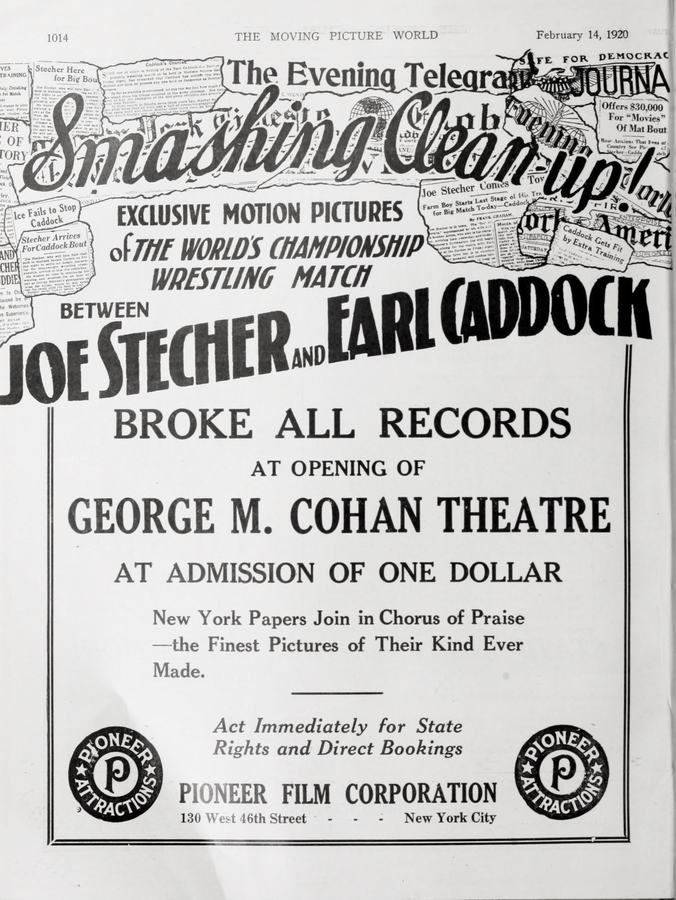
Two men, one ring, zero sound—yet the silence detonates louder than any IMAX boom.
Imagine a cathedral built of sweat. Wood planks creak underfoot like pews; gas-jets of winter breath rise in place of incense. Into this makeshift basilica steps Joe Stecher, six-foot-one of Plains lank, arms so long he could shake your hand from the adjacent borough. Opposite him, Earl Caddock—Olympic-caliber amateur, Doughboy still carrying Verdun in his lungs—wraps his taped wrists, eyes the color of winter wheat. On paper it is merely a contest for the world heavyweight grappling crown; in the emulsion of time it becomes a ghost-poem about industrial America chewing its last innocence.
The camera never blinks. It cannot zoom, cannot cutaway to a swooning dame in the third row. Instead it lingers, a monastic witness, as bodies braid and unbraid inside a 20-foot square of hemp rope.
What unfolds is less sport than symphonic variation. First movement: collegiate courtesy, collar-and-elbow ties, soles squeaking like cautious mice. Second: crescendo of cartilage, Stecher’s neckscissors—a move banned in polite company—squeezing Caddock’s carotids until the veteran’s cheeks bloom the color of the ropes themselves. Third: adagio of despair, Caddock’s gasps visible only as mercury plumes in the gelid air. And finale: the champ’s shoulder kisses the canvas, a gesture so soft it could be lovers rather than adversaries. Garden crowd detonates; flash-powder suns ignite; 1920 roars its approval at having survived influenza and war only to be pinned by its own spectacle.
We live in an age of omniscient replay, yet this single-angle artifact—scarcely ten minutes survive of what was originally a 2-hour bout—delivers more existential vertigo than any 4K slugfest. Its poverty of perspective becomes profundity: no commentary, no score, no slo-mo to reassure us what we just saw. We are stranded, like the spectators themselves, in a purely phenomenological moment. The absence of audio forces the viewer to supply interior sound: the scrape of kneecaps, the hiss of lungs betraying their owner, the low guttural of men tasting iron behind clenched teeth.
Compare it, for reckless context, to How Could You, Caroline?—a froth of flappers and jalopies that same year. Where that film seduces with the decade’s exuberant artifice, Stecher-Caddock offers a blood-simple authenticity that feels almost obscene. Or stack it against A White Wilderness, whose Arctic panoramas connote man versus nature; here the wilderness is internal—ligament, ego, legacy.
Because the Edison camera cranked at a hand-variable 14–18 fps, bodies smear into cubist flickers. When Stecher bridges—torso arched like a drawn longbow—each frame registers a stroboscopic sculpture of strain. Speed corrected to modern 24 fps, motion snaps into uncanny clarity; suddenly you perceive the micro-shimmy in Caddock’s left thigh as he resists the over-under hook. It is cinema as electromyography, a silver-plated x-ray of willpower.
Director? Uncredited. Writers? None. The performers author themselves in sweat-glyphs, a palimpsest for every immigrant ticket-holder who saw in these strongmen the avatar of their own daily grappling with machinery, debt, diaspora. The film therefore attains what later wrestling spectacles—bloated by pyrotechnics and soap-opera scripts—can only simulate: genuine communal catharsis.
Note Caddock’s torso, mottled by shrapnel stars. The camera cannot linger, yet the eye seeks them out, those pale constellations amid the suntan. Here is a man hailed as Adonis who carries inside him the inverse of manifest destiny—metal seeded by European artillery. His looming defeat reads, retroactively, as the moment when America’s pre-lapsarian muscle meets the twentieth century’s first mechanized disillusion. Meanwhile Stecher, draft-deferred farm-boy, embodies a newer, rawer archetype: the rural technocrat of violence, calibrating torque like a harvester calibrates wheat.
Women? Absent from frame, yet everywhere in the hush: suffrage freshly ratified, their gaze now economic as well as political. The Garden’s mixed crowd—bob-haired stenographers clutching program leaflets next to Bowery roughnecks—signals a shifting auditorium. One senses that every held breath measures not merely sporting suspense but social recalibration.
Without this bout, no Hulkamania, no Raw is War, no pay-per-view pageantry. Yet paradoxically the match also stands as wrestling’s virgin spring—before predetermined finishes, before neon spandex. It is both Adam and Armageddon, alpha and archive. Modern WWE rhetoric brags about moments; here the moment is all that exists, unvarnished, un-smack-talked, un-reTweeted.
Scholars of early cinema often overlook sports reels, hunting instead for narrative milestones like Over the Garden Wall. Yet Stecher-Caddock prefigures Italian neorealism’s body-centric nearness by a quarter century. The non-actors, the location ambiance, the refusal to beautify—Rossellini would recognise the lineage instantly.
Talkies arrived, and with them exposition. Grunts were replaced by wisecracks; the sonic veil of ignorance lifted. Paradoxically, knowledge diminished. In silent combat, meaning is a Rorschach; each spectator inks their own dread. Once commentators barged in, interpretation calcified. Thus the film’s muteness feels prophetic, a warning about the tyranny of narration.
Color? Not needed. The grayscale palette is a mercy: blood shows only as a darker shade of sweat, bruises as slight lunar shadows. Violence, abstracted, becomes universal. To colourize this footage would be to turn it into mere gore, a souvenir for the morbid. Black-and-white preserves the metaphysical dimension, the sense that these bodies are ideas wrestling inside the national mind.
1. Kill the lights. Let the screen dominate like a confession booth.
2. Disable ambient audio—no lo-fi playlist, no popcorn crunch. Your living room must become a secular monastery.
3. Run it looped. After the fifth viewing you will notice Stecher’s pupils dilating microseconds before he shoots the double-leg; you will read intent itself.
4. Resist YouTube rabbit-holes of modern ‘shoot fights’. Contextualise instead with contemporaneous texts: Dos Passos, Main Street, the influenza stats. Let literature and epidemiology lean against the ropes with your wrestlers.
Some historians decry these early fight films as barbaric relics, proto-YouTube snuff. I dissent. The ethical crux lies not in the spectacle but in our gaze. To rubberneck at Caddock’s collapse for cheap adrenaline is to replicate the 1920 crowd’s bloodlust. To study the tremor in his oblique muscles as American post-war anxiety made flesh—that is to honor.
Notably, the bout’s contract stipulated a no-time-limit finish, a rarity even then. Such stipulations nowadays serve narrative shock; in 1920 they served truth. The film’s willingness to let bodies find their own terminus constitutes an early, albeit accidental, documentary ethic.
When the referee’s arm finally chops the canvas, the gesture feels less terminus than transmission. You can almost hear the telegraph wires humming from New York to Omaha: The farm boy conquered the war hero; the new century begins. Yet the conquest is not malicious. Stecher, helping Caddock to his feet afterward, slaps his back with the gentleness of a brother acknowledging shared doom. The camera catches it—an act cut from most newsreel prints, but extant in the Library of Congress negative. Seek it out; it is the film’s Sistine finger-touch, a wordless covenant that in violence we also manufacture tenderness.
I have watched this fragment perhaps thirty times. Each iteration it contracts and expands: some nights it feels no longer than a sneeze, other nights an odyssey. Such elasticity is the hallmark of art that refuses to calcify into artifact. It breathes because we breathe; it loses because we lose; it wins because, God help us, we still need to win.
Watch it once for history, twice for poetry, thrice for penance. After that, you are no longer spectator—you are sweat on the canvas, smoke in the rafters, a believer in the heretical gospel that silence can slam you harder than any suplex.
IMDb 5.7
1915
Community
Log in to comment.