DbcultAccessing Vault...
6.5/10
Senior Film Conservator
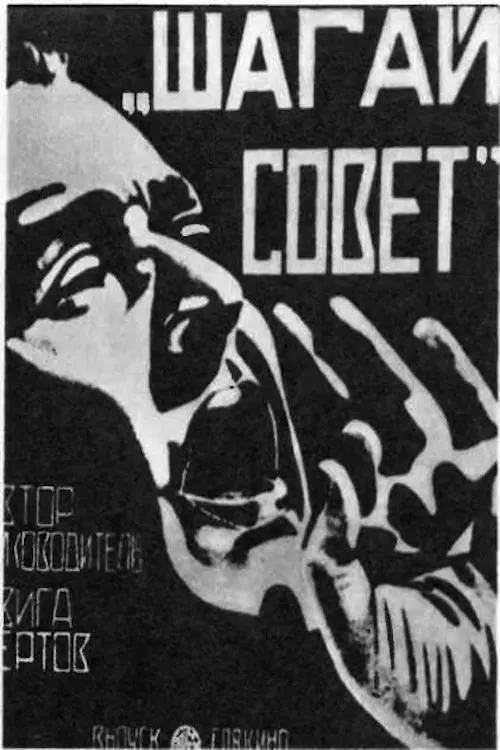
A definitive 6.5/10 rating for a film that redefined the boundaries of cult cinema. Stride, Soviet! remains a cornerstone of transgressive art.
Is this film worth watching today? Short answer: yes, but only if you view cinema as an architectural tool rather than a storytelling medium. This film is for the avant-garde enthusiast who wants to see the birth of modern editing; it is not for those seeking a traditional narrative or emotional character arcs.
Dziga Vertov’s 1926 work, Stride, Soviet!, remains one of the most aggressive examples of the 'Kino-Eye' philosophy put into practice. It is a film that demands your attention not through the charisma of its actors—of which there are none—but through the sheer kinetic energy of its assembly. While other films of the era like Marionettes were exploring the artifice of performance, Vertov was attempting to kill the theater entirely. He wanted the lens to be an objective observer that could see better than the human eye. The result is a jarring, fascinating, and occasionally exhausting experience.
1) This film works because it treats the camera as a sentient participant, creating a visual rhythm that anticipates modern music videos and fast-paced digital content.
2) This film fails because its lack of a central human protagonist makes it feel like an academic exercise in social engineering rather than a piece of human art.
3) You should watch it if you want to understand how the language of visual persuasion and political montage was invented before the digital age began.
Vertov was a fanatic. To understand Stride, Soviet!, you must understand that Vertov hated the 'staged' cinema. He viewed fiction films as a 'cine-nicotine' that drugged the masses. In this film, he uses the camera to strip away the romanticism of Moscow and replace it with the cold, hard steel of industrialization. The camera doesn't just sit there; it climbs, it ducks, and it stares. In one specific sequence, Vertov focuses on the faces of workers in a way that feels almost intrusive, capturing the sweat and the grime without the softening light of a studio.
This approach was radical. While contemporary dramas like Robes of Sin relied on moralistic storytelling, Vertov relied on the 'truth' of the machine. He believed that by showing the Moscow Soviet at work—cleaning streets, building power plants, and managing ledgers—he was showing the only truth that mattered. It works. But it’s flawed. The 'truth' he shows is highly curated, a manufactured reality that serves the state as much as it serves the art.
The pacing of this film is its most modern attribute. Vertov uses montage not just to transition between scenes, but to create a heartbeat. There is a sequence involving the printing of newspapers where the movement of the machinery is cut in perfect synchronization with the movement of the workers' hands. It is rhythmic. It is hypnotic. It turns the city of Moscow into a giant, breathing organism. This is a far cry from the slower, more theatrical pacing found in films like The Nation's Peril.
However, this relentless pace can be a double-edged sword. For a modern viewer accustomed to the narrative hooks of something like A Connecticut Yankee in King Arthur's Court, the lack of a story to follow can lead to a sense of detachment. You are watching a machine work, but you aren't necessarily rooting for the machine. Vertov doesn't care about your feelings; he cares about your perception. He wants to rewire your brain to see the beauty in a gear-shaft or a sewage pipe.
We have to address the elephant in the room: this is propaganda. It was commissioned by the Moscow Soviet to showcase their achievements. In the same way that Die Herrin der Welt 6. Teil - Die Frau mit den Millionarden sells a fantasy of wealth and adventure, Vertov sells a fantasy of collective efficiency. He shows the failures of the past—the beggars, the ruins, the filth—and contrasts them with the 'success' of the present. It is a brutal simplification of history.
Yet, as a critic, I find the propaganda to be the most interesting part of the film. It is so transparent that it becomes a study in psychology. Vertov uses double exposures and split screens to show the 'old' world literally being overwritten by the 'new.' It’s a visual metaphor for erasure. He is not just recording the city; he is performing an exorcism of the Tsarist ghost. This level of technical sophistication was unheard of in more standard fare like Parson Pepp or Money to Burns.
If you are looking for a relaxing evening of entertainment, the answer is a resounding no. Stride, Soviet! is a difficult, demanding film that requires the viewer to engage with it on a structural level. However, if you are a student of cinema or a history buff, it is essential. It is the missing link between the early trick films and the sophisticated documentaries of the modern era. It shows a director grappling with the power of the image and winning.
Compared to the narrative simplicity of Cirkus Bimbini, Vertov’s work feels like it’s from another century entirely. He was ahead of his time, even if his ideology was rooted in a specific, turbulent moment. The film is a masterclass in how to use editing to create meaning where none existed before. It is a testament to the fact that cinema can be a weapon, a tool, and a poem all at once.
Pros:
- Revolutionary editing techniques that still feel fresh.
- A rare, unvarnished look at 1920s Moscow infrastructure.
- Bold, experimental cinematography that pushes the limits of the era's technology.
Cons:
- Zero narrative arc to keep the casual viewer engaged.
- Heavy-handed political messaging can be off-putting.
- Some sequences feel repetitive and overstay their welcome.
One cannot discuss Stride, Soviet! without mentioning the sheer technical bravery of Vertov. He was working without the safety net of sound, relying entirely on the visual to communicate complex socio-economic ideas. While a film like Confession might use dialogue to convey internal struggle, Vertov uses the juxtaposition of a wealthy woman’s fur coat against a beggar’s tattered rags. It’s visual shorthand, and it’s devastatingly effective.
The use of the camera as a 'character' is something that wouldn't become common for decades. Vertov places his lens in positions that seem impossible for 1926—underneath trains, high above the streets, and directly in the path of moving machinery. This wasn't just for show; it was to prove that the camera could go where the human could not. It was an assertion of technological dominance. Even in the genre-heavy world of The Wild Wild West or the melodrama of Shall We Forgive Her?, you rarely see this level of formal experimentation.
Ultimately, Stride, Soviet! is a precursor to Vertov’s more famous Man with a Movie Camera. It is the rough draft of a revolution. You can see him testing the boundaries of what an audience will tolerate. How many shots of a factory can you show before the viewer loses interest? Vertov bets that if the rhythm is right, the viewer will never look away. He mostly wins that bet.
In the context of 1920s cinema, which was often stuck between the traditions of the stage and the new possibilities of the screen, Vertov was a flamethrower. He burned down the old ways of seeing. While other directors were making films like Der Schloherr von Hohenstein, which looked backward at aristocratic tropes, Vertov was looking forward at a world of concrete and electricity. He was a liar, perhaps, in his portrayal of a Soviet utopia, but he was a brilliant one. We shouldn't trust him, but we can't look away.
Stride, Soviet! is a monumental piece of film history that is as much a political document as it is an artistic one. It is cold, mechanical, and entirely devoid of traditional sentiment. It is also one of the most visually inventive films of its decade. Vertov didn't just record the achievements of the Moscow Soviet; he created a visual language that we are still using today in everything from news broadcasts to TikTok transitions. It is essential viewing for anyone who wants to see where the power of the image truly began. It works. But it’s flawed. And that’s exactly why it’s worth your time.
IMDb —
1927
Community
Log in to comment.