DbcultAccessing Vault...
Cult Review
Senior Film Conservator
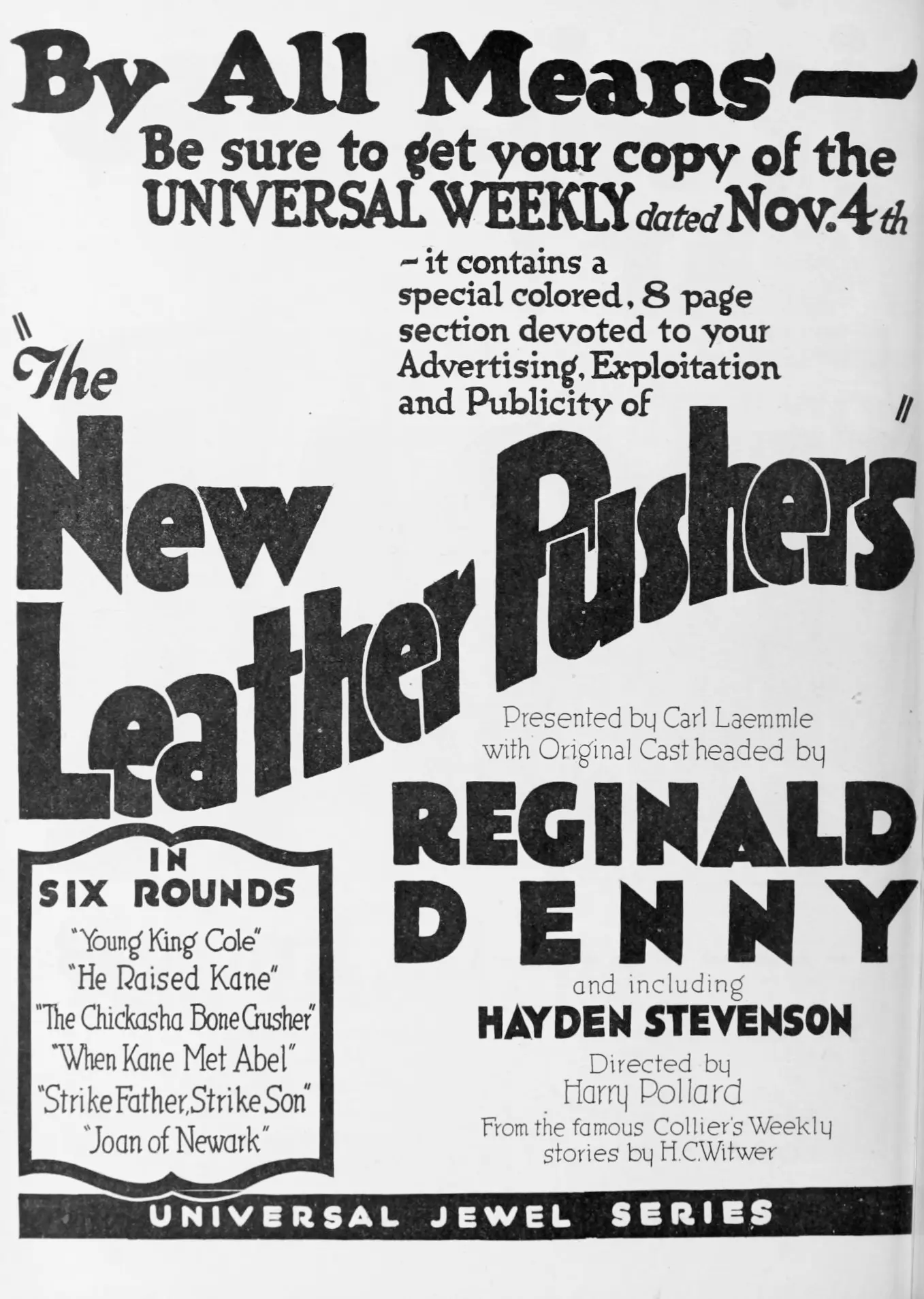
To gaze upon the flickering frames of Strike Father, Strike Son is to witness the birth of the modern sports archetype. This 1922 artifact, a crucial vertebrae in the spine of the Leather Pushers series, offers more than mere fisticuffs; it provides a window into the soul of an era obsessed with the dichotomy of refinement and savagery. While contemporary audiences might look toward the more polished narratives of The Ring and the Man for a similar exploration of masculinity, this H.C. Witwer adaptation possesses a raw, unvarnished vitality that remains remarkably potent. The film doesn't just depict boxing; it interrogates the very impulse to fight, wrapping its inquiry in the sweat-stained garments of early 20th-century American ambition.
Reginald Denny, an actor whose physicality often outpaced the scripts he was handed, finds in Kid Roberts a vessel for a surprisingly nuanced performance. Unlike the broader characterizations found in Broadway Arizona, Denny here balances a certain aristocratic aloofness with the explosive kinesis of a middleweight contender. His movements within the ring are not the staged ballets of a lesser performer but a calculated display of controlled aggression. He understands that the camera in 1922 was a hungry beast, demanding a clarity of motion that could bridge the gap between the silent title cards and the audience's imagination. In the sequences where he confronts the metaphorical shadow of his father, Denny’s face becomes a landscape of conflicting loyalties, a stark contrast to the more whimsical expressions he would later adopt in his career.
The supporting cast, particularly Hayden Stevenson, provides a grounding force that prevents the film from drifting into the realm of pure spectacle. Stevenson’s portrayal of the trainer/manager figure avoids the tired clichés that would eventually populate the genre in the decades to follow. There is a transactional intimacy between him and Denny that feels lived-in and weary, reminiscent of the gritty realism found in European imports like Nattens datter III. Elinor Field, meanwhile, manages to carve out a space for her character that transcends the typical 'love interest' boundary. Her presence acts as the moral fulcrum upon which the narrative tilts, offering a reprieve from the hyper-masculine environment of the training camps and smoke-filled arenas.
One cannot discuss Strike Father, Strike Son without acknowledging the literary DNA provided by H.C. Witwer. His prose was the heartbeat of the Leather Pushers series, and even when translated into the silent medium, his unique cadence survives. The title cards are infused with a slangy, rhythmic energy that mirrors the pacing of a three-minute round. This linguistic flair distinguishes the film from the more somber, perhaps overly earnest tone of A Mother's Sin. Witwer understood that boxing was as much about the 'gift of gab' and the promotion as it was about the physical toll. This meta-awareness of the sport as a business—as a performance for the masses—gives the film a modern edge that many of its contemporaries lacked.
The direction, though adhering to the standard Universal house style of the period, occasionally breaks into moments of visual brilliance. The use of depth in the gym scenes, where fighters spar in the background while plot points are negotiated in the foreground, creates a sense of a bustling, indifferent world. It is a far cry from the claustrophobic, almost stage-like sets of The Haunted House. There is a documentary-like quality to the crowd shots during the climactic fight, capturing the frantic energy of the spectators—the 'great unwashed' who lived vicariously through the triumphs and failures of men like Kid Roberts. This sociological gaze elevates the film from a mere short subject to a historical document of American leisure and obsession.
When we place Strike Father, Strike Son alongside The Zone of Death, the contrast in tonal ambition becomes apparent. While the latter leans into the macabre and the existential, the former finds its 'death zone' within the squared circle of the ring. The stakes are just as high, but they are localized within the human body. The film shares a certain kinetic DNA with Double Adventure, yet it trades that film’s breezy escapism for a more somber reflection on the cost of glory. The 'strike' mentioned in the title is not merely a physical blow; it is a generational reckoning, a theme that resonates more deeply than the plot of The Prince and Betty, which handles social class with a much lighter, almost farcical touch.
Furthermore, the visual texture of the film—the way the lighting catches the beads of sweat on Denny’s brow—suggests an evolving sophistication in cinematography. It lacks the experimental shadows of La perla del cinema, but it compensates with a muscular clarity. The editing, particularly during the fight sequences, utilizes a primitive but effective form of montage that would later be perfected in the sound era. Each cut feels like a heartbeat, accelerating as the Kid nears his breaking point. This is cinematic storytelling at its most primal, stripped of the artifice that often burdened the longer features of the time, such as The Girl Who Came Back.
The enduring appeal of Strike Father, Strike Son lies in its refusal to offer easy answers. The conflict between father and son is not resolved with a simple handshake; it is mediated through the violence of the ring. This recognition that some wounds can only be cauterized by physical struggle is what gives the film its lasting weight. It predates the cynicism of 1940s noir but carries a similar undercurrent of disillusionment. In the grand tapestry of silent cinema, where films like Smoldering Embers explored the slow decay of the family unit, Strike Father, Strike Son offers a more explosive alternative. It suggests that the only way to move forward is to strike back at the expectations that bind us.
Even when compared to the animalistic tension of Bjørnetæmmeren, Denny’s performance holds its own as a study in human endurance. The film serves as a precursor to the great boxing epics of the future, establishing a visual and thematic vocabulary that directors would draw upon for decades. It understands the ring as a stage, the fight as a drama, and the boxer as a tragic hero. Whether Kid Roberts is a 'black sheep' in the vein of Black Sheep or a misunderstood champion, the film allows the audience to decide. It avoids the heavy-handed moralizing found in Wits vs. Wits, opting instead for a visceral honesty that remains its greatest strength.
In the final analysis, Strike Father, Strike Son is a testament to the power of the short-form narrative. It doesn't need two hours to convey the complexity of its themes; it does so in a series of sharp, impactful movements. It is a film that demands to be seen not just by historians of the sport, but by anyone interested in the evolution of cinematic masculinity. It is a work of bruised beauty, a relic of a time when the screen was just beginning to learn how to capture the raw, unadulterated rhythm of the human heart in conflict with itself. Like the gifts in Uncle Bim's Gifts, this film is a surprise package, offering far more depth and resonance than its humble origins might suggest. It is a knockout in every sense of the word, a punch that still lands with surprising force a century after it was first thrown.
The technical preservation of such films is vital, as they represent the connective tissue between the theatrical traditions of the 19th century and the visual language of the 20th. In the flickering light of Kid Roberts’ journey, we see the sparks of an industry finding its footing, learning how to tell stories that are both intimate and universal. The father-son dynamic is the oldest story in the book, yet here, under the hot lights of the arena and the watchful eye of H.C. Witwer, it feels as fresh and dangerous as a first-round bell. It is a reminder that while the technology of cinema changes, the fundamental human struggles—for respect, for identity, and for a place in the world—remain eternally the same. To watch Strike Father, Strike Son is to step into the ring with history, and to come out the other side slightly more enlightened about the nature of the fight we all must face.
IMDb 8
1931
Community
Log in to comment.