DbcultAccessing Vault...
Cult Review
Senior Film Conservator
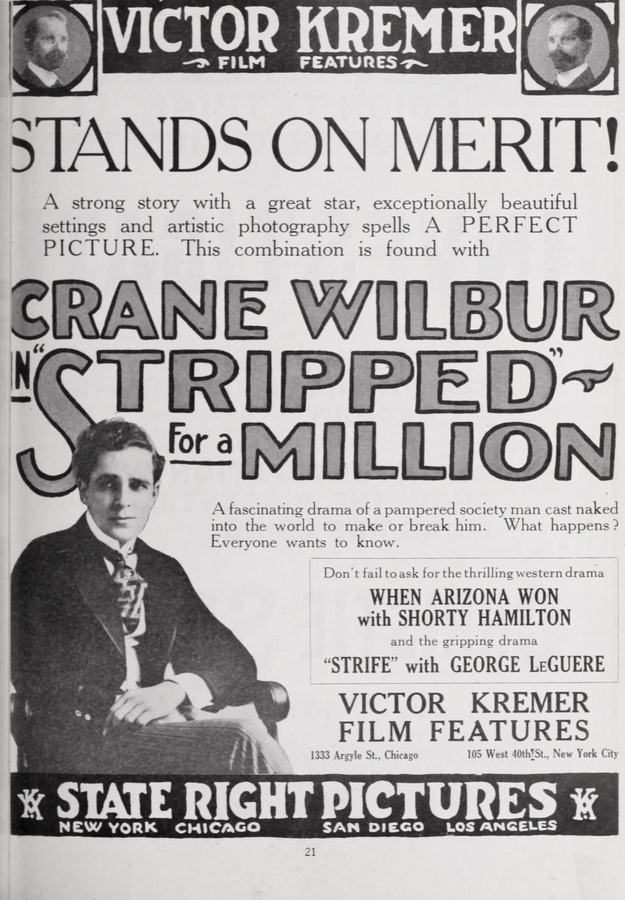
In the pantheon of early American cinema, few narratives capture the anxiety of the nouveau riche quite like Stripped for a Million. Directed with a certain kinetic energy that predates the more polished studio systems of the 1920s, this 1915 gem serves as both a morality play and a scathing critique of inherited privilege. At a time when the world was on the precipice of modern upheaval, the film looks backward to the rugged individualism of the frontier while simultaneously mocking the soft underbelly of the urban elite.
Stanley Warren, portrayed with a surprising amount of physicality by Crane Wilbur, is introduced as the archetype of the idle rich. His twenty-first birthday isn't a celebration of maturity but a peak of excess. The sudden cessation of his funds is not merely a plot device; it is a spiritual castration. The uncle’s will, a document of almost sadistic pedagogical intent, demands that Stanley be reduced to a pre-civilized state. This sequence in the woods, where Stanley is forced to clothe himself in vines, evokes a sense of atavistic regression that feels remarkably modern. It reminds one of the thematic struggles found in The Way of the Strong, where the environment itself becomes a character that tests the mettle of the protagonist.
The cinematography here, while limited by the technology of the era, manages to capture the isolation of the woods. There is no romanticism in Stanley’s nakedness; it is a source of profound social shame. When he encounters June Day, the orphan, we see the first flicker of genuine human empathy. Anita King plays June with a quiet dignity that avoids the saccharine pitfalls often associated with silent film heroines. Her gesture of providing a blanket is the film’s moral anchor, contrasting sharply with the transactional nature of Stanley’s previous social circle.
The narrative shifts from survivalism to social satire once Stanley enters the Peabody household. Caught in the act of 'stealing' clothes—an act of necessity that the law views as a moral failing—Stanley is saved not by justice, but by the whims of the Judge’s sister. This subplot is particularly fascinating. The sister’s attraction to Stanley is a subtle nod to the repressed desires of the Victorian era, a theme explored with more gravity in When a Woman Sins. Here, however, it is played for light irony. Stanley, the former millionaire, is now a servant in a house that represents the very legal and social structures that previously protected him.
The tension is heightened by the presence of his former fiancée’s suitor. This character serves as the embodiment of the status quo—a man who values the name and the fortune over the person. The film cleverly uses the 'no-name' clause of the will to create a suspenseful dynamic. Stanley must remain anonymous, essentially becoming a non-person to reclaim his personhood. This existential paradox is what elevates Stripped for a Million above the standard melodrama of its day. It shares a certain DNA with The Uplifters, particularly in its skepticism toward institutionalized attempts at 'improving' the lower classes.
The final act of the film is a masterclass in narrative subversion. June Day’s expulsion from the orphanage, fueled by the malicious gossip of the Judge’s sister, highlights the precariousness of female virtue in the early 20th century. While Stanley’s struggle is a choice mandated by a will, June’s struggle is an involuntary consequence of a patriarchal society. Their marriage is not just a romantic resolution; it is a defensive alliance against a world that has rejected them both.
When Stanley reveals his name during the ceremony, he consciously chooses his wife over his wealth. In the logic of the film, this is his final test. He has learned that an 'honest living' is not just about labor, but about the integrity of one’s identity. The final twist—the codicil that awards the money to June—is a brilliant stroke of poetic justice. It effectively bypasses the male line of inheritance, rewarding the person who showed the most character when the protagonist had nothing. This ending resonates with the same sense of cosmic irony found in His Last Dollar, though with a more optimistic, feminist slant.
Visually, the film utilizes the techniques of its time—static wide shots interspersed with expressive close-ups—to tell a story that is surprisingly complex. The use of natural lighting in the outdoor sequences provides a stark contrast to the stifling, over-decorated interiors of the Peabody residence. This visual dichotomy reinforces the film’s central theme: the conflict between the raw truth of nature and the artificiality of society. It’s a technique we see mirrored in European cinema of the same period, such as in the works of Mod lyset.
The performances are noteworthy for their lack of excessive gesticulation, which was common in 1915. Crane Wilbur brings a grounded, almost weary quality to Stanley that makes his transformation believable. Anita King’s June is the film's silent heart, her eyes conveying a depth of sorrow and hope that dialogue would likely oversimplify. The supporting cast, particularly the actors playing the Judge and his sister, provide a necessary comedic foil, grounding the film’s higher moral questions in recognizable human pettiness.
Ultimately, Stripped for a Million is a profound meditation on the value of a human being once all external markers of status are removed. It challenges the viewer to consider whether character is something innate or something forged in the fires of adversity. While it retains the charm of a silent comedy, its underlying message is one of radical empathy. It suggests that the only way to truly 'win' the game of capitalism is to be willing to walk away from it for the sake of another. In a modern era obsessed with personal branding and net worth, this century-old film feels more relevant than ever. It is a testament to the enduring power of storytelling that transcends the limitations of its era, offering a timeless reflection on what it means to be truly wealthy.
Related explorations in silent cinema: The False Faces | Sweet Alyssum | The Stranglers of Paris
IMDb —
1917
Community
Log in to comment.