DbcultAccessing Vault...
Cult Review
Senior Film Conservator
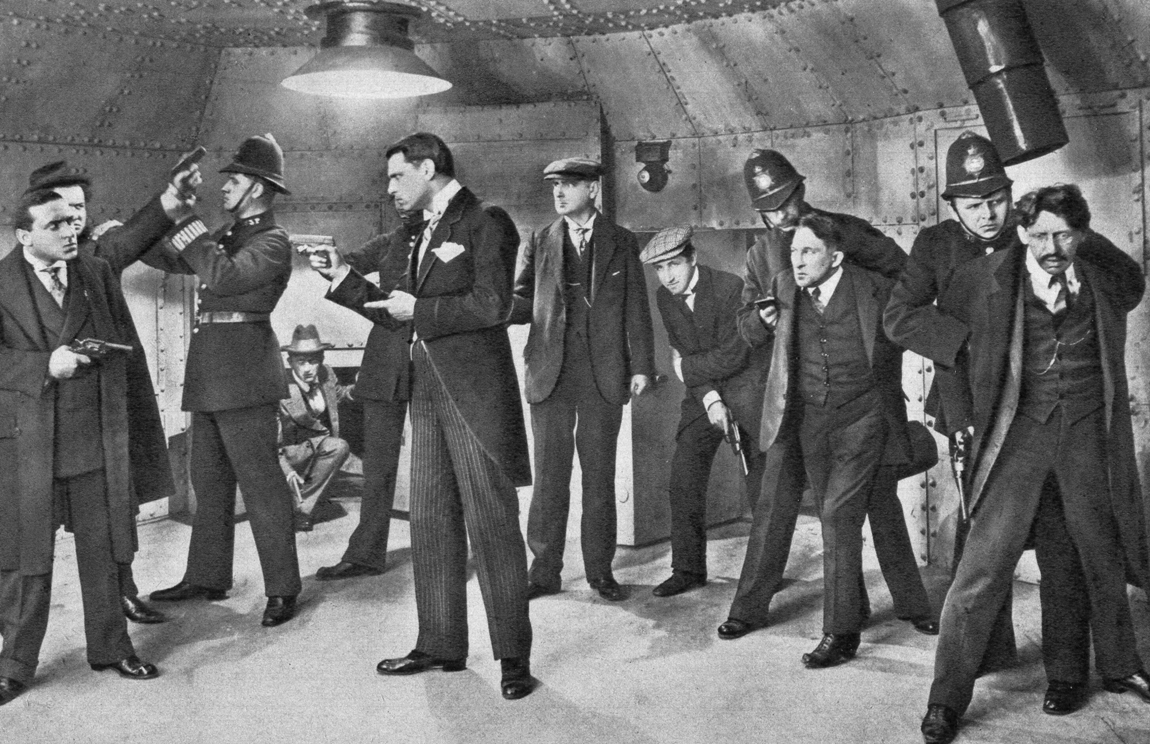
Nobody exits Das Panzergewölbe unscathed; the film itself is a riveted iron lung hissing celluloid ether into your pupils until the Weimar chill crawls under your collar.
Imagine, if you dare, a Berlin that never saw sunrise again after 1926. Directors Joe May and Arzén von Cserépy weld expressionist angularity to pulp velocity, forging a spy fable that feels like Lang’s Spione beaten into shape by a blacksmith drunk on Nietzsche. Ernst Reicher, who both writes and embodies Stuart Webbs, strides through this underworld in a leather trench that squeaks like a confession. His silhouette—part maître d’, part mortician—cuts across chiaroscuro streets where gas lamps sputter like dying stars. The plot, ostensibly about a stolen siege cannon, mutates into a referendum on industrial modernity: can a society armed to the molars still claim to be civilised?
The titular vault is not a mere set but a character—ribbed, spitting sparks, exhaling ozone. Cinematographer Max Grix frames it with low-angle awe so that every girder looms like a cathedral pillar forged by Satan’s apprentices. When Webbs descends its spiral staircases, the camera pirouettes in clockwise obsession, a visual mantra that whispers: descent is destiny.
Arthur Ullmann, playing munitions baron von Kastell, chews scenery with a restraint that paradoxically amplifies menace. His monocle becomes a silver coin tossed into the viewer’s soul—will it land heads or tails? One moment he strokes a pet ferret, next he signs death warrants with the same languid wrist. The performance is a seminar in minimalist villainy, miles away from the histrionic somnambulists populating Dante’s Inferno or the bourgeois guilt of The Curse of Greed.
Meanwhile Hermann Picha, perennial character chameleon, essays a surveillance clerk whose hobby is cataloguing tram schedules—information later weaponised into a ticking timeline. It’s a throwaway subplot that blossoms into a meditation on data as ammunition, decades before Snowden’s grandmother was even born.
Intertitles arrive sparingly, haiku-brief. One reads: „Stahl schläft nicht“—steel never sleeps. Another simply flashes „BERLIN 3:12 A.M.“ while a metronomic thud underscores the image—presumably a conductor striking a bass drum off-screen, yet it imprints itself as the city’s arrhythmic heart. This percussive absence of orchestral comfort is what separates Das Panzergewölbe from the symphonic pomp of Oliver Twist or the pastoral lullabies in The Springtime of Life.
Visually, the palette is a bruised triptych: sodium yellow for gaslit corridors, submarine green for sewers, arterial crimson for the cannon’s muzzle. These hues do not merely tint; they seep, like dye in water, until the narrative itself appears to bleed. When Webbs finally cracks the vault’s code—an octet of rivets aligned to Orion’s belt—the screen floods with a sulphurous flare that singes the retina. In that instant you grasp the film’s thesis: knowledge, once unbolted, scorches both keeper and thief.
Ernst Reicher’s authorship is no vanity credit. He pioneered the German detective serial in 1914, and by 1926 he refines the formula into a diamond bit. Webbs here is less a sleuth than a cartographer of dread, mapping the city’s unconscious the way Freud mapped the psyche. Watch how Reicher signals cognition: a microscopic tilt of the head, a blink held half a second too long—Gestalt epiphanies rendered without words. Compare this to the flailing histrionics of Wer ist der Täter? where the detective solves crimes by shouting at them.
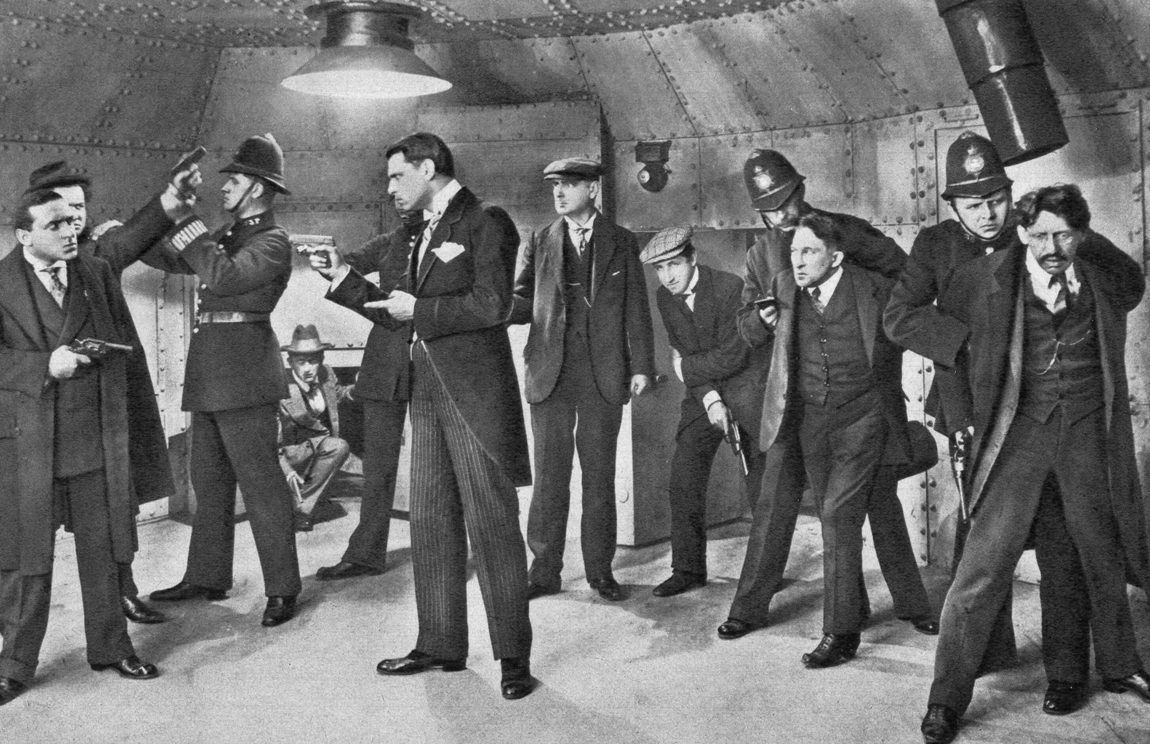
Reicher’s screenplay, co-forged with May and von Cserépy, also weaponises MacGuffin alchemy. The cannon’s schematics are hidden inside a reel of comedy footage—an early ancestor of the “film within the film” ruse later popularised by Hitchcock. When the reel unspools on a makeshift screen for von Kastell’s lieutenants, Buster Keystone-style slapstick erupts, lulling them into titters just before Webbs swaps the canisters. The gag lands like a stiletto between ribs: laughter itself becomes espionage.
Context matters. 1926 Germany totters on the cusp of electrification yet still smells of coal smoke; the Rentenmark has stabilised nightmares but not memories. Das Panzergewölbe distils that tension into a single image: a Siemens generator roaring beside a medieval anvil. The film premiered two months before Fritz Lang began shooting Metropolis; its propulsion feels swifter, pulpier, closer to the street. Where Joan of Arc mythologises martyrdom and In Search of the Castaways romanticises empire, Webbs confronts the machinery that will soon enable both fascism and futurism.
Gender dynamics, though sidelined, flicker with subversion. The lone female operative, Fräulein Doro (played with brittle resolve by an uncredited actress), navigates boardrooms as deftly as sewers. Her fate—imprisoned inside a freight elevator between two sub-basements—becomes a literalisation of Weimar womanhood: ascending toward emancipation yet shackled by iron tradition. The camera lingers on her eyes through a grate, pupils reflecting torchlight like twin novas about to collapse.
Stack Das Panzergewölbe against May’s own Das Geheimschloss and you’ll notice a leap from stagey interiors to kinetic geography. Where Geheimschloss unfolds like a diorama, Panzergewölbe hurtles—trams, elevators, conveyor belts—achieving a vertiginous momentum matched only by The Escape yet with far loftier thematic stakes.
Against Gatans barn’s social realism, Webbs’ adventure might appear escapist. But scratch the oxidised surface and you find the same anxious heartbeat: children of the asphalt trying to outrun the machinery that birthed them. The difference is May coats that anxiety in phosphorescent thrills rather than soot.
Most prints were lost in the Verdun fire at Ufa’s storage facility, 1943. What survives is a 1.2-kilometre roll of nitrates discovered in a Slovenian monastery, replete with Slovene intertitles that feel oddly fitting—another layer of cipher. The digital restoration by the Munich Filmmuseum preserves the cigarette burns that once cued projectionists; those perforations now dance like bullet holes in the viewer’s peripheral vision.
Contemporary composers have attempted new scores—ranging from industrial electronica to chamber noir—but the wisest choice remains pure silence punctuated by a single tam-tam every eleven minutes. That interval mirrors the narrative’s cardiac rhythm: systolic intrigue, diastolic dread.
So why should you—sated on Marvel drones and algorithmic scripts—spend 107 minutes with a flickering artefact? Because Das Panzergewölbe reminds us that cinema, at its forge-hot core, is neither comfort nor escape but confrontation. It drags you down iron staircases until the boundary between viewer and vault corrodes. You surface blinking, ears ringing, convinced that somewhere beneath your local multiplex lies a cathedral of rivets humming: steel never sleeps.
Verdict: compulsory viewing for anyone who believes suspense is more than jump scares—who craves the metallic taste of history whispering through perforated images. Let the cannon roar silently; let Webbs vanish into the dark like a match that’s shown you the shape of the room and nothing more.
IMDb 5.7
1932
Community
Log in to comment.