DbcultAccessing Vault...
Cult Review
Senior Film Conservator
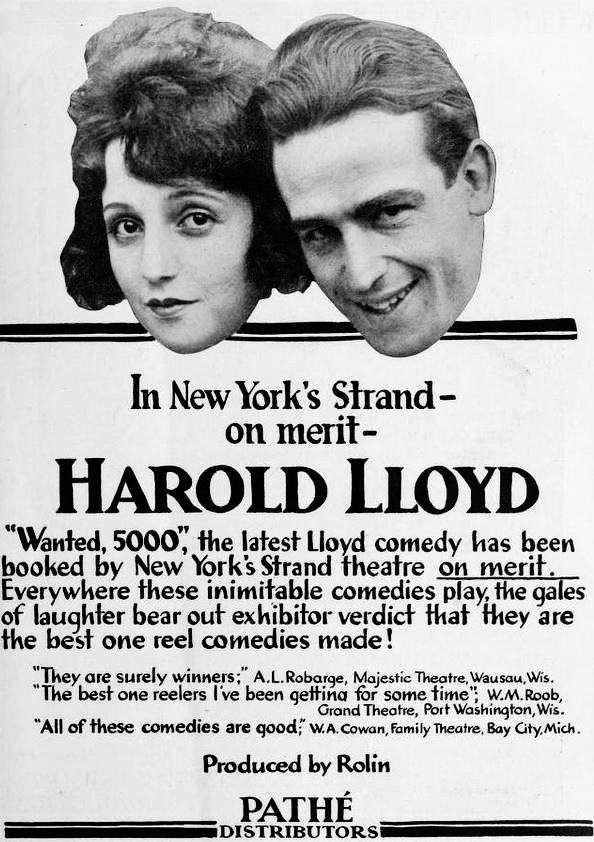
To understand the frantic ebullience of 1919’s Wanted - $5,000, one must first dismantle the prevailing notion that silent comedy was merely a sequence of percussive falls and custard-based projectiles. In this pivotal short, Harold Lloyd—an actor who would soon eclipse even the pathos of Chaplin in sheer commercial vitality—presents a masterclass in the comedy of aspiration. Unlike the existential dread found in contemporary dramas like The Might of Gold, Lloyd’s work here treats the accumulation of capital not as a moral rot, but as a ludic obstacle course. The film functions as a bridge between the primitive 'Lonesome Luke' era and the fully realized go-getter persona that would define the Roaring Twenties.
The premise is deceptively pedestrian: Harold must procure $5,000 to win the hand of the girl (the luminous Bebe Daniels). However, the execution is anything but. The screenplay, though uncredited in the traditional sense, reflects the collaborative 'gag-room' atmosphere of the Hal Roach studios. It is a world where the laws of physics are frequently suspended in favor of narrative momentum. Where a film like Gates of Brass might approach the barriers of social class with a heavy-handed solemnity, Wanted - $5,000 treats the $5,000 price tag as a MacGuffin of the highest order, driving Harold through a series of increasingly improbable scenarios.
The film’s brilliance lies in its spatial awareness. Lloyd, along with his frequent collaborator 'Snub' Pollard, utilizes the frame not as a proscenium arch, but as a dynamic, three-dimensional space. The 'novel way' Harold extracts the funds from the father is a sequence of surreptitious maneuvers that echo the devious ingenuity of the era. This isn't the grim desperation seen in Parasites of Life; it is a joyous subversion of authority. The father, played with blustering incompetence by the reliable Bud Jamison, represents the old-world gatekeeper—a figure who must be outwitted rather than overthrown.
Consider the pacing. The transition from the romantic introduction to the frantic quest for lucre is handled with a swiftness that puts modern blockbusters to shame. Lloyd’s physicality is understated here compared to his later 'thrill' comedies, yet there is a rhythmic grace to his movements. Every adjustment of his iconic spectacles serves as a punctuation mark in a visual sentence. This era of filmmaking was obsessed with the concept of the 'self-made man,' a theme also explored with far more cynicism in The Solitary Sin, yet Lloyd infuses the trope with a uniquely American brand of resilient charm.
When placed alongside European counterparts like Das Glück der Frau Beate, the cultural specificity of Wanted - $5,000 becomes startlingly clear. While European cinema of the time was often preoccupied with the psychological debris of the Great War, American shorts were pivoting toward a frantic, almost manic, pursuit of happiness. The film shares a certain kinetic DNA with The Bull's Eye, though it swaps the latter's serial adventure tropes for domestic machinations. It is fascinating to observe how the quest for a specific dollar amount creates a ticking-clock tension that would become a staple of the genre.
The supporting cast provides a sturdy foundation for Lloyd’s antics. Bebe Daniels, before she became a major star in her own right, offers more than just a decorative presence. Her chemistry with Lloyd is palpable, providing the emotional stakes necessary for the comedy to resonate. In many ways, her character's agency—or lack thereof—mirrors the themes found in A Woman Alone, though filtered through the prism of lighthearted farce. The presence of James Parrott and Noah Young further solidifies the Roach studio's roster of reliable character actors, each bringing a specific flavor of histrionic flair to the proceedings.
One cannot ignore the transactional nature of the romance. The plot’s insistence on a specific financial threshold ($5,000) reflects a society where marriage was still very much an economic contract. This theme is handled with far more gravity in Infatuation, but Lloyd’s comedy manages to satirize the requirement even as the protagonist strives to meet it. The 'novel way' Harold secures the money—essentially a series of comedic deceptions—suggests that in the game of love and capitalism, the rules are merely suggestions for those clever enough to circumvent them.
Technically, the film is a fascinating relic. The cinematography by Walter Lundin (who would go on to shoot Lloyd’s greatest features) is clean and functional, prioritizing the clarity of the gag over artistic experimentation. This contrasts sharply with the more expressionistic or atmospheric attempts found in films like Satanasso or The Man Behind the Curtain. In Lloyd’s world, the sun is always shining, the shadows are minimal, and the path to success is visible if one only has the audacity to run toward it. This visual clarity mirrors the moral clarity of the narrative: Harold is the hero because he is the most adaptable.
As we look back from the vantage point of over a century, Wanted - $5,000 stands as a testament to the durability of Lloyd’s screen persona. While other comedians of the era, such as those in Come Robinet sposò Robinette, relied on more localized or vaudevillian tropes, Lloyd was crafting a universal language of ambition. The film’s brevity is its strength; there is no room for the extraneous subplots that often bogged down features like The Rainbow Princess or Each to His Kind.
The final act, involving the father and the ultimate acquisition of the funds, is a masterclass in comedic irony. It subverts the expectation of hard work, suggesting instead that the modern world rewards the quick-witted and the bold. It is a sentiment that would have been deeply resonant in a post-war America looking to redefine itself. Even when compared to the more rugged narratives of Man and Beast or the somber tones of The Deserter, Lloyd’s short feels remarkably contemporary in its obsession with 'making it.'
In conclusion, Wanted - $5,000 is more than a mere historical curiosity. It is a vibrant, breathing piece of cinema that captures a specific moment in the evolution of the medium. It showcases a star on the precipice of greatness, a studio system finding its feet, and a genre—comedy—discovering its ability to reflect the socio-economic anxieties of its audience through the lens of laughter. For any serious student of silent film, it remains an essential text, a delightful romp through the fiscal and romantic hurdles of a bygone era that feels strangely familiar even today.
IMDb 5.7
1933
Community
Log in to comment.