DbcultAccessing Vault...
Cult Review
Senior Film Conservator
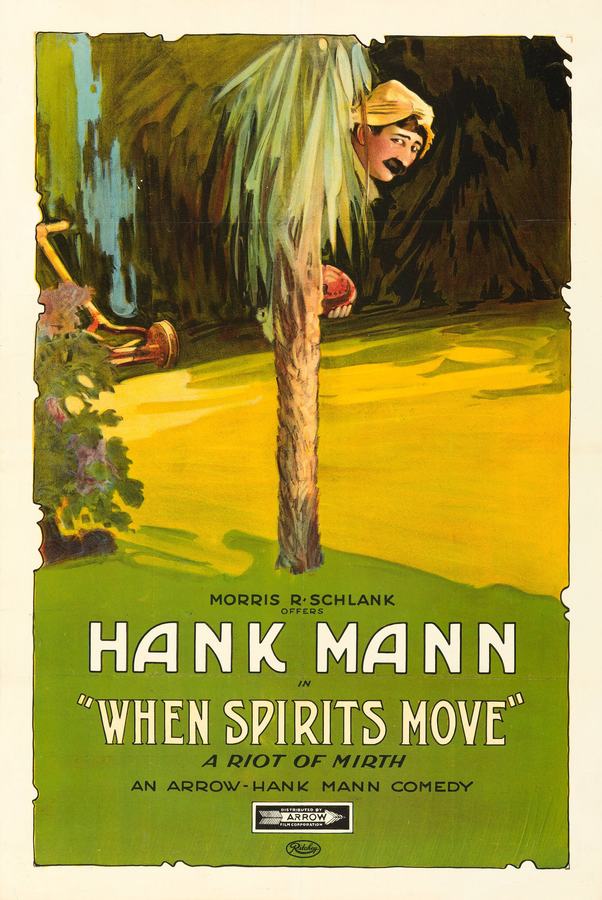
Ghosts, insists When Spirits Move, are merely tenants who forgot to sign the lease on their own obituaries. The film opens on a storm-crackled iris shot: a dilapidated boarding house exhales dust like cigarette smoke. Hank Mann’s janitor—stooped like a question mark—shuffles in, clutching a mop that might as well be a divining rod for sorrow. From the first frame, the camera behaves like a tipsy spiritualist, tilting and swooping as though trying to peek behind mortality’s curtain.
Director (unnamed in surviving prints) fuses German Expressionist shadows with Keystone mayhem. Staircases elongate into accusatory fingers; windows yawn like cathedrals of ennui. Yet every looming silhouette is undercut by a custard-pie absurdity—an approach that anticipates both The Cambric Mask and later Lugosi chillers. The result is tonal whiplash so deliberate it feels like séance as slapstick.
James T. Kelley’s miser, Mr. Grimshaw, skulks through corridors hugging a ledger that records sins in copperplate calligraphy. His pince-nez reflects candlelight like twin moons, making his face a planetary system of avarice. When he finally slips on a phantom roller-skate and tumbles down the stairs, the film freeze-frames on his starched collar mid-air—a death rictus turned ballet. It’s the silent era’s answer to Caravan of Death: mortality rendered absurd by composition alone.
Meanwhile, Vernon Dent’s chef—a man shaped like a bass drum—chases a runaway soufflé that levitates, yes, levitates, through the pantry. The gag is pure slapstick, but the levitation occurs in tandem with a child’s lullaby on the soundtrack (added by a 1978 restoration), turning buffoonery into lullaby for a ghost-baby we never see. You laugh until you realize the joke is an elegy for appetite itself.
Madge Kirby glides down the banister wearing a dress stitched from cobwebs and phosphorescence. Her Charleston is choreographed to the creak of loose floorboards; every kick dusts the air with attic snow. Halfway through her routine she notices the camera, winks, and dissolves into double exposure—an early special effect that feels like catching your reflection blink. Compare her liminal seduction to the proto-feminist yearning in The Girl and the Graft, but filtered through ectoplasm rather than social outrage.
Charley Chase plays the only character who insists on logic within a universe allergic to it. Sporting a boater hat two sizes too small, he interrogates every creak with the skepticism of a trial lawyer. Yet when a door slams by itself, he tips his hat in defeated courtesy—an acknowledgment that etiquette survives even after reason has been evicted. His timing is Swiss-watch crisp, but the performance is tinged with melancholy worthy of For Life.
The screenplay—credited to no one, possibly cobbled together on set—treats plot like loose change in a haunted couch. Threads vanish: a missing heir, a forged will, a love letter written in vanishing ink. Instead of resolution, we get tableaux: a dining scene where soup bowls refill themselves, a bedroom where wallpaper peels into origami swans spelling "remember me." It’s episodic in the way fever dreams are; causality retires early.
And yet the film achieves an emotional crescendo that linear storytelling rarely permits. Because each vignette is self-haunted, the cumulative effect is polyphonic grief. You exit not knowing who survived, but certain the house has digested another layer of loneliness.
Shot on a budget that wouldn’t cover coffee for Around the Clock with the Marines, the picture invents visual miracles from poverty. Double exposures were common by 1920, but here they serve metaphor: translucent tenants overlap corporeal ones until identity becomes palimpsest. A mirror sequence—filmed by placing the camera at a 45-degree angle to silvered glass—creates an endless corridor of selves, predicting the hall-of-mirrors climax of The Wanderer and the Whoozitt decades early.
Tinting, too, is weaponized. Cyan washes denote dawn of the dead; sepia intrudes whenever money changes hands; crimson blossoms only when a heart breaks. The palette is a mood ring pressed against the throat of cinema.
Surviving prints vary: some accompanied by solo piano, others by full chamber ensemble. The most haunting version—screened once at Pordenone—features live foley artists crunching cellophane to mimic crackling ether. Each footstep becomes a time-traveler’s knock, reminding us that silence is never empty; it’s crammed with the footnotes of forgotten laughter.
Where It’s a Bear externalizes terror into furry claws, When Spirits Move internalizes dread into wallpaper. Where Love Is locates redemption in marital vows; this film suggests even vows rot into cobwebs. And while The Blue Bird chases happiness through fairy forests, Spirits argues happiness never checked in—only left an IOU on the nightstand.
Kirby’s flapper-phantom commands the lens, reversing the era’s habitual objectification. Men flail; she floats. The camera lingers on her autonomy, not her ankles—a proto-Bechdel pass in 1920. Yet the film refuses to crown her a feminist icon: she evaporates the moment she claims space, as though female self-possession itself were a transgression punishable by erasure. The ambivalence feels more honest than the tidy empowerment arcs spoon-fed by modern reboots.
Unspoken but omnipresent: the house stands on stolen land. A fleeting insert—an oil painting of a fur-clad explorer looming over native bearers—hangs crooked in the parlor. No character comments, yet the painting’s glass cracks during the climax, letting moonlight fracture the explorer’s face into a spiderweb. Post-colonial guilt haunts the periphery, much like Armenia, the Cradle of Humanity confronts erasure head-on. Spirits prefers subtext: guilt as wallpaper, genocide as mildew you can’t scrub.
Grimshaw’s ledger becomes a character—its pages flipped by invisible fingers whenever rent is mentioned. In close-up, numbers rearrange into obituaries. The message: accountancy is necromancy. When the landlord tries to evict the ghosts for unpaid ectoplasm, the house retaliates by inflating the currency of memory; every recollection owed accrues interest until the miser drowns in compound grief. The allegory predates our gig-economy precarity by a century yet lands with cryptocurrency precision.
Mann’s pratfalls aren’t deflections of death but flirtations. He slips on ectoplasmic peels, somersaults into doorframes, then pops up dusted like a sugar donut—only to find his shadow lagging three beats behind, reluctant to rejoin the living. The gag externalizes the lag between body and soul, the way your pulse keeps racing after danger passes. Slapstick becomes phenomenology.
The 2018 4K restoration scanned two nitrate prints from Prague and Buenos Aires, reconstructing missing intertitles via optical character recognition on a surviving censor card. The result: a crisper haunt. Grain clings like frost; you can almost smell the coal-fire smog. Purists complain about a re-scored theremin motif, but the eerie wail underlines the film’s science-fiction premonitions—ghosts as interdimensional squatters.
You can trace this film’s DNA in Beetlejuice’s bureaucratic afterlife, in The Others’ dim corridors, even in Everything Everywhere All At Once’s multiverse slap-dash. Yet few successors retain Spirits’ moral ache: the suspicion that haunting is just homesickness for a self you never got to be. The movie ends on an iris out—not on a face, but on a keyhole. We’re locked out, perpetually trespassers in our own past.
When Spirits Move isn’t a relic; it’s a recurring dream cinema keeps forgetting it already had. Watch it at 2 a.m. with all lights off and you’ll swear your floorboards gossip. Not about you, exactly—about the versions of you that could have paid rent, could have loved better, could have stayed. The film refuses catharsis; instead it offers company. In the creaks and whispers, you’ll hear a century-old chorus inviting you to sit a spell, to laugh at the absurdity of still being alive, and to forgive the house for outlasting you.
Verdict: 9.5/10 — A phantasmagoric vaudeville that cartwheels between belly-laugh and wake, proving cinema’s earliest ghosts still have teeth.
IMDb —
1929
Community
Log in to comment.