DbcultAccessing Vault...
Cult Review
Senior Film Conservator
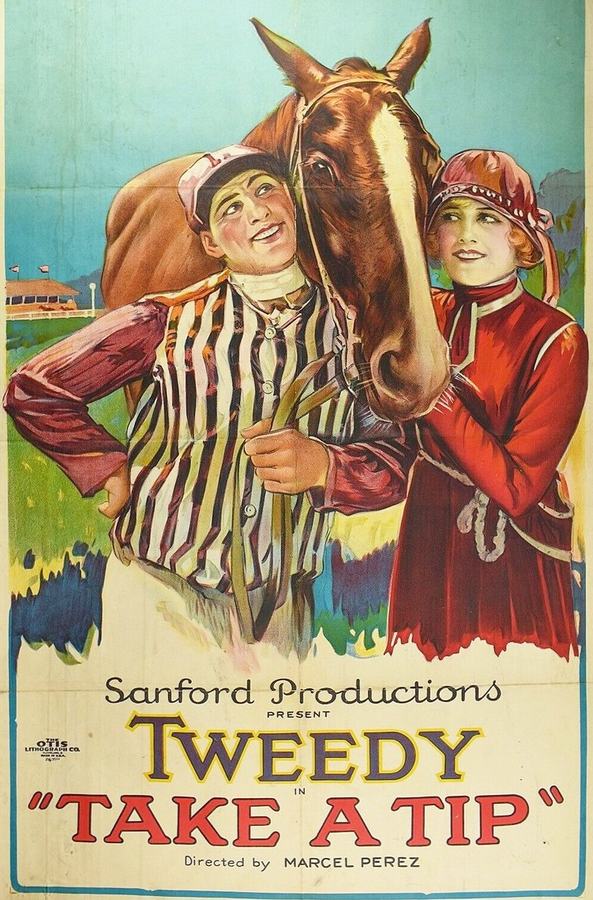
To witness Marcel Perez in Take a Tip is to observe a dervish of cinematic energy that defies the rigid categories of early twentieth-century performance. While the pantheon of silent comedy is often dominated by the holy trinity of Chaplin, Keaton, and Lloyd, Perez—operating here under the moniker of Tweedy—represents a fascinating, more anarchic alternative. This 1919 short film is a concentrated vial of his specific brand of madness. Unlike the sentimental pathos of Chaplin or the stoic engineering of Keaton, Perez offers a visceral, almost surrealist approach to the pratfall. In Take a Tip, the plot is a mere skeletal structure, a scaffolding upon which Perez hangs a series of increasingly improbable physical feats.
The narrative, such as it is, revolves around the precarious nature of luck and the disastrous consequences of following unsolicited advice. It is a theme that resonated deeply with post-WWI audiences, who found themselves in a world where the old rules no longer applied. When we compare this to the more grounded, domestic narratives like A Family Affair, the sheer velocity of Take a Tip becomes even more apparent. Perez does not just occupy space; he colonizes it with a frantic, peripatetic grace that suggests the very air around him is combustible.
One cannot discuss the efficacy of this film without acknowledging the indispensable contribution of Dorothy Earle. In the silent era, the 'leading lady' was frequently relegated to the role of a passive prize or a weeping willow. However, in the collaborative ecosystem of Perez’s productions, Earle acts as the tectonic plate upon which the comedy shifts. Her timing is impeccable, providing a sophisticated foil to Tweedy’s elastic absurdity. She possesses a screen presence that is both luminous and grounded, a necessary requirement when your co-star is prone to literal and metaphorical flights of fancy.
Their chemistry is palpable, a rhythmic interplay that elevates the film above the standard 'knockabout' shorts of the period. While films like Little Miss Fortune leaned heavily into the sentimental tropes of the era, Take a Tip remains refreshingly cynical about the human condition. Earle’s character doesn't just tolerate the chaos; she is often the catalyst for it, or at the very least, the amused observer of the wreckage. This dynamic creates a sophisticated layer of irony that was quite advanced for 1919, suggesting a partnership of equals in a genre often defined by slapstick misogyny.
Placing Take a Tip within the broader context of its contemporaries reveals its unique DNA. Consider the canine-led humor of Brownie's Busy Day; while both films rely on physical humor, Perez’s work is imbued with a psychological restlessness that the animal-centric shorts lack. There is a sense of existential dread lurking beneath the surface of Tweedy’s smiles—a man constantly at odds with the physical world. This tension is what makes the comedy so resonant even a century later.
Furthermore, the film’s visual language is surprisingly sophisticated. The use of depth of field and the placement of the camera to capture the full scope of a stunt shows a director (likely Perez himself, though often uncredited or working in close collaboration) who understood the power of the frame. Unlike the heavy-handed moralizing found in The Little Samaritan or the dark, brooding atmosphere of The Dark Road, Take a Tip embraces the light. Yet, it is a light that exposes the absurdity of social pretension. It shares a certain kinship with the transgressive spirit of Frisky Lions and Wicked Husbands, though it trades that film's overt ribaldry for a more surreal, kinetic wit.
The construction of a gag in Take a Tip follows a specific, escalating logic. It begins with a minor transgression or a simple misunderstanding—often involving a financial 'tip' or a suggestion for a bet—and spirals into a grand, operatic display of destruction. This escalation is handled with a surgical precision that belies the apparent messiness of the action. Perez’s background in European circus and music hall traditions is evident in every frame. He treats his body as a prop, a malleable object that can be bent, thrown, or collapsed to elicit a visceral response from the viewer.
"The genius of Perez lies in his ability to make the impossible look inevitable, and the inevitable look like a surprise."
When we look at the melodramatic leanings of films like Reputation or the swashbuckling bravado of The Sea Panther, we see a cinema trying to establish its narrative legitimacy through scale and gravity. Take a Tip, conversely, finds its legitimacy through its rejection of gravity. It is a film that understands the inherent silliness of the human form. The way Perez interacts with the environment—tripping over curbs that weren't there a second ago, or tangling himself in the simplest of garments—speaks to a universal truth about our lack of control over our own lives.
It is a tragedy of film history that Marcel Perez is not a household name. In 1919, he was a titan of the short form, a man who had already conquered Europe as 'Robinet' before reinventing himself in America. Take a Tip is a vital artifact of this transition. It lacks the somber, heavy-handedness of German expressionism, such as Die Diktatur des Lebens, and avoids the occasionally stilted nature of early features like A napraforgós hölgy. Instead, it offers a pure, unadulterated shot of cinematic adrenaline.
The film also touches upon the social anxieties of the time. The concept of the 'tip'—the idea of getting ahead through insider information or luck—mirrors the speculative fever of the era. Much like the characters in Vagabond Luck, Tweedy is a man searching for a shortcut to prosperity, only to find that every shortcut leads to a brick wall. This thematic resonance gives the film a weight that survives the passage of time, even as the specific social mores it parodies have faded into obscurity.
The cinematography in Take a Tip is remarkably fluid for a production of its age. The camera is not merely a static observer; it is an active participant in the comedy. Pan shots and clever editing emphasize the scale of the physical gags, ensuring that the audience never misses a beat of Perez's histrionics. This is a far cry from the more theatrical, stage-bound feel of In and Out. There is a sense of the outdoors, of the bustling American street, that gives the film a documentary-like texture despite its absurd content.
The lighting, though primitive by modern standards, is used effectively to highlight Earle’s expressive face and Perez’s exaggerated movements. In an era where many films, such as The North Wind's Malice, were struggling with the transition to more naturalistic visual storytelling, Take a Tip leans into the artifice of the medium to create a self-contained world of logic. It is a world where a man can fall from a great height and bounce back with nothing but a slightly bruised ego, a testament to the resilient spirit of the era's comedy.
As we look back on Take a Tip from the vantage point of the twenty-first century, we see more than just a dusty relic. We see the blueprint for much of the physical comedy that would follow. The DNA of Perez’s Tweedy can be found in the work of Jacques Tati, Jerry Lewis, and even the silent-inflected performances of modern actors. The film’s refusal to settle into a single mood—shifting from romance to chaos to social satire in the blink of an eye—prefigures the genre-bending works of the later silent era, such as Kiss and Make Up.
The interplay between Dorothy Earle and Marcel Perez remains the film’s beating heart. It is a reminder that comedy is, at its core, a collaborative art form. Without Earle’s poise, Perez’s chaos would be overwhelming; without Perez’s energy, Earle’s elegance would have no purpose. Together, they create a cinematic experience that is as effervescent as a glass of champagne and as jarring as a bucket of ice water. Take a Tip is a celebration of the unexpected, a joyous romp through the wreckage of a world that takes itself far too seriously. It invites us to laugh at the absurdity of our own ambitions and to find beauty in the most spectacular of failures.
In the final analysis, Take a Tip is an essential watch for any serious student of film. It captures a moment in time when the medium was still discovering its own power, and when performers like Perez and Earle were pushing the boundaries of what was possible on screen. It is a film that demands to be seen, not just for its historical value, but for its sheer, unbridled sense of fun. It is a reminder that sometimes, the best advice you can take is to simply sit back and enjoy the show.
IMDb —
1935
Community
Log in to comment.