DbcultAccessing Vault...
Cult Review
Senior Film Conservator
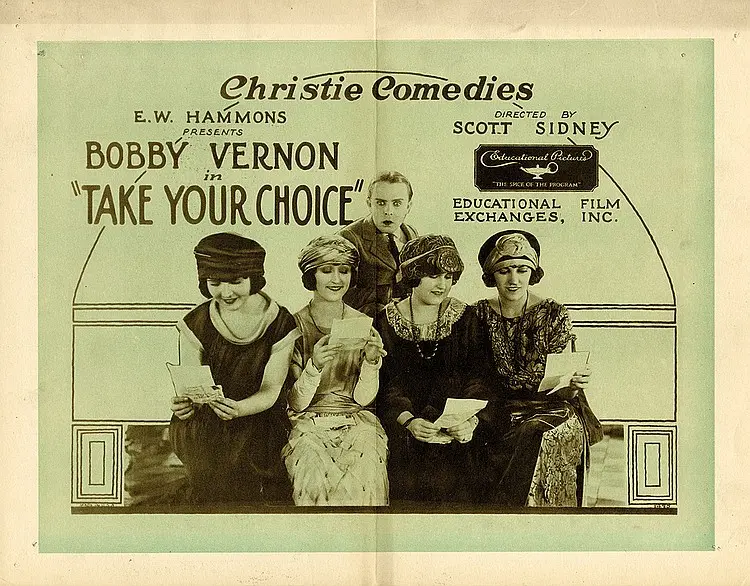
The silent era of cinema was an age of kinetic alchemy, where the base metal of physical exertion was transmuted into the gold of narrative comedy. In the 1920 Al Christie production, Take Your Choice, we witness a quintessential example of the 'boy-next-door' archetype, embodied by the energetic Bobby Vernon, being thrust into a maelstrom of social and legal peril. Unlike the stoic pathos of Keaton or the acrobatic optimism of Lloyd, Vernon’s screen presence in this film is defined by a frantic, almost desperate desire to maintain a veneer of dignity amidst escalating chaos. The premise—a man forced to roller-skate in a tuxedo due to a lost election bet—is more than a mere sight gag; it is a profound commentary on the performative nature of the American upper class during the post-WWI boom.
The opening act of Take Your Choice serves as a masterclass in the utilization of urban space as a comedic apparatus. When Dick (Vernon) takes to the streets on eight wheels, the film captures a burgeoning Los Angeles that is still negotiating the space between pedestrians and the internal combustion engine. The sequence where Dick hitches himself to the rear of a car—only to find it is a police vehicle—is a rhythmic triumph. The editing, supervised by the astute Frank Roland Conklin, creates a sense of mounting dread that mirrors the protagonist's own realization of his predicament. This is not merely slapstick; it is an exploration of the fragility of social status. One moment, Dick is a man of means; the next, he is a literal hitchhiker on the wheels of justice.
The courtroom scene that follows introduces a recurring theme in 1920s comedy: the fallibility of the judiciary. As Dick’s skates turn the halls of justice into a skating rink, the judge becomes a victim of unintended physical assault. This subversion of authority was a staple of the era, yet here it feels particularly pointed. The judge’s subsequent ultimatum—marry or face the crushing silence of solitary confinement—highlights the era’s societal obsession with domesticity as a form of social control. In a way, the film suggests that for a young man of Dick’s station, marriage is simply a different kind of prison, albeit one with better curtains.
The narrative pivot involving the five letters is where Take Your Choice transitions from a chase film into a farce of manners. Dick’s decision to mail five proposals is a symptom of a character who views women as interchangeable solutions to a legal problem. This cynical approach to romance is, of course, punished by the narrative gods. The butler, played with a delightful, misplaced sense of duty, acts as the agent of chaos. By mailing the remaining four letters, he effectively multiplies Dick’s problem by five, creating a matrimonial hydra that threatens to consume the protagonist's future. This plot device echoes the complications found in The Fresh Heir, where inheritance and obligation collide with disastrous results.
When the 'real' love interest arrives—the daughter of his father’s business partner—the film shifts gears into a more traditional romance, but the shadow of the five impending brides looms large. The arrival of the quartet of jilted, or rather, over-accepted women, provides the film’s most frantic moments. Each woman represents a different facet of the 1920s 'new woman,' yet they are all unified by a desire for the security Dick’s name provides. The dialogue intertitles, while sparse, are sharp and serve to emphasize the mercenary nature of the situation. It is a cynical take on the marriage market that feels surprisingly modern.
Technically, the film is a testament to the efficiency of the Christie Comedies studio. The lighting in the interior scenes, particularly the father’s study, utilizes high-contrast shadows that wouldn't look out of place in a more dramatic work like Im Zeichen der Schuld. This visual weight adds a layer of mock-seriousness to the proceedings. The camera work during the skating sequences is remarkably steady for the period, likely utilizing specialized rigs to follow Vernon as he glides through the streets. The sense of speed is palpable, and the danger of the stunts—performed largely by Vernon himself—adds an edge of authenticity that modern CGI-driven comedies lack.
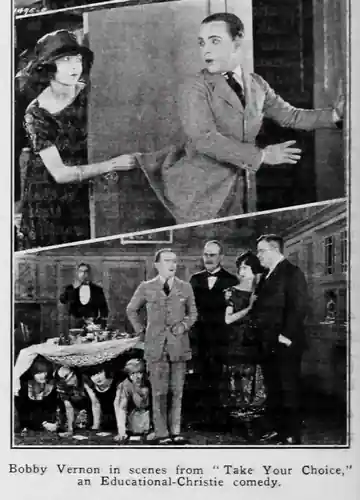
The cast is equally impressive. Natalie Joyce and Charlotte Stevens bring a vitality to their roles that prevents them from becoming mere caricatures in the matrimonial sweepstakes. Their performances require a specific type of silent-film modulation: they must be expressive enough to convey the 'fatal Yes' without descending into the histrionics of the Victorian stage. They navigate this balance with grace, providing a necessary foil to Vernon’s high-strung energy.
When comparing Take Your Choice to other contemporary works, such as Hands Up, one notices a distinct difference in the approach to the 'unlucky protagonist.' While many films of the era relied on external forces of nature or villainy, Take Your Choice derives its conflict from the protagonist’s own poor decisions and the rigid expectations of his class. Like the social anxieties explored in Poor Men's Wives, there is an undercurrent of economic pressure here. When Dick is cut off 'without a cent,' the immediate exit of his four 'fiancées' provides a biting critique of the transactional nature of high-society courtship.
Furthermore, the film’s resolution—relying on the butler’s confession—is a fascinating subversion of the 'hero’s journey.' Dick does not win the day through cleverness or growth; he is saved by the very domestic structure that nearly destroyed him. This reliance on the 'help' to fix the messes of the elite is a theme that recurs in many Christie productions, reflecting a subtle, perhaps unconscious, class consciousness. It lacks the moralizing weight of The Lash of Destiny, opting instead for a breezy reconciliation that prioritizes the status quo over radical character change.
The pacing of the film is relentless. From the initial bet to the final kiss, there is a sense of a clock ticking—a week to get married, a second to lose a fortune, a moment to find true love. This temporal pressure is what drives the comedy. In films like One Every Minute, we see a similar obsession with time and efficiency, but Take Your Choice anchors this in the physical world through the motif of the roller skates. The skates are a literalization of Dick’s inability to slow down and think; he is a man on a trajectory he cannot stop, much like the 1920s themselves, hurtling toward a future they weren't quite prepared for.
The film also handles the 'multi-bride' trope with more sophistication than one might expect. Rather than a simple repetition of the same joke, each arrival is staged with increasing complexity. The butler’s intervention, while appearing to be a simple plot convenience, actually serves to highlight the absurdity of the entire social contract. If a butler can propose for a man, what does the proposal actually mean? It is these underlying questions that elevate the film above standard slapstick fare, placing it in the company of more nuanced comedies like Tangled Hearts or The Ruling Passion.
Ultimately, Take Your Choice is a vibrant, chaotic, and deeply entertaining artifact of the silent era. It showcases Bobby Vernon at the height of his physical powers and demonstrates the creative potential of the short-feature format. While it may not possess the philosophical depth of a European masterwork like La madona de las rosas, it excels in its specific mission: to provide a breathless, laughing reflection of a society in motion. The film reminds us that comedy is often born from the friction between where we are and where we are expected to be—whether that’s in a courtroom, a marriage altar, or simply on a pair of roller skates in the middle of a busy street.
For the modern viewer, the joy of Take Your Choice lies in its lack of pretension. It is a film that understands the value of a well-timed fall and the narrative power of a misplaced letter. It is a testament to an era when cinema was learning to speak through movement, and in the hands of Bobby Vernon and the Christie team, it spoke with a clarity and wit that remains infectious over a century later. It is, quite simply, a choice worth taking.
IMDb 6.3
1932
Community
Log in to comment.