DbcultAccessing Vault...
Cult Review
Senior Film Conservator
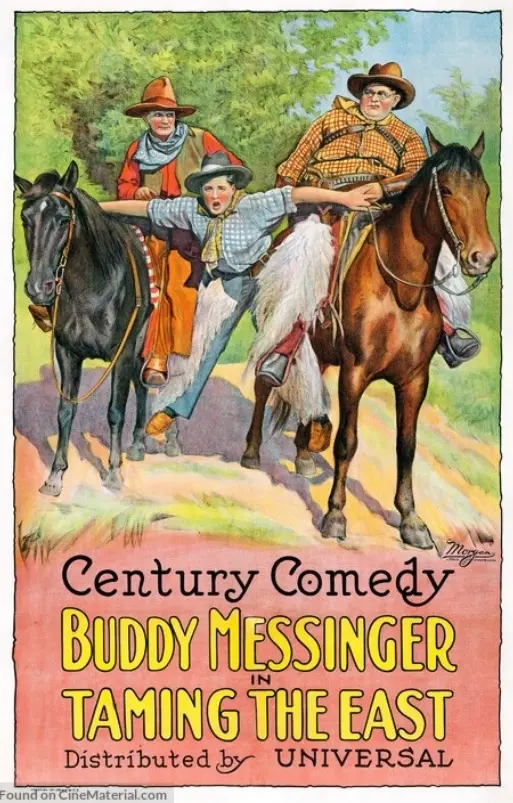
Is Taming the East a hidden gem or a dusty relic? Short answer: It is a fascinating archaeological find for comedy nerds, but a hard pass for anyone who needs a coherent, modern plot.
This film is for the silent cinema completionist who finds joy in the physical geometry of 1920s slapstick. It is absolutely not for the casual viewer who lacks the patience for the theatrical artifice of the pre-talkie era.
1) This film works because of the undeniable physical chemistry between Buddy Messinger and Hilliard Karr, whose 'fat and skinny' dynamic predates more famous duos with a raw, unpolished energy.
2) This film fails because it relies on cultural caricatures that have aged poorly, often substituting lazy tropes for genuine situational comedy.
3) You should watch it if you are researching the early career of Edward Ludwig or want to see the foundational building blocks of the Century Comedies brand.
In the world of silent shorts, the pairing of Buddy Messinger and Hilliard Karr was a reliable commodity. Messinger brings a boyish, almost frantic energy to the screen, while Karr provides the slow-moving, gravitational pull of the straight man. In Taming the East, this contrast is utilized to its fullest extent.
Take, for instance, the sequence in the marketplace. Messinger’s character attempts to utilize a series of Western 'labor-saving' gadgets that inevitably backfire. The humor isn't in the gadgets themselves, but in Karr’s silent, mounting frustration as he becomes the unintended target of every malfunction. It is a predictable rhythm, yet there is a certain comfort in its execution.
Unlike the more sophisticated narrative structures seen in The Spite Bride, Taming the East is content to exist as a series of loosely connected vignettes. It doesn't ask much of the audience, which is both its greatest strength and its most significant limitation. The film feels like a dress rehearsal for the more refined comedies that would follow in the mid-1920s.
Before Edward Ludwig became a name associated with more robust features, he was honing his craft in the trenches of silent shorts. Taming the East shows a director learning how to frame action for maximum clarity. Ludwig understands that in slapstick, the audience needs to see the setup, the anticipation, and the payoff in a single, uninterrupted flow.
There is a specific moment involving a runaway rickshaw that perfectly illustrates Ludwig’s emerging style. He uses a wide shot to establish the chaos of the street, then cuts to a tight close-up of Messinger’s panicked expression. This simple editorial choice heightens the comedy in a way that many of his contemporaries missed. It is far more effective than the static framing found in Back to the Woods.
However, the script is undeniably thin. Ludwig, acting as the writer here, seems more interested in the physical capabilities of his cast than in developing a story with stakes. While films like A Fool and His Money attempted to weave social commentary into their humor, Taming the East stays firmly in the realm of the superficial. It’s clunky. But it works for what it is.
If you are a fan of 1920s cinema, Taming the East is worth watching for its historical value and the energetic performances of its lead duo. It provides a clear window into the transition of silent comedy from pure vaudeville to more cinematic storytelling. However, if you are looking for a film with modern pacing or sensitive cultural depictions, you should skip it.
The cinematography in Taming the East is functional rather than expressive. The lighting is flat, designed to ensure that every facial contortion is visible to the audience in the back of the theater. This was standard for the time, but when compared to the atmospheric work in The Darkening Trail, it feels somewhat pedestrian.
The pacing is where the film truly struggles. At twenty minutes, it feels both too short to develop a plot and too long for the number of gags it contains. There are moments where the action drags, particularly during the transition scenes between the major set pieces. A tighter edit could have turned this into a classic; as it stands, it’s merely a curiosity.
One surprising observation is the use of depth in the marketplace scenes. Ludwig occasionally places background actors in positions that interact with the foreground gags. This creates a sense of a living world, even if that world is a Hollywood backlot version of 'The East.' It’s a small detail, but it shows a level of care that wasn't always present in these quick-turnaround shorts.
It is impossible to review Taming the East without addressing its title and premise. The concept of 'taming' an Eastern culture is rooted in the colonialist mindset of the early 20th century. The film views its setting through a lens of exoticism and 'otherness.' For a modern viewer, this can be a jarring experience.
However, if one looks past the problematic framing, the film actually mocks the Westerners more than the locals. Messinger and Karr are portrayed as buffoons whose arrogance is their downfall. In this sense, the film shares a bit of DNA with The Yankee Consul, where the 'American hero' is often the butt of the joke.
The film doesn't have a mean-spirited bone in its body, but it is undeniably ignorant. It’s a fascinating look at what passed for 'exotic comedy' in 1923, and it serves as a reminder of how far the medium has come in terms of global perspective. It is a time capsule, for better and for worse.
Pros:
Cons:
Taming the East is a minor work in the grand canon of silent film, but it is not without its charms. It captures a specific moment in cinematic history when the comedy short was the king of the box office. While it doesn't reach the heights of Rob Roy in terms of scale, or the narrative intrigue of Stolen Honor, it remains a valuable piece of the puzzle for those interested in the evolution of the genre.
Ultimately, the film is a testament to the power of the comedic duo. Messinger and Karr carry the weight of a thin script on their shoulders and manage to keep it afloat through sheer willpower and physical exertion. It is a flawed piece of entertainment, but its flaws are as educational as its successes. Watch it for the history, stay for the slapstick, but don't expect a masterpiece.
IMDb 7.1
1936
Community
Log in to comment.