DbcultAccessing Vault...
Cult Review
Senior Film Conservator
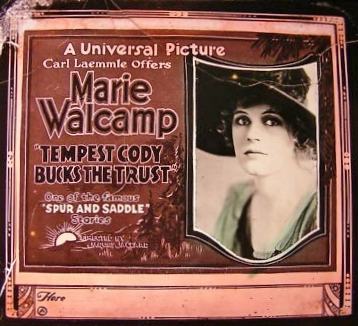
The year 1919 stood as a fractured mirror reflecting the exhaustion of a post-Great War world and the burgeoning ferocity of the American West as a cinematic mythos. Amidst this upheaval, Tempest Cody Bucks the Trust arrived not merely as a flick of celluloid but as a manifesto of kinetic female agency. Marie Walcamp, often overshadowed in contemporary discourse by the likes of Mary Pickford or Lillian Gish, offers a performance here that is radically different from the 'Little Pal' (Little Pal) archetype. While other stars were perfecting the art of the tremulous lip, Walcamp was perfecting the art of the gallop and the grit. This film, part of the legendary Tempest Cody series, serves as a quintessential example of the 'serial queen' era transitioning into more robust, self-contained narratives that tackled the burgeoning anxieties of the American public.
The antagonist of this piece isn't a singular mustache-twirling villain, but rather the 'Trust'—a monolithic entity representing the food profiteers who sought to capitalize on the hunger of a nation. This thematic choice resonates deeply with the zeitgeist of 1919, a year characterized by labor strikes and a palpable fear of corporate overreach. Unlike the domestic tensions explored in The Old Folks at Home, George Hively’s script for Tempest Cody Bucks the Trust takes the conflict into the industrial-agrarian sphere. The plot centers on the storage house, a symbol of communal wealth and survival, which the profiteers intend to destroy. This isn't just arson; it is an act of economic terrorism. The film posits that the true frontier struggle wasn't against the elements, but against the invisible hands of the market.
"Walcamp’s physicality is the film's primary engine. Every frame she occupies vibrates with a restless, almost feral energy that defies the static framing of early silent cinema."
To watch Walcamp is to witness the birth of the modern action hero. In Tempest Cody Bucks the Trust, she aligns herself with the forces of justice not out of a sense of Victorian morality, but out of a pragmatic necessity. Her chemistry with the supporting cast, including the stalwarts Bert Sprotte and Frank Braidwood, provides a grounded realism to the otherwise heightened stakes. While films like The Red Glove utilized mystery and intrigue, this entry in the Cody saga relies on the sheer velocity of its protagonist. The sequences involving the protection of the storage house are choreographed with a spatial awareness that was ahead of its time. Walcamp moves through the frame like a storm—hence the name—cutting through the machinations of John Lince and Madge Hunt’s characters with a decisive, unblinking focus.
The cinematography, though constrained by the orthochromatic stocks of the period, manages to capture the dust and the heat of the conflict with remarkable clarity. There is a tactile quality to the grain storage house—the wooden slats, the looming shadows of the machinery—that makes its potential destruction feel genuinely catastrophic. This isn't the stylized, almost theatrical world of Binnaz or the European sensibilities of Die beiden Gatten der Frau Ruth. This is American ruggedness at its most unvarnished. The editing by the Universal staff maintains a relentless pace, ensuring that the socio-political commentary never bogs down the visceral thrills. The 'Trust' is portrayed through shadows and secret meetings, contrasting sharply with the wide-open, sun-drenched spaces where Tempest operates.
When examining Tempest Cody Bucks the Trust alongside its contemporaries, its unique position becomes clear. It lacks the moralizing sentimentality of The Natural Law or the melodrama of Flor de durazno. Instead, it shares a certain DNA with The Trap, particularly in its depiction of the environment as a character in itself. However, where The Trap leans into the psychological, Tempest Cody leans into the structural. It is a film about systems—how they are built to exploit and how they can be sabotaged by a single, determined individual. Even the comedic undertones found in Meatless Days and Sleepless Nights are absent here, replaced by a grim, focused determination to see the 'Trust' dismantled.
The final act, involving the attempted incineration of the storage house, is a masterclass in silent suspense. The stakes are clearly articulated: if the grain burns, the town starves, and the profiteers win. Tempest’s intervention is not just a physical triumph but a symbolic one. As she douses the flames and rounds up the saboteurs, the film achieves a catharsis that is both personal and collective. It echoes the tension of The Death-Bell, but replaces the supernatural dread with a very real, very human heroism. The storage house remains standing, a monument to the resilience of the common man—and woman—against the encroaching tide of corporate greed.
Why does Tempest Cody Bucks the Trust matter today? In an age of algorithmic dominance and global supply chain anxieties, the film’s focus on 'food profiteers' feels eerily modern. It reminds us that the struggle for economic justice has always been a central pillar of the American narrative. Furthermore, Marie Walcamp deserves a seat at the table of early cinema's greats. Her ability to carry a film on her shoulders, performing her own stunts and projecting a fierce independence, paved the way for every action heroine who followed. While films like The Suburban or Dezata na Balkana explored different facets of the human condition, Tempest Cody focused on the most fundamental: the right to exist without being exploited by the powerful.
The film’s brevity is its strength. There is no wasted motion. George Hively’s writing is lean, stripping away the flowery intertitles of the era in favor of direct, punchy dialogue that propels the action forward. It lacks the experimentalism of Die Narbe am Knie, but it makes up for it with a populist clarity that is deeply satisfying. Even smaller, more domestic films like Baby or the slapstick of Feet and Defeat cannot match the sheer ideological weight of this Western short. It is a testament to the power of genre cinema to reflect and refract the most pressing issues of its time.
As the credits roll—or would have rolled in the theaters of 1919—one is left with a sense of immense respect for the craftsmanship on display. Tempest Cody Bucks the Trust is a lean, mean, and intellectually sharp piece of filmmaking. It captures a moment when cinema was discovering its power to not just entertain, but to advocate. The image of Marie Walcamp, silhouetted against the frontier, remains an indelible icon of resistance. It is a film that demands to be seen not just as a historical curiosity, but as a vibrant, living piece of art that still has much to say about the world we inhabit. In the pantheon of silent Westerns, it stands tall, much like the storage house it so valiantly protects.
© 1919 Film Archive & Review Collective - Exploring the depths of silent cinema with rigor and passion.
IMDb 5.2
1931
Community
Log in to comment.