DbcultAccessing Vault...
5.8/10
Senior Film Conservator
A definitive 5.8/10 rating for a film that redefined the boundaries of cult cinema. Thais remains a cornerstone of transgressive art.
Stepping back into the cinematic landscape of 1917, one encounters Thais, a film that, even a century later, continues to resonate with a peculiar, almost haunting allure. Adapted from Anatole France's celebrated novel, this silent era production is far more than a mere historical curiosity; it's a grand, ambitious undertaking that grapples with profound philosophical and spiritual questions through the nascent art of moving pictures. The very act of watching it today is akin to sifting through an ancient scroll, discovering not just a story, but a reflection of an era's moral anxieties and artistic aspirations. It's a testament to the raw power of early cinema, where elaborate sets, nuanced pantomime, and the sheer charisma of its stars had to carry the entire weight of narrative and emotion.
The narrative, a sweeping saga of spiritual conflict and carnal temptation, centers on Paphnutius, a wealthy Alexandrian at the cusp of a profound spiritual transformation. He’s poised to embrace the nascent, radical tenets of Christianity, a faith burgeoning in the heart of a pagan empire. Yet, his path to asceticism is cunningly diverted by a friend, who, perhaps with a touch of cynical amusement, suggests one last indulgence: a visit to Thais, the city's most legendary courtesan. Thais is not merely a woman; she is an institution, a living embodiment of Alexandria’s decadent splendor and unbridled hedonism. Her allure is legendary, her presence magnetic, and Paphnutius, despite his burgeoning spiritual resolve, is drawn into her orbit like a moth to a dangerously beautiful flame.

What unfolds is a masterclass in early cinematic character study. Paphnutius's initial fascination with Thais rapidly escalates into a passionate, consuming love. This isn't a simple infatuation; it's a profound internal earthquake, challenging every fiber of his newfound faith. The film masterfully portrays this internal struggle through the actor's expressions and gestures, a silent ballet of conflicting desires. The love, however, is not without its earthly consequences. A rival for Thais's affections emerges, leading to a violent confrontation that forces Paphnutius to commit a terrible act. This act of murder, a stark antithesis to the Christian principles he sought to embrace, shatters his brief period of worldly abandon and violently thrusts him back towards the spiritual path. The weight of his conscience becomes unbearable, driving him to seek solace and redemption in the most extreme form: he becomes a monk, retreating to the austere solitude of the cloister.
Yet, the narrative, much like the human heart it explores, refuses to settle into easy answers. Paphnutius’s monastic life, intended as a balm for his tormented soul, is not a final escape. The memory of Thais, the woman he both desired and condemned, continues to haunt him. Her image, her laughter, her very essence, becomes an inescapable presence in his supposedly sacred solitude. This psychological torment is brilliantly conveyed, often with simple yet effective visual metaphors typical of the era, where a lingering shot or a specific facial expression could speak volumes. He realizes that his own peace of mind is inextricably linked to her fate, and his spiritual journey cannot be complete without addressing hers. This realization propels him from the cloister, back into the bustling, sinful heart of Alexandria, not as a lover, but as a zealous evangelist. His new mission: to convert Thais, to save her soul from damnation, and in doing so, perhaps, find his own salvation.
The success of his mission is both triumphant and tragically ironic. Thais, swayed by Paphnutius's fervent devotion and perhaps by her own burgeoning spiritual yearning, indeed embraces Christianity and joins a nunnery, trading her lavish life for one of piety and penance. Her transformation is presented as a profound victory, a soul snatched from the jaws of perdition. However, the film's true genius lies in its refusal to offer a simplistic happy ending. While Paphnutius saves Thais's soul, he irrevocably loses his own peace of mind. The very act of converting her, of confronting his past desires and the woman who embodied them, leaves him scarred. His spiritual victory is a personal defeat, a perpetual torment born from the unresolved conflict between sacred devotion and profane love. This nuanced, bittersweet conclusion elevates Thais beyond a mere morality tale, transforming it into a profound exploration of human complexity, faith, and the enduring power of desire.
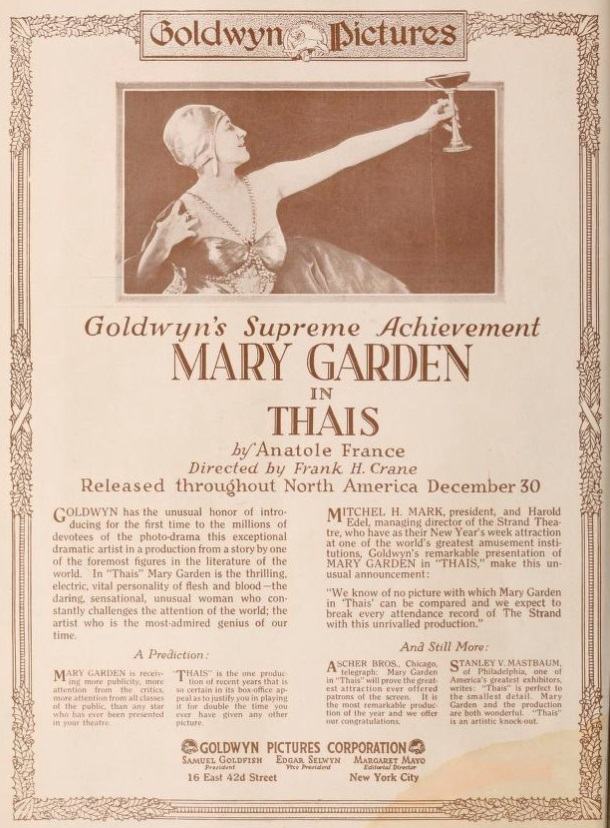
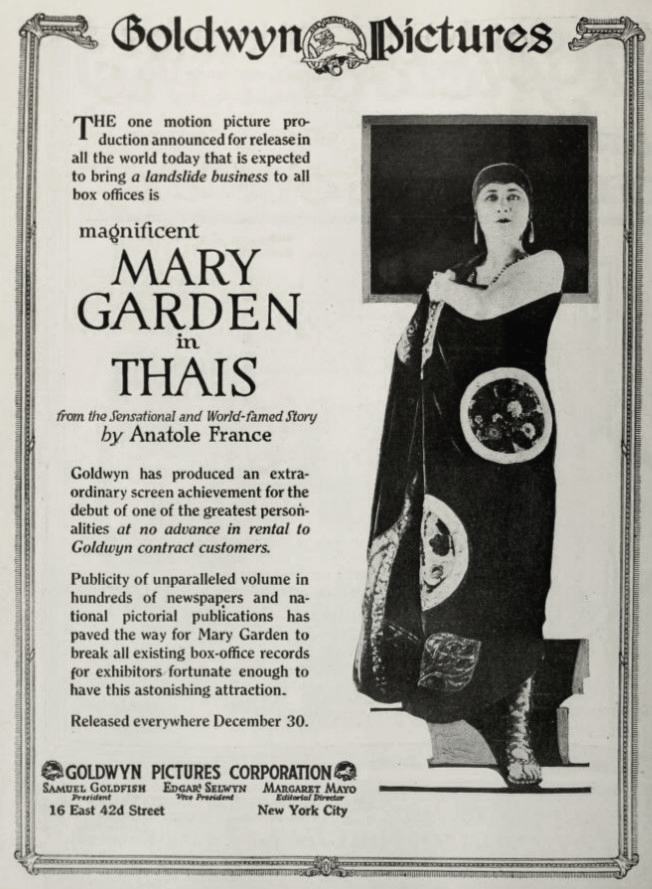
At the heart of this cinematic endeavor is the legendary opera singer Mary Garden, who takes on the titular role. Garden’s performance is nothing short of mesmerizing, a tour de force that transcends the limitations of silent film acting. Her stage background is evident in her expressive physicality and command of gesture, but she also possesses an innate understanding of the camera, delivering intimate moments of vulnerability and raw emotion that captivate the viewer. Her portrayal of Thais is not one-dimensional; she imbues the courtesan with a depth and humanity that makes her conversion feel earned, rather than merely plot-driven. She embodies the allure and the eventual spiritual awakening with equal conviction, making Thais a character who is both captivatingly sensual and profoundly spiritual. It’s a performance that stands shoulder-to-shoulder with other iconic silent era portrayals of strong, complex women, demonstrating that even without spoken dialogue, a performer of Garden's caliber could convey an entire universe of feeling.

The supporting cast, including Alice Chapin, Margaret Townsend, Constance Carper, Lionel Adams, Hamilton Revelle, Crauford Kent, and Charles Trowbridge, contribute significantly to the film’s rich tapestry. While their roles are primarily to support the central drama between Paphnutius and Thais, they each add layers to the vibrant world of Alexandria. Their performances, often characterized by the broad, theatrical gestures common in early silent cinema, nonetheless convey their characters' motivations and emotions with clarity. The sheer scale of the production, with its elaborate historical settings and costumes, suggests a significant investment for its time, aiming for an immersive experience that transported audiences to a bygone era.
The adaptation by Edfrid A. Bingham from Anatole France’s original work is particularly noteworthy. France’s novel is rich with philosophical musings and psychological depth, and translating that into a visual medium without spoken words is a formidable challenge. Bingham’s screenplay manages to distill the essence of the novel’s central conflict – the eternal struggle between flesh and spirit, between earthly pleasure and divine salvation – into a compelling visual narrative. While certain nuances of France's prose inevitably vanish in translation to the screen, the core themes remain powerfully intact, a testament to Bingham’s skill in cinematic storytelling. The film, in its own silent way, probes the hypocrisy often inherent in extreme piety and the complex, often contradictory nature of human desire.
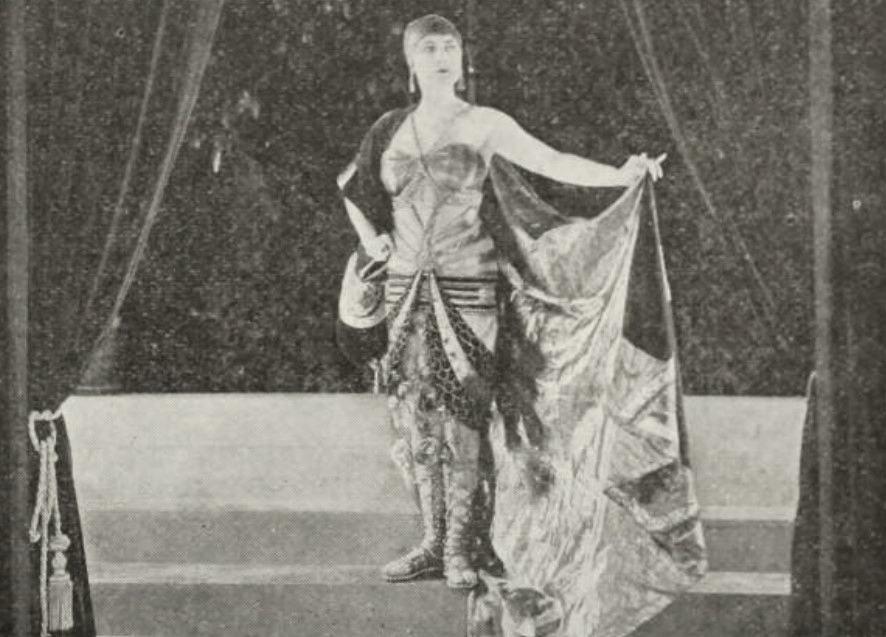
The direction of Thais, while not credited in the information provided, nonetheless showcases a keen understanding of visual storytelling for the era. The use of intertitles is judicious, allowing the visual narrative to carry much of the weight. The cinematography, though basic by today's standards, effectively captures the grandeur of Alexandria and the starkness of the monastic life. The compositions are often theatrical, reflecting the stage origins of many early filmmakers and actors, but there are moments of striking visual poetry that hint at the expressive potential of cinema yet to be fully explored. The film's pacing, while deliberate, allows ample time for the emotional arcs of Paphnutius and Thais to unfold, drawing the viewer into their agonizing spiritual journeys.
Comparing Thais to other films of its period helps contextualize its significance. While many films like The Infant at Snakeville or Lille Teddy focused on comedic shorts or simpler dramas, Thais aimed for a higher artistic and intellectual plane. It stands alongside more ambitious silent dramas like The Lash of Destiny or According to Law in its exploration of moral quandaries and societal pressures, but perhaps with a grander, more operatic sweep. The themes of spiritual struggle and redemption were not uncommon in early cinema, as evidenced by films such as Sweet Alyssum, which often explored melodramatic moral dilemmas. However, Thais distinguishes itself through its literary pedigree and the sheer star power of Mary Garden, bringing a gravitas and artistic ambition that elevated it above many of its contemporaries. It delves into the loss of innocence and the search for meaning in a way that resonates with the more profound explorations found in films like A Girl's Folly, but with a distinctly spiritual rather than purely social lens.

The film’s lasting legacy is not just its historical value as an early feature film, but its enduring thematic relevance. The tension between asceticism and hedonism, the pursuit of spiritual purity versus the undeniable pull of earthly desires, is a timeless human struggle. Thais, through its silent yet powerful imagery, forces us to confront these uncomfortable truths. It challenges the viewer to question the true nature of salvation, suggesting that sometimes, in the very act of seeking to save another, one can become irrevocably lost themselves. Paphnutius's tragic peace of mind, or rather, his profound lack thereof, is a poignant commentary on the complexities of faith and human connection. It reminds us that spiritual journeys are rarely linear or easy, and often lead to unforeseen emotional landscapes.
In an era where cinema was still finding its voice, Thais dared to tackle weighty subjects with artistic ambition. It’s a testament to the vision of its creators and the magnetic performance of Mary Garden that it remains a compelling watch for enthusiasts of classic cinema and anyone interested in the evolution of storytelling on screen. It’s a film that asks more questions than it answers, leaving a lingering impression of the profound and often contradictory nature of the human spirit. The enduring power of Thais lies precisely in this ambiguity, in its refusal to offer pat resolutions, mirroring the messy, often unresolved conflicts that define our own lives. It's a journey into the soul of early cinema, and indeed, into the soul of humanity itself.

IMDb —
1918
Community
Log in to comment.