DbcultAccessing Vault...
Cult Review
Senior Film Conservator
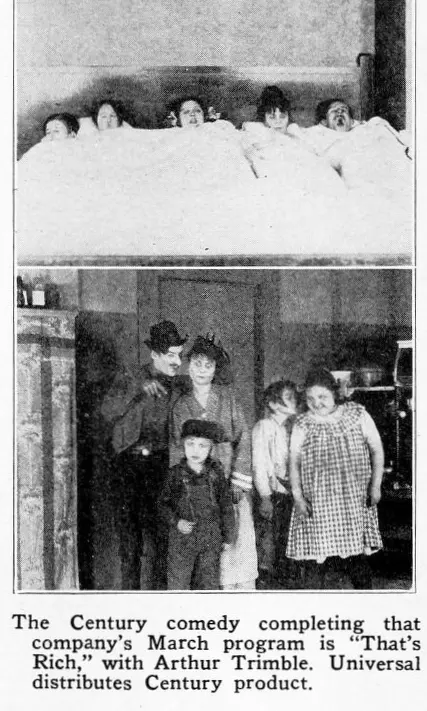
In the cinematic landscape of 1927, That’s Rich stands as a fascinating, albeit brief, exploration of the transactional nature of human empathy. Directed through the sharp narrative lens of Jack Wagner and Noel M. Smith, the film introduces us to Arthur (Arthur Trimble), a boy whose childhood is not defined by play, but by the rhythmic clanking of wrenches and the oppressive weight of fosterage. Unlike the more romanticized versions of orphanhood found in The Princess of Patches, Arthur’s reality is grounded in the grit of a garage. The garage here functions as more than just a set; it is a purgatory of grease and gears where the boy’s value is measured solely by his output. The foster father, a character whose moral compass is dictated entirely by his ledger, represents a stark departure from the spiritual redemptions seen in The Little Church Around the Corner.
Trimble’s performance is a masterclass in silent-era physical storytelling. His face, often smudged with oil, conveys a weary resignation that predates the more modern tropes of the 'troubled youth.' There is a tactile quality to the cinematography that emphasizes the grime of the garage, contrasting sharply with the domestic interiors where the McKenzie sisters, Ella and Ida Mae, navigate their own roles within this dysfunctional family unit. The film cleverly uses the industrial setting to underscore the dehumanization of the foster child, a theme that resonates even more strongly when compared to the domestic order explored in His House in Order.
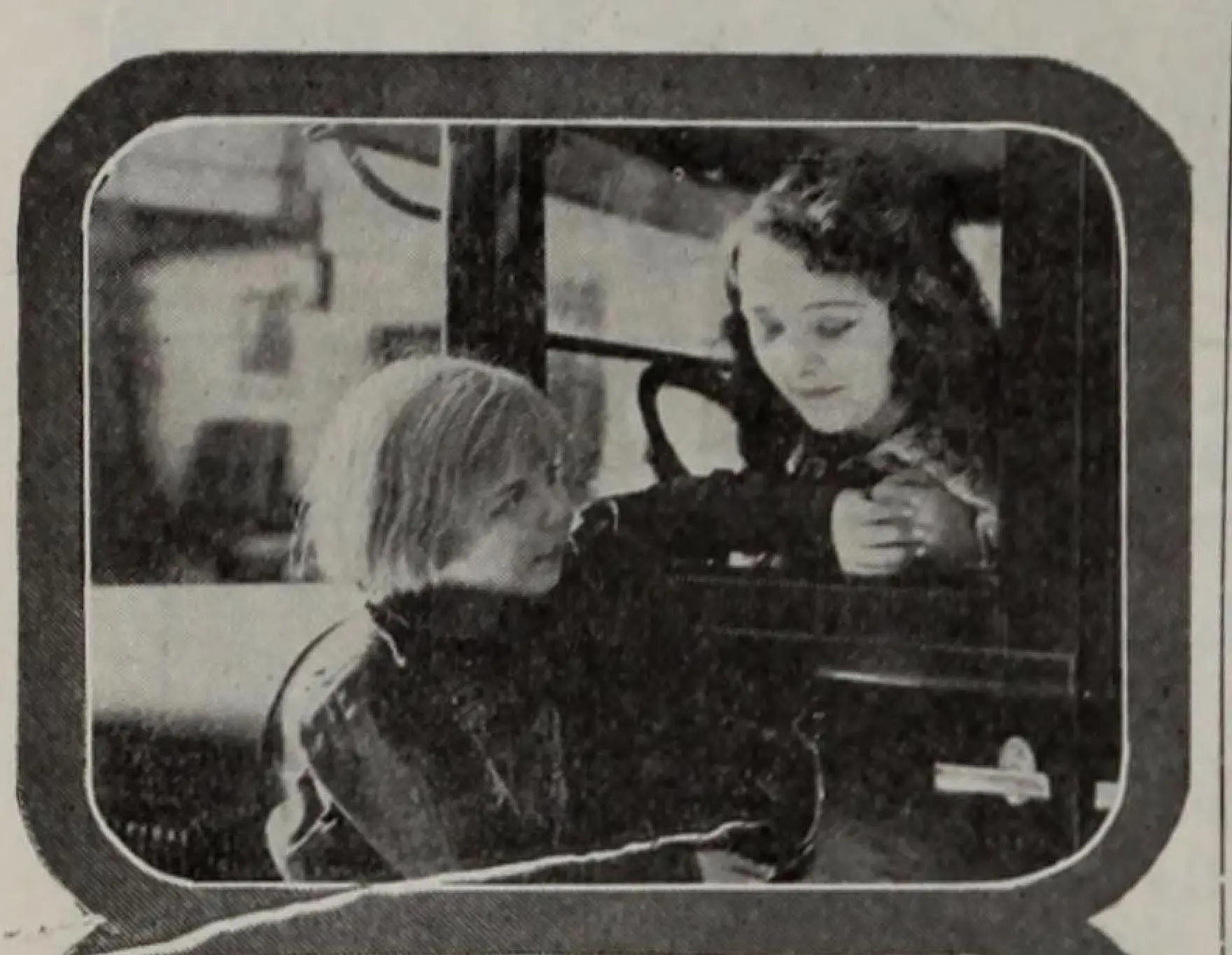
The narrative pivot occurs with the arrival of a stranger—a herald of fortune who claims Arthur is the heir to a million dollars. This moment is the catalyst for a tonal shift that is both comedic and deeply unsettling. The foster father’s immediate pivot from abuser to sycophant is played for laughs, yet it carries a venomous critique of class mobility. We see a mirror of the social deceptions found in Trompe-la-Mort, where identity and worth are fluid concepts dictated by the perception of wealth. In That’s Rich, the sudden influx of luxury is depicted through a series of vignettes: Arthur being fed, Arthur being cleaned, Arthur being treated as a sovereign rather than a servant.
"The film posits that kindness is a luxury good, affordable only when the recipient is perceived to have the power to reciprocate in kind."
The absurdity of this transition is heightened by the presence of the McKenzie sisters. Their interactions with Arthur change from casual indifference to performative affection. This shift highlights the performative nature of social status, a theme that echoes through contemporary works like Miss Peasant. The writers, Wagner and Smith, use this temporary 'golden age' for Arthur to expose the inherent hypocrisy of the adults around him. It is a world where the 'overall hero' (as seen in An Overall Hero) is only heroic if he is backed by a bank account.
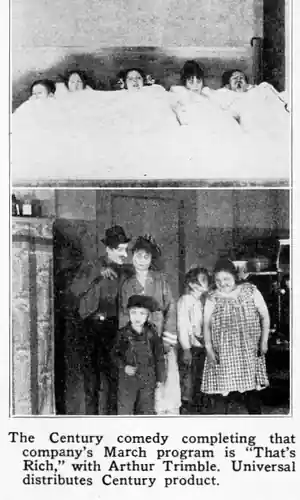
The resolution of the film is where its true brilliance lies. The discovery that the 'messenger of wealth' is an escaped inmate from a mental asylum is a crushing blow to the characters, but a narrative triumph for the audience. This twist serves as a brutal awakening, stripping away the veneer of the American Dream that was briefly dangled before Arthur. The 'madman' is the only character who offers Arthur a way out, even if that way is built on a delusion. This creates a haunting parallel with The Door Between, where the boundary between perception and reality is precariously thin.
When the truth is revealed, the foster father’s reversion to his abusive state is instantaneous. The cruelty is not just in the loss of the money, but in the withdrawal of the humanity that was briefly afforded to Arthur. This cycle of hope and despair is handled with a deftness that avoids the saccharine pitfalls of many silent shorts. It lacks the grandiosity of the National Red Cross Pageant, opting instead for a localized, intimate tragedy. The garage, once again, becomes Arthur’s world, but it is now haunted by the memory of what could have been. The film’s conclusion is a sobering reminder of the structural barriers facing the youth of the era, themes also touched upon in Youthful Cheaters and Wanted: A Baby.
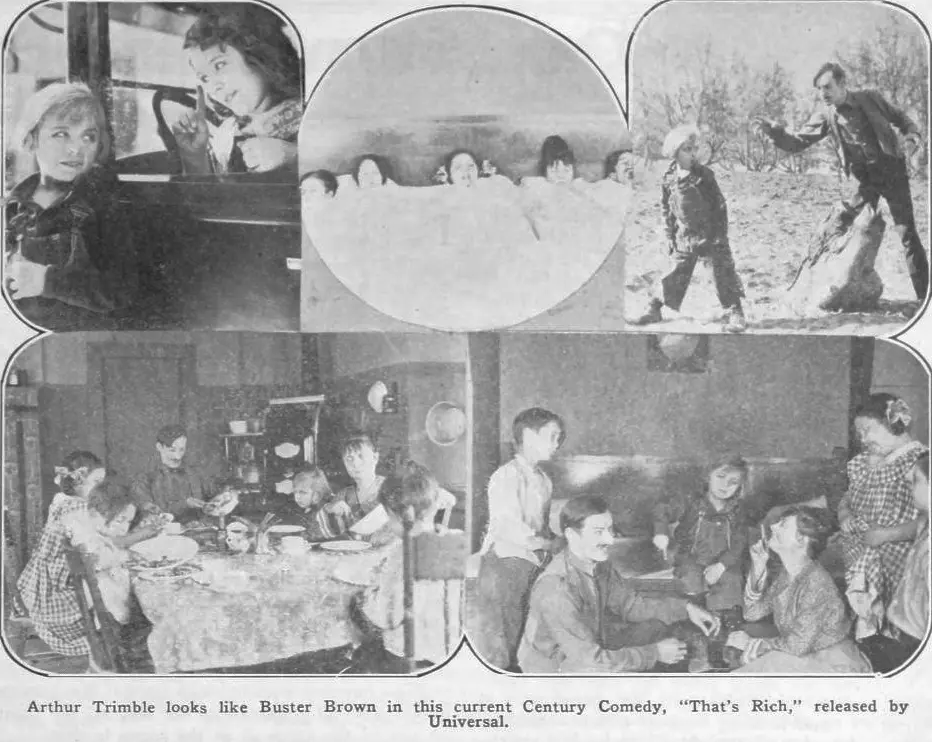
From a technical standpoint, That’s Rich utilizes the limited space of the garage and the domestic interior to create a sense of claustrophobia. The lighting is often harsh, reflecting the unforgiving nature of Arthur’s environment. While it may not have the exotic flair of A Prisoner in the Harem or the pastoral beauty of Miyama no otome, its aesthetic is one of functional realism. The editing by Smith ensures that the comedic beats land with precision, particularly during the transition scenes where Arthur is being 'upgraded' to his wealthy persona.
The film also serves as a fascinating companion piece to Taxi Please and Playmates, which similarly explore the intersections of childhood, labor, and social expectation. However, That’s Rich is darker in its implications. It suggests that the 'Nabab' figure (as explored in Le nabab) is often a fiction, a ghost that haunts the working class, promising a salvation that never truly arrives. The McKenzie sisters provide a necessary foil to Arthur’s isolation, their presence reminding the viewer of the social hierarchies even among the young. Their performances, while supporting, add a layer of domestic complexity that enriches the central conflict.
In the final analysis, That’s Rich is a vital artifact of 1920s cinema. It captures a moment in time when the medium was beginning to grapple with the complexities of the modern industrial age and the widening gap between the haves and the have-nots. Arthur Trimble’s portrayal of the resilient foster child remains one of the more understated yet powerful performances of the decade. The film’s refusal to provide a happy, 'rags-to-riches' ending is a bold choice that elevates it above its more conventional peers. It is a work that demands to be seen not just as a comedy, but as a sociological study of greed and the fragility of the human condition.
As we look back on the filmography of Wagner and Smith, That’s Rich stands out for its economy of storytelling and its unflinching gaze at the darker side of human nature. It reminds us that wealth is not just about the accumulation of capital, but about the power to define one’s own humanity. Without it, Arthur is just another cog in the machine, a boy in a garage waiting for a miracle that was never meant to be. This film is a testament to the power of silent cinema to communicate profound truths through the simplest of setups, making it a timeless piece of art that continues to resonate with anyone who has ever felt the sting of social invisibility.

IMDb —
1923
Community
Log in to comment.