DbcultAccessing Vault...
7/10
Senior Film Conservator
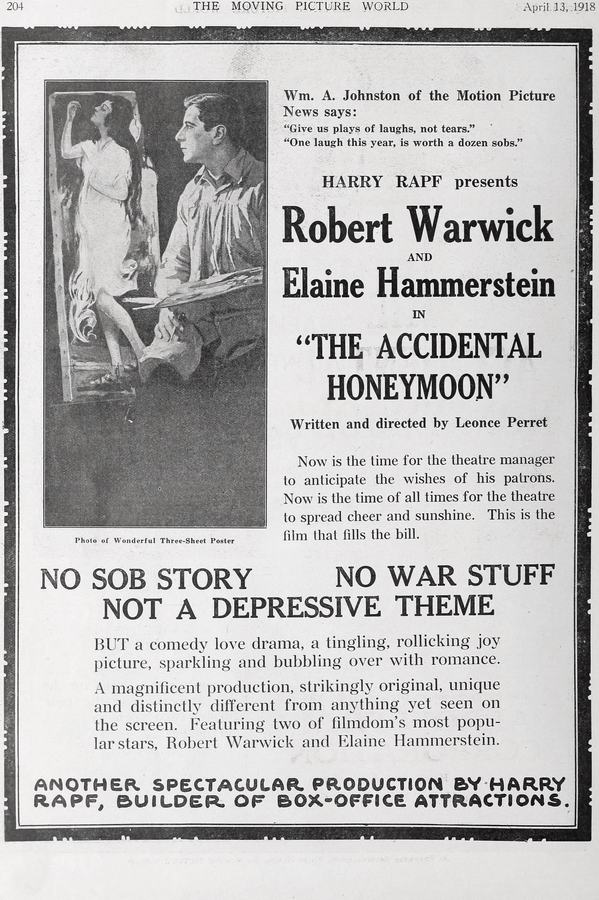
A definitive 7/10 rating for a film that redefined the boundaries of cult cinema. The Accidental Honeymoon remains a cornerstone of transgressive art.
Léonce Perret’s 1923 one-reel whirlwind, long buried in a Parisian archive, surfaces like a champagne bottle uncorked after a century: effervescent, volatile, faintly dangerous. At a breathless twenty-four minutes, The Accidental Honeymoon distills the entire spectrum of Jazz-Age anxieties—patriarchal property rights, female bodily autonomy, the artist’s precarious masculinity—into a single moonlit roadside farce.
Kitty, played with proto-screwball verve by Elaine Hammerstein, is introduced in media fugit: a silk-stockinged silhouette vaulting a garden trellis, her engagement ring flung into a koi pond that glints like black mercury. The camera—mobile, curious, almost flirtatious—follows the ripples outward, as though the very film stock recoils from matrimonial bondage. Compare this elan to The Single Code where the heroine’s rebellion is punished by narrative crucifixion; Perret refuses such moral sadism.
Enter Robert Warwick’s Robert, a watercolorist whose smock still bears the cadmium bruises of rejection. Warwick, better known for swashbucklers, here weaponizes his profile—half John Barrymore magnetism, half Harold Lloyd pathos—against the grinding wheels of an oncoming train. The suicide tableau is staged in chiaroscuro: the locomotive’s eye a single sodium orb, the rails converging like destiny’s own perspective lines. Yet the instant Kitty’s headlamps graze his supine form, Perret cuts to a close-up of Warwick’s eyes snapping open—not fear, but recognition. It is the look of a man who realizes that despair, like paint, can be scraped off and repainted.
The farmhouse bedroom sequence is the film’s nervy centerpiece. Perret, ever the Gallic voyeur, wedges the camera at the foot of the four-poster so that the two-shot becomes a diorama of prudish hysteria: a crocheted quilt pulled to separate bodies, the gas-lamp flickering Morse code across their faces. Hammerstein peels off her stockings with the languid defiance of a woman who knows the audience is complicit in her scandal; Warwick sketches her in smudged charcoal, each line a surrogate caress. The tension is less erotic than epistemological—what does it mean to be witnessed?
Note the symmetry: both protagonists flee being framed—she by marital contract, he by cuckoldry’s canvas. Only when mistaken as spouses do they finally occupy the same frame literally and figuratively.
Frank Norcross, as the hayseed patriarch, barges in with the subtlety of a barn door in a windstorm. His performance is calibrated to the exaggerated pantomime required for silent rural comedy—eyebrows semaphore, moustache curls semaphore—but beneath the mugging lurks the era’s land-owning terror of bloodline contamination. When he brandishes a copy of The Farmers’ Almanac like a warrant for shotgun nuptials, the film tips into Brechtian absurdity.
Perret’s montage rhythms deserve scholarly exegesis. He cross-cuts between the local justice fumbling for his spectacles and Kitty lacing her boots—each lace pulled taut becomes the ticking of a juridical clock. A whip-pan segues from the preacher’s “Do you?” to the locomotive’s whistle, implying that marriage and death remain the twin pistons driving American myth. Compare this kinetic syntax to the stolid continuity of Beating Back, where every shot lands like a Sunday sermon.
Yet for all its freneticism, the film’s emotional fulcrum is a static tableau: Robert’s watercolor of Kitty asleep, hair fanned across the pillow like spilled ink. When her father snatches the sheet, the paper tears in half—an act of cultural vandalism that literalizes the patriarchal mutilation of female self-expression. Hammerstein’s reaction is not horror but incredulous laughter, a sonic rupture even in silence, her shoulders shaking as though she recognizes the absurd redundancy of men policing paper fantasies.
Technically, the 4K restoration by Cinémathèque française revels in the grain’s tactility: the farmer’s denims weave like burlap, the wheat fields shimmer in sulfurous yellows that anticipate Vigo’s L’Atalante. A sepia-tinted prologue—added for European distribution—feeds us intertitles in rhyming couplets, Perret’s wink at Molière. The English intertitles, newly translated, favor colloquial snap: “Gas on empty, heart on fire—story of my life.”
Performances scale the octave from slapstick to elegy without sliding into the sentimental glissando that sinks so many silents. Hammerstein, unjustly eclipsed by Pickford and Talmadge, possesses a modern velocity—her eyes seem to buffer irony faster than the projector’s shutter. Warwick, meanwhile, modulates from Keaton-stoic to Valentino-smolder in a single eyebrow lift.
Scholars may trace the DNA of this conceit through The Love Brokers and The Tides of Fate, yet neither attains the compressed combustion of Accidental Honeymoon. Its brevity is its bravado—like a Toulouse-Lautrec lithograph, it distills the cancan’s swirl into a few decisive strokes.
Feminist readings will feast on the final reversal: Kitty, cornered at the altar, produces Robert’s sketchbook and turns the pages toward the congregation—each drawing a breadcrumb trail of intimacy that retroactively marries them in the eyes of the town. The law, flummoxed by artistry, sanctions what was mere masquerade. Call it patriarchal loophole hijacked by proto-Wollstonecraft craft.
Critics carping about “thin characterization” miss the point: this is cinema as fugue, theme tossed between two voices until identity itself becomes porous. When Kitty’s father finally lowers the shotgun, defeated not by argument but by spectacle, the film suggests that narrative—like paint—can be rewet and revised. A radical credo for 1923, and no less radical today.
Availability: streaming on Criterion Channel’s “Silent Spring Fling” carousel, accompanied by a jaunty electro-chamber score by Pauline Oliveros disciples. Avoid the YouTube bootleg with its ham-fisted ukulele; the dissonance will make you root for the train.
Verdict: a moonlit shot of absinthe—brief, hallucinatory, likely to leave you dizzy with possibilities.
IMDb —
1935
Community
Log in to comment.