DbcultAccessing Vault...
Cult Review
Senior Film Conservator
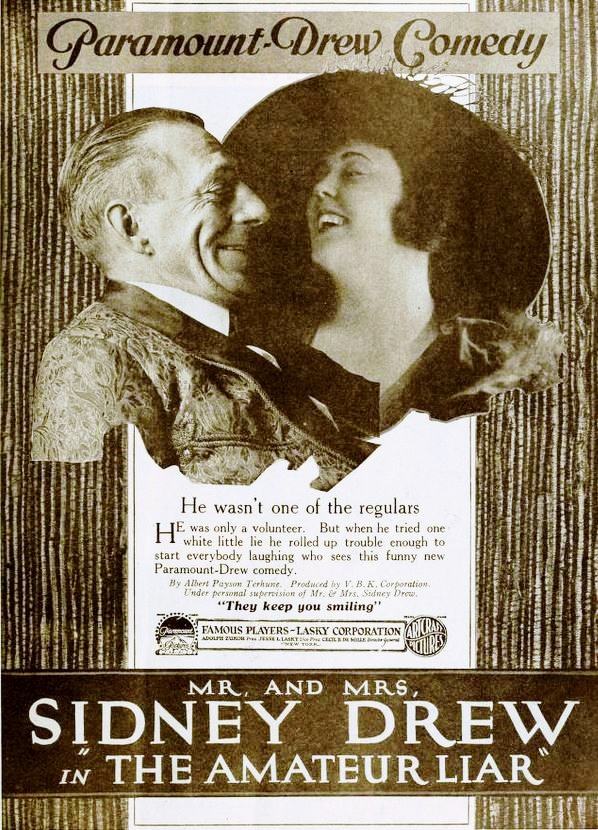
The year 1919 represented a pivotal nexus for American cinema, a period where the primitive energy of early nickelodeons began to coalesce into the more refined, narrative-driven structures of the silent feature era. At the heart of this transformation stood Sidney Drew and Lucile McVey (Mrs. Sidney Drew), a duo whose contribution to the 'polite comedy' genre remains unparalleled. The Amateur Liar serves as a quintessential specimen of this approach, eschewing the broad, percussive humor of their contemporaries for a nuanced exploration of middle-class anxieties. Unlike the kinetic violence of slapstick, the friction here is purely cerebral, born from the precarious equilibrium of a domesticity built upon social performance.
The narrative engine of The Amateur Liar is fueled by the snowball effect of a singular moral lapse. Henry, portrayed with Sidney Drew's signature understated exasperation, finds himself trapped in a cycle of obfuscation. This is not the calculated criminality one might find in a contemporary melodrama like De Luxe Annie, but rather a pathetic, deeply human struggle to maintain the status quo. Henry’s lies are not predatory; they are defensive, a series of panicked improvisations that highlight the absurdity of social expectations. The film functions as a proto-sitcom, yet it possesses a psychological depth that anticipates the darker thematic undercurrents of later cinematic eras.
As the web of falsehoods tightens, the audience witnesses a fascinating disintegration of the protagonist's agency. Every attempt to liberate himself from the initial lie only serves to bind him tighter. This thematic obsession with the inescapable nature of one's choices draws a striking contrast to the more fatalistic narratives of the time, such as A Fallen Idol. Where the latter treats moral failure as a grand tragedy, the Drews treat it as a series of inconvenient, increasingly hilarious logistical hurdles.
The collaboration between Sidney and Mrs. Sidney Drew was a rare egalitarian partnership in the early film industry. Not only did they co-star, but they also shared writing and directing duties, often alongside Tom Bret. This synergy is evident in the film’s sophisticated pacing and its reliance on subtle facial expressions over exaggerated pantomime. While films like Shannon of the Sixth relied on external conflict and spectacle, The Amateur Liar finds its drama in the micro-expressions of a man realizing he has just mentioned a person who doesn't exist to a person who knows everyone.
The visual language of the film, while static by modern standards, utilizes the space of the American home to create a sense of mounting claustrophobia. The framing is deliberate, often trapping Henry in the center of the shot as his wife Polly—played with a keen, observant intelligence by Mrs. Sidney Drew—hovers at the periphery, her very presence a silent demand for the truth he can no longer provide. This domestic battleground is far removed from the rugged landscapes of The Girl from Outback, yet the stakes feel equally high because they involve the total annihilation of a man's dignity.
To understand the specific charm of The Amateur Liar, one must look at how it navigates the gender roles of 1919. In many films of this period, such as The Unchastened Woman, female characters are often cast as either the moral compass or the seductive ruin. Polly, however, is neither. She is a pragmatic partner whose intelligence is the very thing Henry fears. His lies are an admission of her superiority; he lies because he knows he cannot outmaneuver her in a fair debate. This dynamic is a precursor to the sophisticated marital comedies like Lord and Lady Algy, where the humor is derived from the parity between husband and wife.
Furthermore, the film’s exploration of financial and social pressure mirrors the themes found in The Day She Paid. While the latter approaches the concept of debt with a heavy hand, the Drews suggest that our greatest debts are the ones we owe to our own integrity. Henry’s "amateur" status as a liar is crucial—he lacks the sociopathic grace of a professional con artist, making his failures relatable to anyone who has ever told a white lie to avoid a tedious dinner party.
In an era where cinema frequently detoured into the exotic or the supernatural—think of the haunting imagery in Voodoo Vengeance or the adventurous spirit of Diane of the Green Van—the Drews remained steadfastly committed to the mundane. There are no green vans or voodoo dolls here; the only curse is Henry’s own tongue. This commitment to realism, albeit a heightened, comedic realism, gives the film a timeless quality. The specific lies might date back to the Wilson administration, but the impulse to protect one's ego through fabrication is universal.
The film also avoids the heavy-handed moralizing often found in international cinema of the time, such as the tragic overtones of La España trágica o Tierra de sangre or the stark sisterly conflicts in Søstrene Morelli. Instead, it maintains a lightness of touch that belies its insightful critique of social mores. Even when Henry is at his most desperate, the film never loses its sense of playfulness. It is an innocent adventuress of the domestic sort, much like the protagonist in An Innocent Adventuress, navigating a world where the greatest dangers are social gaffes and hurt feelings.
Technically, The Amateur Liar is a masterclass in the use of intertitles to enhance rather than replace visual storytelling. The dialogue cards are snappy and reflect the sophisticated wit of the Drews’ stage background. The cinematography, though largely static, employs a depth of field that allows for simultaneous action in the foreground and background—a technique that would later be perfected by masters of the form. This allows the audience to see Polly’s reactions to Henry’s lies in real-time, heightening the comedic irony.
Sidney Drew’s performance is a study in controlled panic. His eyes dart with a frantic energy that contrasts with his stiff, formal posture. It is a physical embodiment of the "amateur" liar—someone who is not quite comfortable in their own skin when it is draped in falsehood. This is a far cry from the more rugged, traditional masculine roles seen in The Man Who Came Back. Henry doesn't need to return from a far-off land to find himself; he needs to find his way back to the truth in his own living room.
The title itself is a stroke of genius. By labeling Henry an 'Amateur,' the film immediately establishes a rapport with the audience. We are all amateurs in the face of the complex social requirements of modern life. Unlike the characters in The Purple Dress, who are defined by their aspirations and outward appearances, Henry is defined by his internal failure to reconcile his desires with his reality. He wants The World to Live In to be simple, yet he is the one complicating it.
The resolution of the film, while satisfying the comedic requirements of the era, leaves a lingering question about the sustainability of the domestic contract. Once the web is unraveled, can things ever truly return to the way they were? The Drews don't provide a saccharine answer, instead opting for a humorous resignation that acknowledges the inherent absurdity of the human condition. In the end, The Amateur Liar remains a vital piece of cinema history because it refuses to look away from the small, pathetic, and hilarious ways we fail each other every day. It is a brilliant, shimmering jewel of the silent era that deserves to be viewed with the same reverence as the more dramatic epics of its time.
IMDb 6.4
1933
Community
Log in to comment.