DbcultAccessing Vault...
Cult Review
Senior Film Conservator
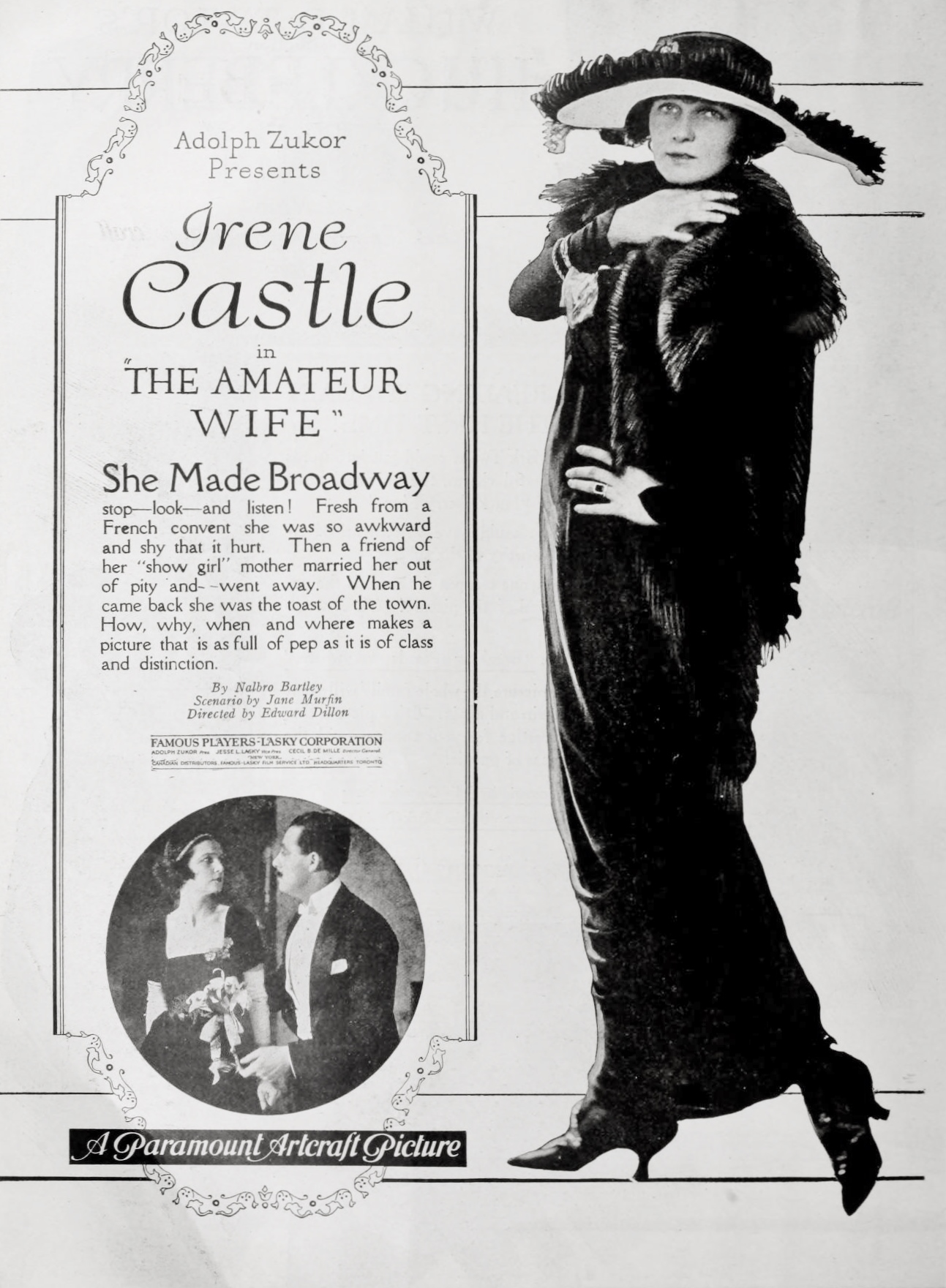
A convent girl walks into her mother’s cabaret—what follows is not a joke but a gunshot that ricochets through every gilt-edged frame of The Amateur Wife.
The picture opens on a trans-Atlantic liner slicing through slate seas; Justine Spencer stands at the rail, Bible in gloved hand, hair scraped tighter than a nun’s wimple. Director William P. S. Earle shoots her in profile against a cruciform mast, a visual omen that piety will soon be keelhauled. Back in Manhattan, the camera glides past doormen powdered like marzipan and into the Spencer apartment—an Aladdin’s cave of peacock feathers, where Mrs. Charles Dewey’s Dodo belts a torch song to a parlour full of tuxedos and hungry eyes. The cutting rhythm between ship and salon—brine-damp austerity versus champagne iridescence—announces the film’s dialectic: spirit versus flesh, repression versus release.
Ellen Olson’s Justine is introduced in a doorframe, backlit, silhouette swallowed by the yawning hall. She looks like a chalk sketch someone forgot to colour; the crowd of admirers parts, whispers ripple, and for a heartbeat the screen stills on the embarrassment of skin and bone inside gabardine. Olson lets her eyelids flicker—half shame, half appraisal—before she folds into herself like a closed fan. The moment is microcosmic: the entire narrative hinges on who gets to occupy space, who earns the right to be looked at.
Jealousy arrives wearing Arthur Rankin’s smouldering grin as Billy Ferris, a Broadway backer whose wallet is as thick as his pride. In a bravura sequence set during a rooftop rehearsal, Ferris watches Dodo trade stage kisses with a juvenile tenor. Earle intercuts Rankin’s tightening grip on a champagne flute with Dodo’s trilling high-C; glass fractures, music soars, and the edit foreshadows the coming bloodbath. That night, rain lashes the neon letters of the Follies next door, providing a crimson-gold halo while Ferris confronts Dodo. The murder itself is off-camera—only the revolver’s flash lights the window, a stroboscopic ghost that imprints itself on Justine’s horrified pupils. Ferris’s subsequent suicide lands his body across Dodo’s dressing-table, a Pièta in greasepaint. The sequence is silent-era shorthand: violence as silhouette, grief as negative space.
Enter Cosmo Spotiswood—William P. Carleton wearing a carnation and ennui like medals. Carleton plays him with the languid self-absorption of a man who tips hat-check girls in aphorisms. He marries Justine because, as the title card confesses in a curl of Art-Deco lettering, “A corpse needs a mourner; a girl needs a name.” Their honeymoon is a glacier-bound montage: Niagara Falls frozen in winter, the roar muffled under ice, the pair separated by veils of mist. Earle frames them in opposing thirds of the screen, a visual prenup of estrangement.
Cosmo’s departure for Europe is shot like a funeral in reverse—steam, whistles, and a wife left smaller than the departing ship. Here the film pivots from melodrama to metamorphosis. Justine’s chrysalis is the cavernous Spencer townhouse, now emptied of laughter. She wanders hallways draped in dust sheets; mirrors turn her stark face into a gallery of self-reproach. Loti, Dodo’s former maid (an effervescent Irene Castle), arrives like a cavalry charge of chic. Castle, a real-life ballroom celebrity, floats through scenes as if music still plays; she teaches Justine to Charleston while maids beat rugs in off-beat counter-tempo. The bobbing of Justine’s hair is shot in extreme close-up—scissors like a guillotine, each lock a severed tether to sanctimony.
What follows is a fashion montage that predates the 1930s consumer musicals: silk chemises slide over goose-pimpled skin; ropes of pearls clack like castanets; a backless lamé gown pools at ankles that once wore wool stockings. Cinematographer S.J. Warrington bathes these scenes in a nimbus of diffused light, turning fabric into liquid metal. The palette—amber, platinum, sea-foam—anticipates Technicolor dreams in a monochrome world.
The transformed Justine re-enters society at a yacht-club soirée shot entirely in reflections—polished brass rails, champagne buckets, midnight water—so that every image is doubled, hinting at duplicity. Suitors swarm: a polo player who smells of salt and leather, a banker whose eyes are calculators, a novelist scribbling her epigrams on shirt cuffs. Justine negotiates them with the poised cruelty of a cat flicking a wounded sparrow. Olson’s performance modulates: chin lifted, voiceless laughter, a gaze that inventories flaws. The camera adores her now; iris shots close in like kisses.
Cosmo’s return is staged as a homecoming to a stranger’s soirée. He descends a staircase into his own drawing-room yet hesitates, unsure whether he is host or interloper. Justine greets him wearing a dress the colour of arterial blood, backless save for a lattice of beads. In a single sustained take, Carleton registers the tremor of a man whose private museum piece has walked off the pedestal and into the arms of paying customers. The marriage, once as cold as a morgue slab, ignites via the flammable chemistry of jealousy. Their reconciliation clinch is shot behind a Chinese screen, shadows writhing like fire; intertitles cease, letting the audience lip-read urgency.
Yet the film refuses a cosy resolution. A final coda shows Justine alone on the same liner that brought her, now first-class, swathed in furs, eyes masked by sunglasses. She toys with a wedding ring—slipping it off, on, off—while gulls wheel overhead. Earle holds the shot until the horizon swallows ship and self alike, suggesting the cyclical engine of desire and reinvention. The amateur wife has become a professional woman, but at what tariff of soul?
Ellen Olson navigates Justine’s arc with the precision of a watchmaker, letting tremors of buried sensuality leak through corseted rigidity. Watch her hands: at first they clutch a rosary like a life-vest; by midpoint they drum a foxtrot rhythm on a marble balustrade, restless for syncopation. Carleton’s Cosmo is a study in privileged paralysis—his smile a velvet glove stretched over iron selfishness. In a superb bit of silent acting, he practices a smile in a mirror before greeting Justine, rehearsing warmth like a bad actor learning new lines. Irene Castle, though third-billed, pirouettes away with every scene, delivering comic relief without burlesque, her eyes sparkling with survivor’s mirth.
Art director Alex Saskins contrasts convent stone with Broadway gilt, while costumer Augusta Anderson drapes post-war ennui in beads that click like typewriter keys. Note the colour symbolism: when Justine is repressed, backgrounds are slate; after her transformation, set decorators scatter amber glassware, saffron curtains, even a canary in a gilded cage. The camera, often handheld on makeshift dollies, glides through crowds as if searching for oxygen. Shadows are painted onto walls à la German Expressionism, turning parlours into psyche-scapes.
Jane Murfin and Nalbro Bartley’s intertitles crackle with flapper argot: “Love is a ticker that only rings up zeros when you’re not looking.” Beneath the gloss lurk proto-feminist questions: who owns a woman’s image? Is marriage a passport or a prison? The picture suggests that self-fashioning is the only currency left after trust funds and reputations collapse. Yet it avoids moral absolutes; both propriety and promiscuity are portrayed as performances, each with its price of admission.
Place The Amateur Wife beside The Awakening of Helena Ritchie and you see two heroines crawling out of chrysalises forged by patriarchal fire. Yet where Helena seeks redemption through motherhood, Justine opts for autonomy wrapped in lamé—an ethos closer to the jazz-scored rebellion of A Youthful Affair. The makeover trope would resurface in 1930s consumer musicals, but here it is tinged with Gothic guilt: every sequin is sewn with blood.
Is the film dated? In spots, yes—cardboard ethnic stereotypes linger like smoke, and the dénouement hinges on a husband’s change of heart rather than the heroine’s self-actualisation. Yet its visual lexicon, its refusal to punish female appetite, and its embrace of urban modernity make it feel decades younger than its 1920 vintage. Restoration prints occasionally surface on archival tours; if you catch one, savour the way nitrate breathes—hot, flammable, alive—much like Justine herself.
Final tally: A champagne flute half-full—effervescent, perilous, leaving an aftertaste of iron and roses.
IMDb —
1926
Community
Log in to comment.