DbcultAccessing Vault...
Cult Review
Senior Film Conservator
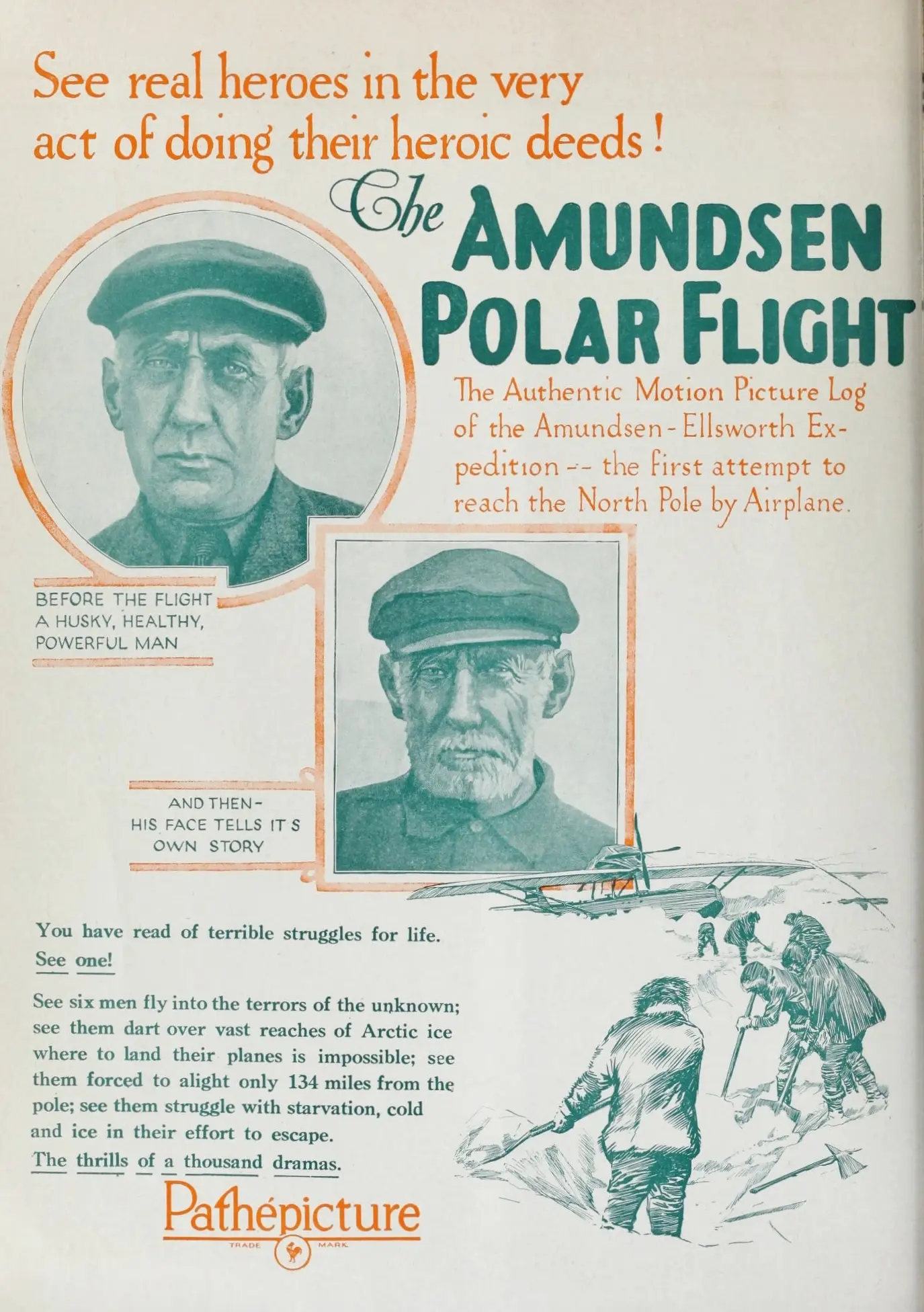
Should you invest your time in this archival journey to the top of the world? Short answer: only if you prefer the cold, hard facts of history over the polished drama of a Hollywood blockbuster.
This film is specifically for history buffs, aviation enthusiasts, and those who find beauty in the grainy, unedited reality of early 20th-century exploration. It is absolutely not for viewers seeking high-octane action or a traditional narrative arc with character development.
1) This film works because it provides an unvarnished, claustrophobic look at the physical reality of 1920s exploration that modern CGI simply cannot replicate.
2) This film fails because its tension is entirely reliant on the viewer's prior knowledge of the Byrd-Amundsen rivalry, offering little internal dramatic structure.
3) You should watch it if you want to witness the exact moment the world became smaller through the lens of a camera that was likely freezing as it rolled.
The Amundsen Polar Flight is a strange beast. It documents the 1926 flight of the airship Norge, but it feels less like a celebration and more like a desperate attempt to reclaim a narrative. Just days before Amundsen and Ellsworth took to the skies, Richard E. Byrd claimed to have reached the Pole in his Fokker F.VII. This film is the visual rebuttal.
The cinematography is utilitarian. We see the massive, lumbering shape of the Norge, a silver whale against a sky that looks like hammered lead. There is a specific shot where the airship casts a shadow over the jagged pack ice. It is a haunting image. It reminds us that these men were suspended by nothing but hydrogen and hope over a graveyard of frozen water.
Unlike the theatrical flair of Lady Windermere's Fan, which used the camera to highlight social nuance, this film uses the camera as a survival tool. Every frame feels heavy. You can almost feel the frostbite creeping into the edges of the film stock.
One must appreciate the sheer difficulty of capturing this footage. In 1926, cameras were bulky, hand-cranked machines. Lubricants froze. Film became brittle and snapped like dry twigs. Yet, we get these sweeping, albeit shaky, panoramas of the polar wastes.
The pacing is glacial—literally. There are long stretches where nothing happens but the hum of engines and the passing of white desolation. In a modern context, this would be edited down to a three-minute montage. Here, the duration is the point. You are meant to feel the monotony of the flight.
It contrasts sharply with the urban dramas of the era like The Ghost of Rosy Taylor. While those films were exploring the interiority of the human condition in a changing society, Amundsen was capturing the exteriority of a world that didn't want humans in it at all.
Yes, the footage captures the actual 1926 expedition. While the exact point of the North Pole is indistinguishable from the surrounding ice, the film documents the precise geographical crossing. It serves as primary historical evidence of the Norge's flight path.
There is a palpable sense of melancholy in this film. Amundsen was the first to the South Pole, but the North Pole was his white whale. To see him and Ellsworth preparing the Norge, knowing that Byrd had already claimed the prize, adds a layer of tragedy to the proceedings.
The film doesn't show the arguments or the bitterness. It shows the work. We see the men hauling supplies, checking the engines, and staring out of the gondola windows. Their faces are weathered, not by age, but by the environment. It is a more honest depiction of heroism than the melodrama found in Her Silent Sacrifice.
The film is a study in stoicism. There are no subtitles expressing their disappointment. There is only the mission. This silence is more powerful than any dialogue. It forces the viewer to project the internal conflict onto the frozen faces of the explorers.
If you are looking for entertainment, no. This film is a chore. It is repetitive, colorless, and silent. However, if you are looking for a window into a vanished world, it is indispensable. It captures a moment when the map was still being filled in with ink and blood.
Comparing it to the narrative structure of The Prodigal Son is useless. One is a story; the other is a fact. The Amundsen Polar Flight exists in a space between journalism and art. It is raw data that happens to be beautiful in its desolation.
I would argue that the film’s biggest strength is its lack of polish. In an age where we can see the North Pole on Google Earth, seeing it through a flickering 35mm lens makes it feel dangerous again. It restores the mystery of the horizon.
Pros:
Cons:
The Amundsen Polar Flight is a magnificent failure of a movie that succeeds brilliantly as a historical artifact. It is a film about a man who won the race but lost the headline. It is cold. It is distant. It is deeply human.
While films like The Libertine focus on the excesses of the spirit, this film focuses on the limits of the body. It reminds us that for all our technology, we are still small creatures in a very large, very cold world. It isn't a masterpiece of cinema, but it is a masterpiece of survival.
"The ice doesn't care about your camera, and the wind doesn't care about your legacy. This film is the record of men who tried to make them care anyway."
Final thought: Watch it with a blanket and a hot drink. You’ll need both.

IMDb —
1926
Community
Log in to comment.