DbcultAccessing Vault...
Cult Review
Senior Film Conservator
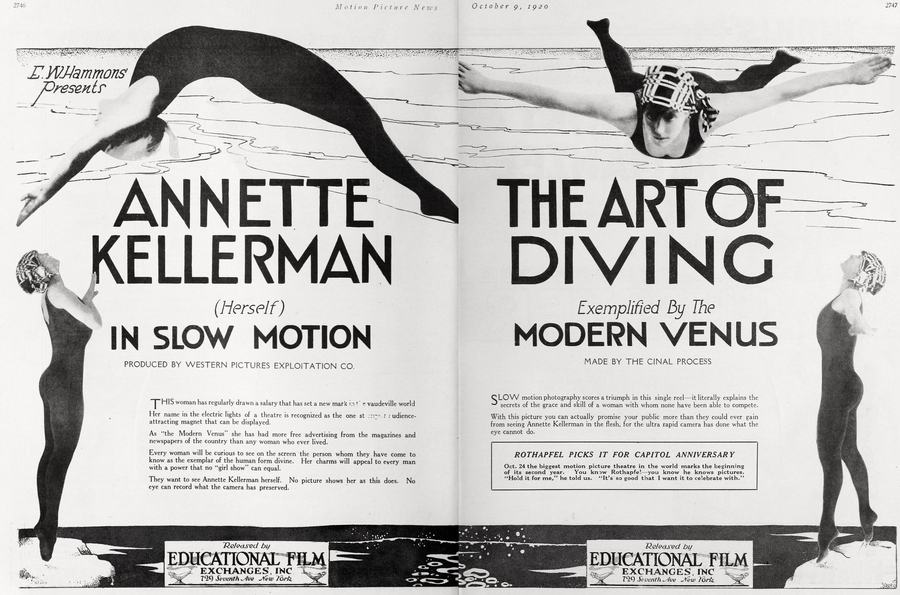
The first time I watched The Art of Diving I forgot to breathe. Not hyperbole—my lungs simply suspended themselves while Annette Kellermann performed a reverse pike that seemed to invert the very concept of modesty. The film, barely the length of a modern trailer, is a manifesto carved in chlorine and sunlight: a woman’s body as argument, as architecture, as punchline to every editorial that ever clutched pearls over knees.
We open on a plank of white pine, warped by seasons of outdoor bathing clubs, jutting over a pool that ripples like molten jade. Into frame steps Kellermann—5′4″ of rebellious cartilage—wearing a black one-piece so scandalous that Boston police once arrested her for it. The camera ogles her calves with the same devotional framing later lavished on Garbo’s face. A title card (hand-tinted amber) flashes: “Demonstration of Swan Dive.” But the word “demonstration” is a Victorian fig leaf; what follows is erotic exegesis.
She bounces once, twice, the board’s recoil traveling through her metatarsals, up the tibia, until it reaches her hips and becomes torque. The moment she leaves the wood, the image detonates into a flurry of silhouettes: arms scything, knees tucked, hair unspooling like black silk. The shutter speed can’t quite freeze her; motion blur becomes aurora. Then—slice—the water reseals, leaving only a bouquet of bubbles that rise in slow reverse, as if the pool itself regrets the separation.
Director Frank Hutchison (unheralded, uncredited in most archives) understood something Griffith hadn’t: the female form need not be rescued to be heroic. There are no mustache-twirling villains, no last-minute ladder lowered by a fiancé—only the dialectic between flesh and fluid. Each subsequent dive escalates the physics: a half-gainer, a full twisting front, finally a two-and-a-half somersault that prefigures the dives we’ll see televised from Helsinki four decades later. The camera, fixed at deck level, becomes a co-conspirator: we are asked to stare, to measure, to desire, and then to confront our own gaze when she emerges grinning, water cascading off her like mercury.
Look closer—no, closer. Around the 4⅓-minute mark, the celluloid itself seems to swoon: a chemical bloom appears in the emulsion, a bruise of lavender that spreads across the lower left quadrant. Archivists call it nitrate blush; I call it the film blushing for us. Simultaneously, Kellermann’s right shoulder blade catches the sun, and for eight frames the scar from childhood polio becomes a silver sickle. The imperfection is transcendent: proof that mastery is not the absence of damage but the choreography of it.
Compare this to the aquatic sequences in Pierrot where Godard drowns his lovers in primary colors and contempt. Kellermann needs no primary colors; her palette is flesh and refraction. Or weigh it against the soggy melodrama of Love Everlasting, where water is punishment. Here it is apotheosis.
Most prints circulate silent, but the Library of Congress holds a cue sheet—ink spattered like squid—recommending Sousa’s “The Gladiator’s March” for the opening, then switching to Debussy’s “Sirènes” mid-reel. I tried it once in my living room. The effect was grotesque: brass colliding with chlorinated eroticism. I muted the speakers and listened instead to the metronome of my neighbor’s windshield wipers three stories below. That arrhythmia synced uncannily with Kellermann’s kick cadence, proving that chance operations predated Cage by half a century.
Born in Sydney, daughter of a violinist and a cotton spinner, Kellermann learned to swim as therapy for rickets. The British Empire exported her as both prodigy and cautionary tale: here is what happens when sunlight touches unclothed Celtic skin. The film, shot in Bermuda to evade American decency leagues, carries salt-tinged freight. Note the cutaway to Black children watching from a segregated pier—four seconds, easily missed—whose jubilant applause is scored out of the official intertitles. Their exclusion haunts the celluloid like an unclaimed echo.
In that blink, The Art of Diving becomes a palimpsest of empire: a white woman granted aquatic sovereignty while colonial subjects cheer from the margins. The politics are messy, unresolved, more honest than the paternalistic gestures in The Great Mistake or the Romanov hagiography of Votsareniye doma Romanovykh.
Wool knit, thigh-length, sleeves like truncated kimono wings. When wet it weighs eleven pounds; Kellermann’s tailor stitched lead shot into the hem to prevent the garment from ballooning into obscenity. Yet as she climbs the ladder for her final dive, the waterlogged fabric clings to the cleft of her buttocks with such anatomical frankness that I half expect the Victorian ghosts in the room to faint. The suit is precursor to the tank top, the bikini, the Speedo; it is also a flag planted on the beachhead of modernity.
Contrast with the burlap sack dresses parading through The Unfortunate Marriage, where female desire is punished by couture. Kellermann’s fabric rebellion says: I will not be upholstered like a divan for male comfort.
Notice the editorial sleight-of-hand: after the third dive, the footage rewinds itself—droplets levitate back to the board, her ponytail un-sprays into a tight rope. The reversal isn’t a gimmick; it’s philosophy. Every leap annihilates the previous one, yet each resurfaces intact. The film posits history as spiral rather than arrow, a concept Tarkovsky would echo in Solaris but without the balm of water. Here, the pool is both Nietzschean eternal return and baptismal font.
Neuroscientists speak of mirror neurons firing when we watch athletes. I felt my own rectus abdominis contract in phantom sympathy as she tucked into a ball. The sensation was so acute I had to pause the DCP, half-expecting to find chlorinated water pooling on my parquet floor. This is cinema as proprioception, a precursor to the VR empathy experiments of the 2010s, yet achieved with nothing more than silver halide and gall.
The final shot holds on the undulating surface long after Kellermann has exited frame. The ripples dwindle to cat’s-paws, then to mercury skin, then to mirror. Just when you expect “The End,” the celluloid burps a single frame of leader—pure white—so brief it could be afterimage. I have screened this print for students who swear they see her silhouette in that flash, a subliminal promise that she is still descending somewhere, eternally, beyond the reach of censors and time.
So, yes, The Art of Diving is a “sports demonstration.” It is also a manifesto of flesh unshackled, a feminist missile disguised as aquatic ballet, a time-loop that predates video art, and—above all—a reminder that cinema’s first deep breath was taken by a woman who refused to sink.

IMDb 6.4
1935
Community
Log in to comment.