DbcultAccessing Vault...
Cult Review
Senior Film Conservator
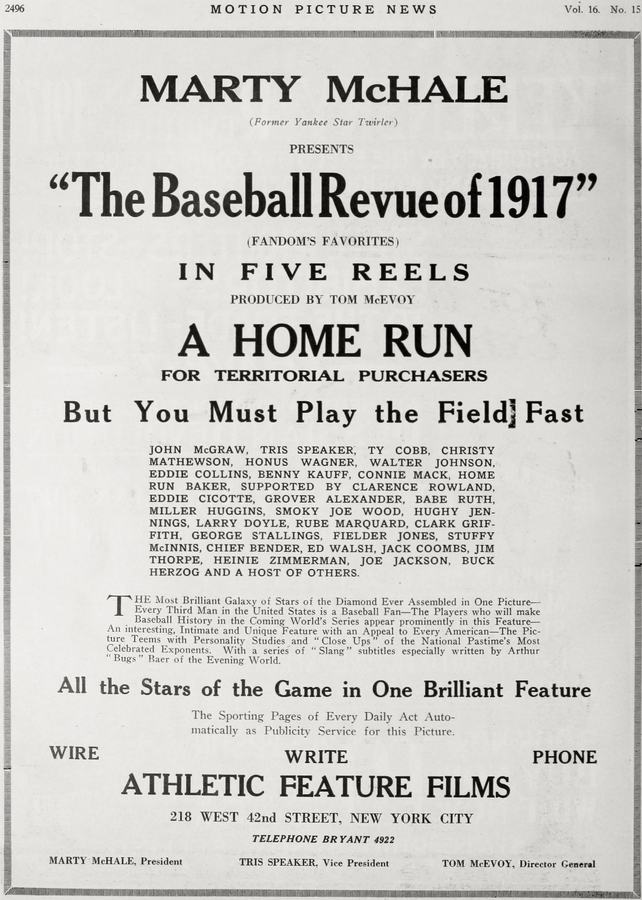
Stepping into the flickering glow of The Baseball Revue of 1917 feels akin to unearthing a time capsule, a fragile cinematic relic from an epoch that, in many ways, feels utterly alien to our contemporary sensibilities. This isn't just a film; it's a visceral document, a spectral echo of a burgeoning national pastime captured on fragile nitrate stock. In 1917, the world was a tumultuous cauldron of geopolitical upheaval, with the Great War raging across Europe, and America's eventual entry casting long shadows over daily life. Yet, amidst this global turmoil, the rhythmic crack of a bat and the roar of a crowd offered a cherished reprieve, a collective heartbeat that pulsed through the nation. This 'Revue' offers an unparalleled glimpse into that specific cultural moment, showcasing Major League Baseball not as the polished, multi-billion dollar spectacle we know today, but as a raw, almost artisanal craft.
The very concept of a 'sports highlight reel' in 1917 was revolutionary. Without the instantaneous gratification of television or the pervasive reach of radio, these cinematic compilations were often the only way for fans outside major metropolitan areas to witness the athletic titans of their age in motion. The film, credited to Tom McEvoy, who likely served as its assembler or editor, is a testament to the nascent art of sports cinematography. It's a compilation of moments, fleeting and often grainy, yet imbued with an almost mystical significance. We see the players not as distant, mythic figures, but as flesh-and-blood men, their uniforms often ill-fitting by modern standards, their movements imbued with a different kind of grace – less about explosive power, more about fundamental skill and strategic placement. The pitches are underhand or sidearm, the swings more compact, the fielders often barehanded or with rudimentary gloves. It's a ballet of anachronisms, yet utterly captivating.
The technical limitations of the era are, paradoxically, part of the film's enduring charm. The cameras were bulky, stationary behemoths, often positioned high in the stands, capturing the action from a distant, almost omniscient perspective. There are no dramatic close-ups, no slow-motion replays, no intricate tracking shots following the arc of a fly ball. Instead, we are presented with wide, panoramic vistas of ballparks teeming with spectators, their faces often indistinct blurs, yet their collective energy palpable even through the silent film's lack of auditory cues. The art of conveying excitement without sound is a challenge that The Baseball Revue of 1917 navigates with remarkable efficacy. The kinetic energy is translated through the players' rapid movements, the dust kicked up on the base paths, and the theatrical gestures of both players and umpires. It's a purely visual narrative, demanding a different kind of engagement from the viewer, one that relies on imagination to fill in the missing roars and cheers.
Comparing this 'Revue' to a narrative feature from the same period, say, The City or even David Garrick, highlights its unique position. While those films sought to craft elaborate fictional worlds or dramatize historical narratives, The Baseball Revue of 1917 endeavors to capture raw reality, albeit a curated one. It's a form of early documentary, a precursor to newsreels and sports broadcasting. The 'writing' by Tom McEvoy, in this context, isn't about dialogue or character arcs, but about the sequencing of events, the rhythmic flow of plays, and the subtle emphasis on certain moments that define a season. It's a directorial hand guiding the viewer's eye through the highlights, shaping a coherent narrative from disparate fragments of action. This editorial craft is crucial, as it transforms mere footage into a compelling historical record.
While specific names may not be explicitly highlighted in intertitles, the film implicitly celebrates the stars of the 1917 season. We see the legendary pitchers, their wind-ups a study in early biomechanics; the agile fielders, making plays that would still draw gasps today; and the powerful hitters, their swings a potent blend of brute force and surprising finesse. These are the progenitors of modern baseball, the men who laid the groundwork for the sport's enduring appeal. Their dedication, their athleticism, and their sheer love for the game shine through the aged celluloid, bridging the century that separates us from their playing days. It's a reminder that the essence of baseball – the tension of the pitcher-batter duel, the thrill of a stolen base, the camaraderie of the dugout – remains remarkably consistent, even as the surrounding spectacle has evolved dramatically.
The absence of sound is perhaps the most profound element, compelling us to focus solely on the visual storytelling. We observe the subtle body language, the unspoken communication between players, the sheer physical exertion evident in every slide and throw. It invites a different kind of contemplation, allowing the viewer to project their own understanding and appreciation onto the silent tableau. This is a stark contrast to the sensory overload of modern sports broadcasts, where every grunt, every crack, every statistic is meticulously amplified. Here, the purity of the game itself takes center stage, stripped of all extraneous noise. It's an almost meditative experience, allowing for a deeper appreciation of the fundamental artistry of baseball.
But The Baseball Revue of 1917 is more than just a historical sports film; it's a significant cultural artifact. Like I'm Glad My Boy Grew Up to Be a Soldier, which reflects the jingoistic sentiments of the time, this film captures a different facet of American identity. It showcases a society engaging in its leisure activities, finding solace and excitement in a shared passion, even as the specter of war looms large. The crowds themselves are a fascinating study – men in suits and hats, women in elaborate dresses, children wide-eyed with wonder. Their fashion, their demeanor, their very presence paints a vivid portrait of early 20th-century America. It's a testament to the fact that film, even in its earliest forms, was already serving as a powerful mirror reflecting the societal norms and preoccupations of its age.
The film's longevity, its mere existence, is a triumph in itself. Many silent films have been lost to the ravages of time, neglect, or the inherent instability of nitrate film stock. That The Baseball Revue of 1917 has survived to offer us this invaluable portal to the past is a cause for celebration. It allows us to connect directly with a moment in history, to witness the origins of traditions that continue to define the sport today. It’s a powerful reminder of how ephemeral moments can be preserved and transmuted into enduring historical records through the magic of cinema. Much like the efforts to preserve narrative classics such as Les Misérables, Part 2: Fantine, the preservation of this unique sports documentary ensures that future generations can understand the foundational elements of American popular culture.
The 1917 season itself was significant, marked by the Chicago White Sox winning the World Series against the New York Giants. While the film doesn't delve into the dramatic intricacies of every game, it captures the essence of the competitive spirit that drove these teams. It shows us the intensity in the players' eyes, the determined set of their jaws, the sheer physical effort expended in every play. This wasn't merely entertainment; it was a deeply ingrained part of the American fabric, a source of local pride and national unity. The simplicity of the presentation allows the inherent drama of the game to speak for itself, unadorned by modern production excesses.
For the modern baseball enthusiast, The Baseball Revue of 1917 offers a fascinating counterpoint to today's game. The speed of play, the strategic nuances, the physical conditioning of the athletes – all present a compelling study in evolution. It prompts reflection on how much has changed, and yet how much has remained fundamentally the same. The basic rules, the objective, the thrill of victory and the agony of defeat, are timeless. This film, therefore, acts as a crucial anchor, connecting the sport's present to its foundational past, illustrating the enduring appeal of the game across generations.
In an age of digital saturation and instantaneous access, the silent, grainy footage of The Baseball Revue of 1917 demands a different kind of appreciation. It's a reminder of cinema's power not just as an art form, but as a historical record, a window into worlds long past. It offers a profound sense of connection to the pioneers of the game, to the fans who cheered them on, and to an America that was simultaneously simpler and more complex than our own. It's a vital piece of both cinematic and sporting history, inviting us to pause, observe, and reflect on the enduring magic of baseball and the remarkable ability of film to transcend time.
The film, despite its age and inherent limitations, holds up as a compelling watch for anyone with an interest in the origins of American sports, the evolution of cinematography, or simply a desire to connect with a bygone era. It's a testament to the vision of individuals like Tom McEvoy who understood the importance of capturing these fleeting moments for posterity. In its silent grandeur, it speaks volumes about the enduring spirit of the game and its indelible place in the nation's collective memory. It’s a journey worth taking, a silent pilgrimage back to the diamond of 1917, where the echoes of history are still vividly playing out on screen.
IMDb —
1919
Community
Log in to comment.