DbcultAccessing Vault...
Cult Review
Senior Film Conservator
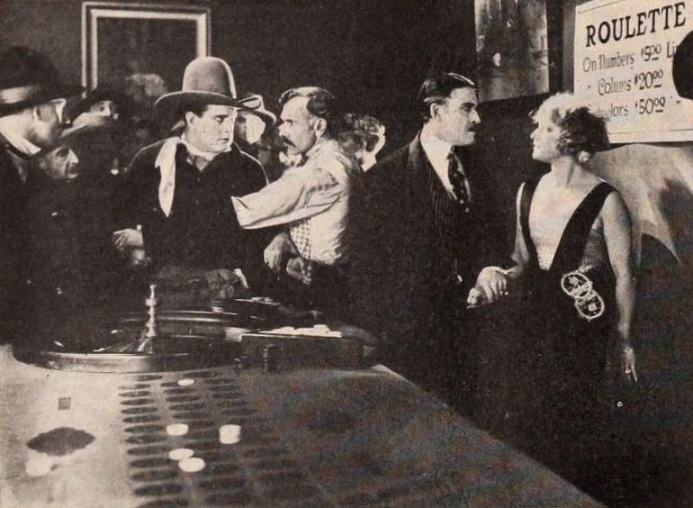
Card sharps, champagne rot, and filial sacrifice—The Beautiful Gambler shuffles them together until even morality itself feels like a rigged game. Released in the giddy twilight of nickelodeon innocence, this 1921 potboiler brandishes shadows longer than any alley in pre-Code cinema, suggesting that American silent film stumbled upon film-noir grammar a full decade before the French coined the term.
Picture the opening tableau: mahogany doors swing inward to reveal Mark Hanlon—once a titan of river commerce—now hunched over a faro layout as if in prayer. Cinematographer Frank Good (unbilled yet indispensable) captures the scene in chiaroscuro so severe that every dust mote becomes a witness. Willis Marks plays Hanlon with trembling mutton-chop whiskers, his eyes already hollowed out by guilt. The script, adapted from Peter B. Kyne’s serialized pulp, wastes zero time sermonizing; instead, it lets the betting chips do the talking, each clack a Mephistophelian chuckle.
Within ten brisk minutes, Hanlon mortgages the ancestral home—its wallpapers once scented with lavender sachets—signing the deed atop a mirror scarred by razor-straight card scratches. The moment is framed in medium shot, the camera stationary, almost documentary, so that the modern viewer feels complicit, as though our gaze were another debt collector.
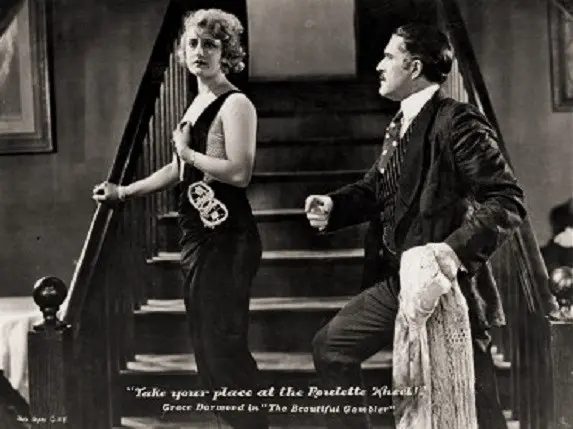
Enter Grace Darmond’s Molly, a flapper before the term caught fire. She glides down the grand staircase in a gown the color of tarnished pewter, the bias-cut silk clinging to her like gossip. Darmond’s performance is calibrated at the intersection of porcelain poise and quiet panic; her eyes—dark, glassy—suggest someone perpetually counting backward from disaster. No ingenue simpering here: when her father confesses the ruin, she steels herself, lifts her chin, and within a hard-cut marches into Kirk’s office to barter her future.
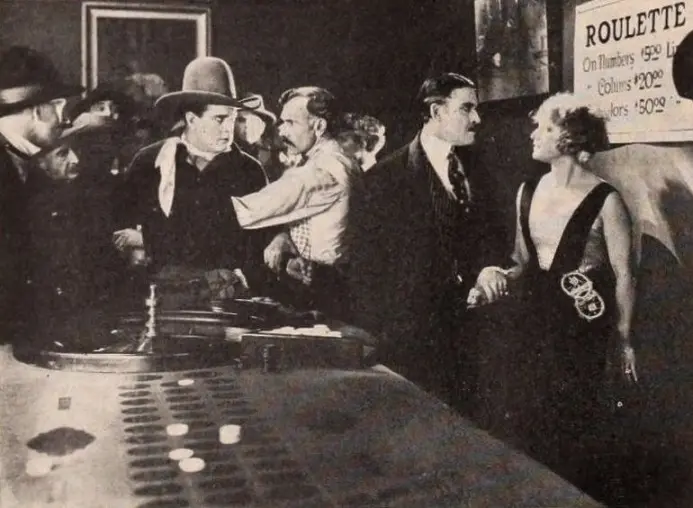
The film’s mid-section luxuriates in casino tableaux that rival von Sternberg’s later excesses. We see roulette wheels spinning like cyclones, their red-black blur echoing Molly’s own vertigo. Chandeliers drip faux-crystal teardrops; cigar smoke coils like ectoplasm. Lee Kirk—played by Herschel Mayall with a carnivorous calm—presides over it all, his tuxedo lapels as sharp as eviction notices. The screenplay cannily withholds overt menace; instead, Kirk woos Molly with velvet-gloved coercion, promising to "clear the slate" if she consents to marriage. The transaction feels queasily modern, a #MeToo parable avant la lettre.
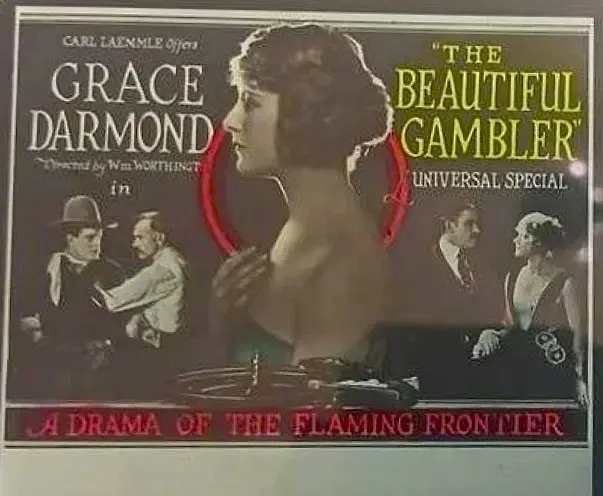
Jack Mower’s Miles Rand arrives wearing dust, not dollars—a cowpoke coat two seasons out of date. In contrast to the tuxedoed predators, his moral silhouette is sketched by white-hat chiaroscuro. Yet the film refreshingly refuses to paint him as savior simplex. He too gambles, albeit on love rather than cards, and the narrative wagers everything that his protective instinct can outdraw Kirk’s possessive cruelty. Their first meeting—an impromptu rescue when a drunken high-roller paws Molly—unfurls in a single, unbroken two-shot that traps them within the same gilt frame: protector and protected, yet both prisoners of circumstance.
Watch how Darmond lets her shoulders soften when Miles addresses her by name rather than title—an acting choice delivered at micro-budget scale yet richer than many modern superhero monologues. Silent cinema at its best communicates via muscle tension, not monologue, and The Beautiful Gambler is a masterclass in kinetic subtext.
When the saloon fire arrives, it’s rendered chiefly through silhouettes and double-exposure: orange-red tinting swallows the monochrome, silhouettes twist in danse macabre. The producers lacked the budget for full-scale pyrotechnics, yet the conflagration’s impressionistic shorthand lands harder than CGI conflagrations that cost GDPs of small nations. Kirk’s presumed death—his silhouette collapsing beneath a falling beam—feels both tragic and karmic.
Cut to Manhattan two years later: snowflakes the size of communion wafers drift past brownstone lintels. The film stock itself seems colder, bluer. Molly and Miles share a modest flat overlooking a butcher shop whose painted pig doubles as ironic commentary on the couple’s lingering feeling of being carved up. Their domestic scenes luxuriate in quiet—breakfast coffee steam, the hush of shared newspapers—until Kirk reappears, face scarred like a topographical map of vengeance. The pacing here is merciless: no exposition dump, just a cut from domestic bliss to Kirk’s gloved hand rapping on the door. It’s cinema as ambush.
What follows is a courtroom sequence that prefigures Hitchcock’s wrong-man thrillers. Miles stands accused; the DA flourishes a blood-spattered glove like a macabre magician. Close-ups of jury members evoke cogs in a machine designed to grind. Meanwhile, Molly’s frantic testimony—communicated via title cards that hammer like typewriter keys—proves futile against circumstantial gears. The tension crests not with a Perry-Pie-in-the-Sky reveal but with the quiet shuffle of the handyman (Charles Brinley), a peripheral figure we barely noticed, stepping forward to confess. His monologue—delivered entirely in intertitles—carries the weary cadence of a man who’s waited his entire life to exhale.
Notice the color palette shift: the courtroom walls appear grayer, the windows’ light colder, as though justice itself suffers from anemia. Only when the confession lands does a stray sunbeam strike Molly’s cheek, a splash of yellow relief that feels practically technicolor within the monochrome moral dungeon.
Herschel Mayall’s Kirk oozes the reptilian charm of a man who views people as poker chips. Watch how he fingers his watch-chain—each gesture a silent raise of the stakes opposite him. Jack Mower counters with stoic minimalism; his clenched jaw alone suffices for pages of dialogue. Yet it’s Grace Darmond who magnetizes: her face registers the arithmetic of survival—hope minus time equals resignation—without once lapsing into melodrama. In a medium famed for fluttering lashes and chest-clutching, her restraint feels avant-garde.
Compare her to the flapper firebrands in Less Than Kin or the ethereal ingenue in Soul Mates: Darmond’s Molly is less an archetype than a fracture line where innocence and pragmatism grind against each other.
While German studios were forging Dr. Caligari’s labyrinth, American potboilers like this absorbed expressionism through osmosis. Staircases zig-zag like fractured spines; windowpanes cast lattice-shadows that imprison characters within their own frames. The camera rarely moves—budgets forbade tracks or cranes—but compositions exhale menace: low-angle shots make Kirk loom like a gargoyle; high-angle shots reduce Molly to a pawn on a board she never chose to play.
Note the recurrence of mirrors: cracked in the gambling den, intact in the New York flat. Each reflection doubles the theme of identity-as-wager. When Molly finally confronts Kirk, the two stand angled before a cheval glass so that four figures occupy the frame—self, reflection, adversary, adversary’s reflection—suggesting that every gambler ultimately plays against himself.
Peter B. Kyne, whose prose oozed frontier testosterone, here collaborates with Hope Loring, one of the few female scenarists of the era. Their joint script crackles with sardonic title cards: "Luck is a lady who laughs while she lifts your wallet." The dialogue is terse, epigrammatic, foreshadowing the hard-boiled snap of Chandler. Yet beneath the cynicism lies a moral compass: every chip clipped from the innocent eventually rolls back like a stray penny—slow, dented, but undeniable.
Modern viewers will flinch at the transactional marriage subplot, yet the film refuses to romanticize Molly’s plight. Her agency is circumscribed but not erased; she strategizes, bargains, and ultimately engineers her escape by allying with a man who listens rather than possesses. In an age when student loans and medical bills shackle millions to opaque creditors, The Beautiful Gambler plays like a folk tale for the indebted century.
Moreover, the narrative interrogates the myth of the self-made man: Hanlon believes he can hustle destiny; Kirk trusts cash to purchase souls; Miles gambles on moral capital. All three discover that the house—whether casino, courtroom, or capitalism—always keeps a percentage.
Prints of the film languished for decades in the Library of Congress’s paper-core vaults, mislabeled as "Gambler’s Bride". A 2018 4K restoration salvaged the original tinting schemes—amber for interiors, cyan for exteriors, rose for flashbacks—based on studio cue sheets discovered in the Gloria Swanson archive. The new restoration debuted at Pordenone and is now streamable via several niche platforms. Seek it out; the textures—grain like sifted coal dust—add tactile grit to the parable.
If you savor the moral vertigo here, double-feature it with Witchcraft for supernatural comeuppance, or The False Faces for identity-warping intrigue. Each reveals how 1920s filmmakers probed ethical fault-lines long before MPAA ratings sanitized peril into palatable thrills.
Is the film flawless? Hardly. The climax hinges on a deus-ex-handyman whose prior screen time clocks under sixty seconds. Some intertitles smack of pulpy grandiloquence. Yet these are quibbles beside the film’s existential swagger, its willingness to argue that every human transaction—love, debt, loyalty—is a wager whose outcome remains perpetually unforeseeable.
In an age when algorithms quantify our worth in credit scores and engagement metrics, watching these ghosts of 1921 gamble away birthrights feels less like antiquated melodrama than mirror. The roulette wheel still spins; only the chips have changed shape. Place your bet, dear viewer, but remember—somewhere in the smoky ether, Molly Hanlon’s eyes watch, wide, unblinking, warning: the house always keeps a slice of your soul.
IMDb —
1917
Community
Log in to comment.