DbcultAccessing Vault...
5.7/10
Senior Film Conservator
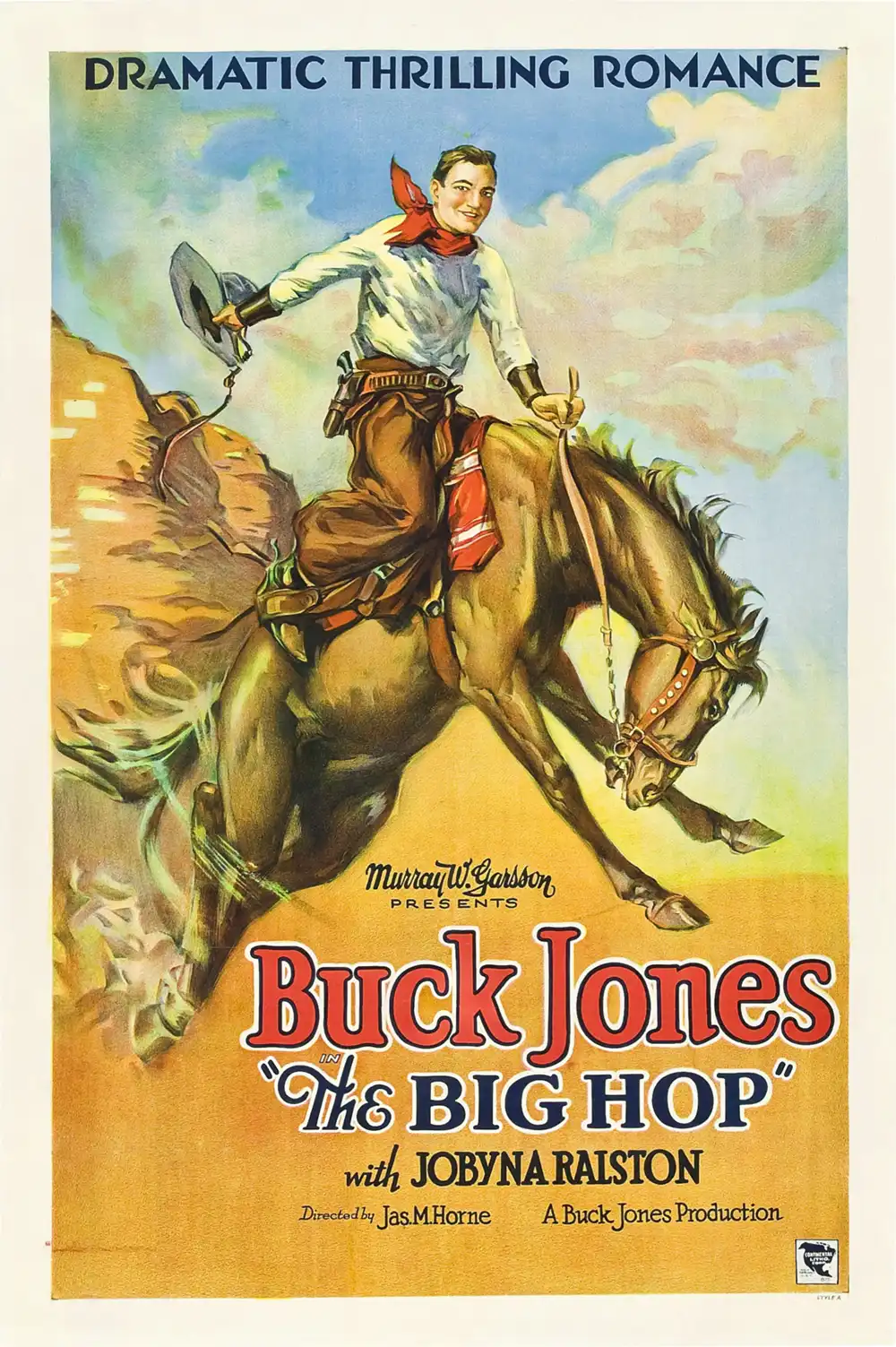
A definitive 5.7/10 rating for a film that redefined the boundaries of cult cinema. The Big Hop remains a cornerstone of transgressive art.
If you are looking for a hidden masterpiece of the silent era, The Big Hop isn't it. However, if you are interested in the exact moment Hollywood tried to pivot its biggest Western stars into the 'modern' world of 1928, this film is a fascinating specimen. It is worth watching today only if you have an academic interest in aviation history or if you want to see Buck Jones look genuinely uncomfortable in a flight suit. It will likely bore casual viewers who expect the high-octane stunts of Wings, as much of the runtime is spent on the ground, dealing with social hierarchies and ranch-hand pining.
Buck Jones was a titan of the B-Western, a man who looked like he was born in a saddle. Watching him in The Big Hop is a jarring experience. In films like Roped, Jones carries himself with a specific kind of physical authority that vanishes the moment he puts on a suit. Here, he plays a poor cowboy who needs to win the hand of Cynthia (Jobyna Ralston). The film treats the airplane not as a miracle of science, but as a mechanical horse—a way for a man of low birth to achieve a 'heroic' status that the frontier no longer provides.
Jones spends a significant portion of the first act looking longingly at Ralston while leaning against fences. There is a specific, awkward sequence where he tries to act 'refined' around her father (Charles Clary) that feels like it belongs in a different movie. His performance is stiff, not because he is a bad actor, but because the script asks him to play a character who is constantly apologizing for his existence until he gets into the cockpit.
Jobyna Ralston, fresh off her legendary run as Harold Lloyd’s leading lady, is the best thing on screen. While the role of the 'prize' daughter is thankless, she brings a level of reactive intelligence to her scenes that the script doesn't technically require. There is a small moment in the garden where she watches Jones walk away; the way she adjusts her shawl and looks down tells you more about her internal conflict than any of the clunky title cards. She manages to make the stakes feel real, even when the plot feels like a series of checkboxes.
The pacing of The Big Hop is uneven at best. The transition from the ranch drama to the aviation contest feels like a gear grind. One moment we are worried about cattle and social standing, and the next, we are thrust into the technicalities of a flight from the US mainland to Hawaii. This was clearly inspired by the real-life Dole Air Race of 1927, and the film assumes the audience is already obsessed with the minutiae of fuel loads and wind speeds.
When the flight finally happens, the tension is undermined by the editing. We get a lot of shots of the propeller spinning and Jones looking intensely at gauges, but there is a lack of spatial awareness. You never quite feel the vastness of the Pacific. There is one genuinely impressive shot, however, where the plane is silhouetted against a low sun over the water—a rare moment where the cinematography moves past 'functional' and becomes beautiful. But these moments are interrupted by overlong reaction shots of the crowd back home, which kills the momentum of the actual journey.
Visually, the film is a tale of two halves. The ranch scenes are shot with the flat, bright lighting typical of 1920s Westerns. Everything is clear, dusty, and a bit harsh. Once the action moves to the hangar and the airfield, the lighting becomes much more interesting. There are some great shadows cast by the wings of the planes, and the interior of the hangar has a cavernous, almost industrial feel that contrasts sharply with the open range. It’s as if the director, James W. Horne, was more excited by the machines than the people.
The tonal shifts are where the film struggles most. It tries to be a romance, a social drama, and an adventure film all at once. The villainous interference by the rival suitor feels like a holdover from a Victorian stage play, complete with metaphorical mustache-twirling. It feels dated even by 1928 standards, especially when compared to the modern, technical aspirations of the flight sequence.
The Big Hop is a movie caught between two worlds. It wants to keep the fans of the old-school Western happy while chasing the new 'Lindbergh' audience. In trying to do both, it doesn't quite master either. The flight itself is a bit of a letdown, and the romance is standard fare. But as a window into what 1928 Hollywood thought the 'new hero' should look like, it is an essential watch for silent film buffs. Just don't expect it to take your breath away.
IMDb —
1936
Community
Log in to comment.