DbcultAccessing Vault...
Cult Review
Senior Film Conservator
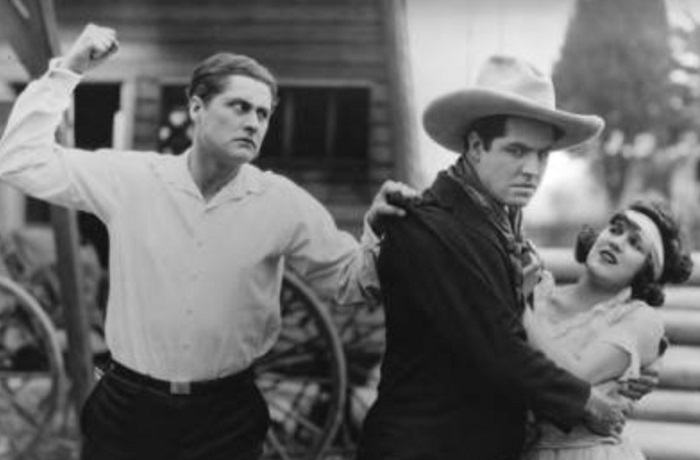
The year 1922 was a watershed moment for the cinematic medium, a period where the primitive language of early film began to coalesce into a sophisticated visual grammar. Amidst this transition, West Meets East emerged not merely as a genre piece, but as a fascinating cultural artifact. Starring the ethereal Marion Aye and the ruggedly dependable Bob Reeves, the film attempts a synthesis of disparate American identities. While many silent Westerns of the era were content with the binary of white hats and black hats, this production delves into the gray areas of cultural assimilation. It stands in stark contrast to the more theatrical flourishes found in The Woman's Law, opting instead for a gritty realism that feels surprisingly modern.
Marion Aye, an actress whose career is often overshadowed by the larger-than-life personas of the silent era, delivers a performance of remarkable subtlety. In an age where histrionics were the standard—often seen in the heightened drama of Trifling Women—Aye employs a restrained physicality. Her eyes, captured in tight close-ups that must have felt revolutionary to 1920s audiences, convey a sense of 'Eastern' alienation that dialogue cards could never fully articulate. She represents the encroachment of civilization, yet she is not the villain; she is the catalyst for a fundamental shift in the landscape's social fabric.
Bob Reeves, playing the quintessential frontiersman, provides the necessary gravitational pull to Aye’s drifting socialite. Reeves lacks the polished artifice found in performers of Severo Torelli, instead offering a performance rooted in the earth itself. His movements are economical, his presence imposing. This duality—the refined versus the raw—is the engine that drives the film’s thematic core. It mirrors the broader national anxiety of the time: the closing of the frontier and the realization that the 'Wild West' was becoming a memory, a theme similarly explored in the more melancholic The Spirit of Cabin Mine.
Visually, the film utilizes the natural topography of its filming locations to reinforce its narrative stakes. The vast, open plains are framed to emphasize the insignificance of the individual, a technique that predates the sweeping vistas of John Ford. The lighting, often harsh and uncompromising, strips away the glamor usually associated with silent stars. There is a specific scene involving a sunset confrontation that rivals the atmospheric tension found in The Wheel of the Law, though here the stakes feel more personal, more visceral. The director avoids the manic energy of Keystone Comedies, choosing instead to let the silence breathe, allowing the audience to inhabit the isolation of the characters.
When placing West Meets East alongside its contemporaries, its unique flavor becomes even more apparent. While Madame Du Barry was busy with the opulence of the French court, this film was finding beauty in the dust. It shares a certain DNA with True Heart Susie in its earnest portrayal of human connection, yet it lacks the sentimentalism of Griffith, favoring a more cynical, or perhaps realistic, view of romance. The romantic subplot between Aye and Reeves is not one of immediate passion but of slow-burning mutual respect—a rare commodity in an era of 'vamps' and 'sheiks'.
The film’s pacing is worth noting. Unlike the rapid-fire editing of Are Flirts Foolish?, there is a rhythmic quality to the sequences in West Meets East. Each shot is held just long enough for the subtext to sink in. We see this same confidence in Az ördög, where the visual composition does the heavy lifting that the script cannot. The interplay between the interior sets—meant to evoke the 'East'—and the exterior 'West' creates a visual dissonance that perfectly mirrors the internal state of the characters. The drawing rooms are cramped, filled with shadows and clutter, while the outdoors are blindingly bright and terrifyingly empty.
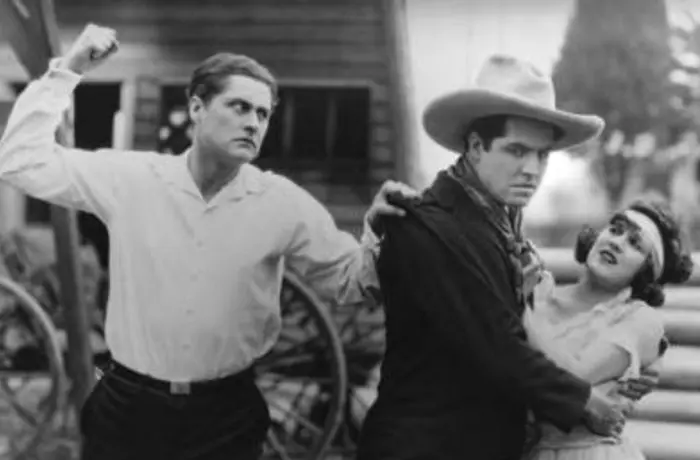
The plot, while ostensibly a tale of a woman finding her footing in a strange land, functions as an allegory for the industrialization of the American mind. The 'East' in the title represents not just a geographic location, but a set of values: law, order, and social hierarchy. The 'West' represents the atavistic urge for freedom and the law of the gun. This tension is explored with much more nuance than in The Unwelcome Wife, where the conflict is purely domestic. Here, the conflict is existential. When Reeves’ character is forced to adopt the 'civilized' methods of the East to save Aye, he loses a part of his frontier soul, a tragic irony that the film handles with surprising grace.
Furthermore, the film’s treatment of its supporting cast provides a rich tapestry of frontier life. We see the influence of early character studies like His First Job, where the minor roles are imbued with as much personality as the leads. These characters serve as the chorus, commenting on the central romance with a mixture of skepticism and awe. They represent the collective memory of the West, a memory that is being rewritten by the presence of the 'Eastern' interloper. This sense of a community in flux is palpable, making the stakes feel larger than just a simple love story.
Technically, West Meets East is a masterclass in silent film lighting. The use of natural light during the exterior shots creates a high-contrast look that emphasizes the harshness of the environment. In the interior scenes, the use of low-key lighting creates a sense of intimacy and mystery, reminiscent of the best work in The Highest Bid. The intertitles are also noteworthy; they are not merely functional but are written with a poetic flair that complements the visual imagery. They bridge the gap between the silent action and the complex emotional states of the characters, ensuring that the audience is never lost in the ambiguity of the performances.
The film also avoids the pitfalls of the 'child star' trope often seen in films like Jackie, focusing instead on mature, adult conflicts. This maturity allows the film to explore themes of regret and the passage of time. There is a haunting quality to the final act, a realization that even though the 'East' and 'West' have met, they can never truly merge. They can only coexist in a state of uneasy tension. This conclusion is far more satisfying than the neatly tied endings of lesser Westerns, leaving the viewer with a sense of profound contemplation.
In the broader context of Marion Aye’s filmography, which includes lighter fare like Her Tender Feet, West Meets East stands as her most substantial work. It proved that she was an actress of depth, capable of carrying a film that demanded more than just a pretty face and a charming smile. Likewise, Bob Reeves solidified his status as a reliable anchor for the Western genre, a role he would play with varying degrees of success for years to come. Together, they created a cinematic partnership that, while brief, left an indelible mark on the silent era.
Ultimately, West Meets East is a film that rewards the patient viewer. It is not a film of grand gestures or explosive action, but of quiet moments and subtle shifts in perspective. It captures a moment in time when the world was changing, and the cinema was changing with it. It is a reminder that even in the earliest days of the medium, filmmakers were grappling with complex questions of identity and culture. To watch it today is to step back into a world that is both familiar and alien, a world where the horizon was the only limit and the meeting of two people could signal the end of an era. It remains a vital piece of film history, deserving of a place in the pantheon of great American Westerns.
As we look back at the cinematic landscape of 1922, it is easy to get lost in the shadows of the giants. But in the quiet corners of film archives, works like West Meets East continue to shine. They offer a glimpse into the soul of a nation in transition, captured on flickering celluloid for all eternity. It is a film that speaks across the decades, reminding us that the conflict between who we are and where we come from is a universal struggle, one that transcends the boundaries of time, geography, and even the silence of the screen.
IMDb 5.5
1933
Community
Log in to comment.