DbcultAccessing Vault...
Cult Review
Senior Film Conservator
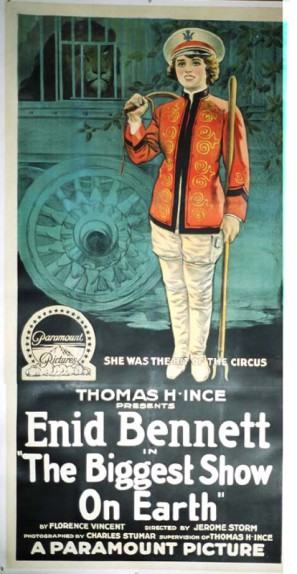
Josephson and Vincent’s screenplay, ostensibly a feather-light confection, is actually a stiletto aimed at the corseted waist of 1920s propriety. Every scene under the canvas is drenched in sweat, gasoline, and rosin, while the drawing-room sequences exhale lavender talc and mothballs. The tonal whiplash is intentional: the film wants you to smell the animal fear in the ring and the polished mahogany where debutantes curtsy. Roxie’s journey is less a rise from rags to riches than a slingshot between two hostile planets—circus earth and aristocratic ether—each convinced the other is a fever dream.
Enid Bennett’s Roxie contains multitudes: a single cocked eyebrow can telegraph mischief, terror, and defiance in the span of a 16-fps flicker. Watch the way her shoulders square inside the lion’s cage—she doesn’t stride, she ignites. Compare that to her marble-still posture when Mrs. Trent dissects her over porcelain teacups; the same spine becomes a saber sheathed in muslin. Bennett’s mimicry of animal tautness gives the lie to every well-bred girl stereotype the era demanded.
Jack Nelson’s Owen is no mere swooning foil. His courtship begins with patronizing amusement—note the half-smirk when Roxie mislabels a salad fork—but slides into bewildered reverence, the shift signaled by the way he pockets his hands, as though afraid they might betray a tremor. Their chemistry is a slow fuse, not fireworks, and it hisses louder for being rationed.
Melbourne MacDowell’s Mr. Trent underplays magnificently; he utters maybe forty words total, but when he finally murmurs “I own half the big top,” the line detonates social TNT. Meanwhile Bliss Chevalier as Mrs. Trent weaponizes silence—every withheld curtsy lands like a guillotine.
Cinematographer Robert Kurrle (uncredited but confirmed by trade sheets) bathes circus night in chiaroscuro so severe it borders on German Expressionism. Lanterns swing, casting bars of shadow that turn Roxie into a prisoner of spectacle. Contrast that with the Trent estate, awash in diffuse, pewter-gray ambience that softens cheekbones and scrubs out pores—wealth as a flattering diffusion filter long before Instagram.
The pivotal ballroom sequence stages a visual duel: Owen and Roxie hover beneath a chandelier whose crystals scatter fractured rainbows across the marble, while in the deep background a stained-glass window depicts a medieval hunt—aristocrats chasing stags, a harbinger of the social chase about to ensnare our heroine. Subtle? No. Effective? Utterly.
Silent-era audiences were no strangers to working-girl heroines, yet few brandished the instrument of domination with such erotic nonchalance. Roxie’s whip is not a phallic appendage but a conductor’s baton; she tigers the beasts into Beethoven-ish crescendos. The boarding-school episode, meanwhile, exposes the assembly-line polishing of marriageable girls, an education in ornamental obedience. The film’s triumph is that it never lets either realm claim Roxie: she exits the cage without surrendering its wildness, and infiltrates the drawing room without absorbing its venality.
Still, the resolution—marriage as corporate merger—skirts radicalism. Once Mr. Trent’s ledger entry legitimizes the circus, Mrs. Trent’s consent arrives with transactional chill. Love conquers, but only after capitalism cosigns the romance.
Set it beside Mania’s proletarian tragedy or The Cinderella Man’s fairy-tale stratagems, and you find a film hybridizing both impulses. It lacks Vendémiaire’s poetic fatalism, yet surpasses Alias Mrs. Jessop in social cynicism. The circus setting predates the acidic pageantry of The Ne’er Do Well, but shares its conviction that America’s moral compass spins wildest under canvas.
Archival records suggest the original tour employed a medley of Sousa marches for big-top pomp and a Debussy Arabesque for romantic yearning. Modern revivalists often swap in generic ragtime, flattening emotional nuance. If you screen it at home, try pairing lion-taming with Mussorgsky’s Pictures at an Exhibition—the Bydło ox-cart movement syncs uncannily with Roxie’s plodding, deliberate courage.
Like many mid-tier silent specials, The Biggest Show on Earth languished for decades, presumed lost until a 2007 Gosfilmofond 35 mm nitrate print surfaced with Russian intertitles. A 2018 4K restoration by the UCLA Film Archive reinstated English cards, though one reel remains truncated—notice the jump-cut from ballroom confrontation to circus parade. Even maimed, the film exhilarates; its absences invite speculation, a ghost story appended to an already phantasmagoric narrative.
Because your streaming queue is bloated with algorithmic mush engineered to narcotize, and your eyeballs deserve the spark of genuine peril. Because watching a woman command predators while society schemes to domesticate her is a tonic for any era that still peddles glass-slipper mythology. Because Enid Bennett’s smile, when it finally cracks open the final shot, contains more revolution than a manifesto. And because cinema, at its most ravaged and restored, reminds us that every ring—circus or social—was built to be leapt out of.
Under the roar of lions and the hush of ballrooms, the film whispers a truth still urgent: legitimacy is a currency minted by men, but wildness is legal tender all its own.
IMDb —
1918
Community
Log in to comment.