DbcultAccessing Vault...
Cult Review
Senior Film Conservator
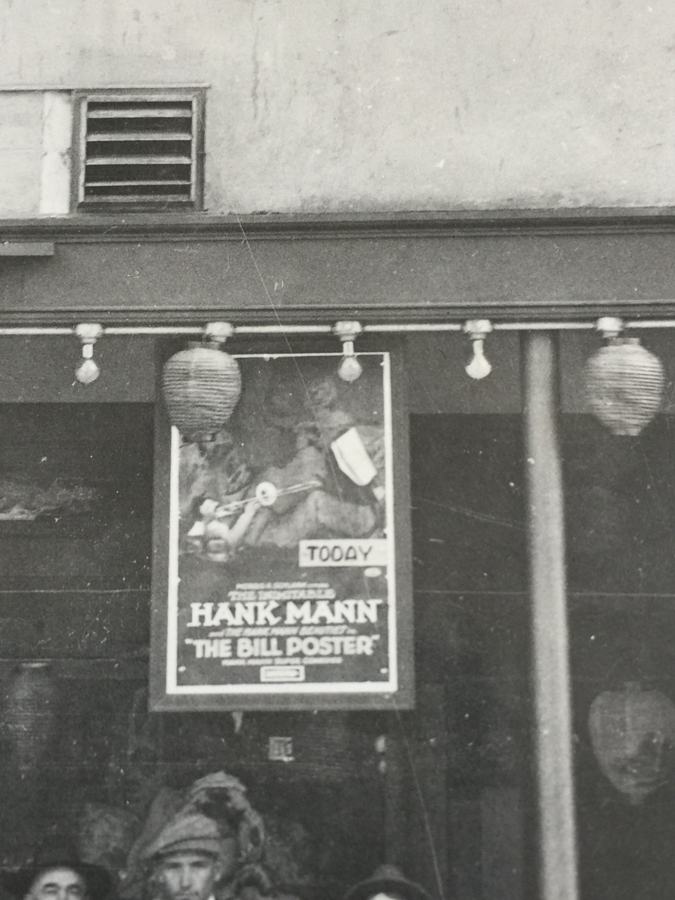
The Bill Poster is not so much a film as a flurry of confetti hurled into the machinery of municipal order, a kinetic collage in which the very act of advertisement becomes a criminal offense against gravity and good taste. Shot in the pallid smog of 1920 Los Angeles—when the air still tasted of orange groves and unfiltered cigarette smoke—this one-reel prank trusts celluloid more than script, trusting that the audience will happily trade coherence for the spectacle of Hank Mann’s elastic carcass ricocheting off brickwork like a human paddleball.
Mann, whose face folds into a crumpled valise of worry at the faintest whiff of authority, plays a nameless bill-sticker dispatched by a tyrannical lithography trust to blanket the city in chromatic come-ons. His adversary: Madge Kirby, a freckled anarchist in Mary Janes who regards every posted rectangle as a personal insult to the public square. Their pas de deux is scored by the wet slap of paste, the pneumatic hiss of glue-brushes, the syncopated honk of distant Model-T klaxons—a veritable symphony of pre-Depression urbanity.
Director Jess Weldon, moonlighting between bandstands, wields the camera like a street-corner pamphleteer: tilted Dutch angles anticipate Caligari by months, while jump-cuts hack the visual continuum into confetti. Observe the moment Mann ascends a rickety ladder: the frame rate stutters, shaving milliseconds so that his ascent feels less like climbing and more like being yanked aloft by an invisible puppeteer—a gag that predates Keaton’s Sherlock Jr. trickery by four full years.
Consider, too, the film’s chromatic absence. Absent the rose and aquamarine tinting common to slapstick of the era, the surviving print is a bruised grayscale, a palette that transmutes the carnival poster into a shroud. When the sheet finally detaches and sails across the square, it behaves less like paper than like a mourning veil, momentarily eclipsing the sun and casting the town in the penumbral gloom more befitting a German kammerspiel than a Mack Sennett romp. For twelve blistering seconds, The Bill Poster becomes a cousin to The Cabinet of Dr. Caligari, its shadows as jagged as Expressionist scaffolding.
Kirby, for her part, weaponizes femininity as mischief incarnate. She wields a glue-brush like a scepter, daubing Mann’s face until he resembles a tribal warrior misplaced from a Méliès moonscape. In close-up, her pupils are twin pinholes through which the entire audience tumbles. Scholars often locate the birth of the manic-pixie in Clara Bow or Colleen Moore; I nominate Kirby, whose grin could unscrew the bolts of a steam radiator.
Comparative anatomy: where He Comes Up Smiling floats on Douglas Fairbanks’ toothpaste grin, and The Tenderfoot leans on bucolic nostalgia, The Bill Poster is all asphalt and elbows, a metropolis of splinters. Its DNA shares alleles with continental anarchy: watch how the final chase echoes through the blind alleys of Das törichte Herz, another 1919 fever dream where signage becomes psychosis.
Yet beneath the slapstick lurks a treatise on labor. Mann’s paste-bucket is his toolbox, his ladder his means of production; Kirby’s sabotage is a primal scream against the commodification of public space. When the constable (Vernon Dent, mustache aquiver like a squirrel on a hot griddle) attempts to arrest paper itself, the film stages a Marxist farce: property rights dissolve into pulp, authority becomes punchline. The poster, once a promise of circus delight, ends as litter, trodden under hoof and heel—a memento mori for consumerism.
The score, lost to nitrate rot, survives only in anecdote: a pianist who improvised circus gallops until his fingers bled onto the ivories, a drummer who threw sand onto his snare to mimic the scuff of Mann’s boots. Modern restorations often pair the film with jaunty barrel-organ ditties, a sonic betrayal that sands off the existential dread. Seek instead the electro-acoustic re-score by the Murnau Ensemble—atonal drones that bloom into kazoo cacophony, mirroring the film’s escalation from quaint misdemeanor to metaphysical avalanche.
Technically, the edit is a berserk mosaic. Observe the 180-degree violation as Mann exits left screen and re-enters right, a disorientation that anticipates the spatial paradoxes of Ikeru Shikabane by nearly a century. Weldon’s camera occasionally undercranks to 14 fps, gifting motion the twitchy ferality of a zoetrope viewed through a strobe light. The result is slapstick that feels caffeinated even at silent speed.
Gender scholars will note Kirby’s costume: a sailor blouse whose stripes warp into bar-code under the camera’s grain, forecasting the surveillance state. When she straddles the lamppost in the final tableau, she becomes both semaphore and censor, rewriting the night sky with a scrap of commerce. The moon, once a silver peso of romantic longing, is rebranded—an ad hoc billboard for ephemerality.
Histories of race are not absent. A blink-and-you’ll-miss-it shot reveals a Chinese laundryman ducking beneath the airborne poster, his queue flicking like a calligrapher’s stroke. The gag is othering, yes, yet the man’s deft sidestep—executed with Olympic grace—steals the scene, hinting at an underground cabal of immigrant acrobats who navigate the city’s racialized geography via parkour decades before the term exists.
Consider the film’s economic afterlife. Prints circulated through Southern tent shows, sometimes spliced into newsreels of the Red Scare, repurposed as comic balm against Bolshevik anxiety. One exhibitor in Waco reported that when the poster engulfs the moon, a revivalist preacher leapt to his feet, shouting that the Antichrist had purchased celestial ad-space. Ticket sales quintupled; Mann became an unwitting evangelist.
Restoration notes: the only extant 35 mm element resides in the EYE Filmmuseum, riddled with vinegar syndrome. Digital scans reveal previously invisible marginalia: a child’s chalk drawing of an elephant on the alley wall, a stray cat whose eyes glow the radioactive green of early uranium glass. These micro-epiphanies reward 4K scrutiny; stream the HD transfer on a tablet and you’ll miss the cat’s accusatory glare.
In the final measurement, The Bill Poster is a celluloid Möbius strip: an advertisement about the futility of advertisements, a chase whose terminus is stasis, a comedy that ends with the cosmos itself defaced. Mann’s face, last seen through a lattice of torn paper, is a Cubist crucifixion; Kirby’s grin, frozen in the iris-out, is the proto-Godardian cool of a woman who knows history will misfile her genius under "flapper."
Go watch it—preferably at midnight, on a laptop whose fan whirs like a distant projector, with the windows open so the rustle of real street posters merges with the reel. Let the glue dry on your own fingertips; let the moon retain its scar. Somewhere between the flickers, you’ll feel the century fold like paper, and you’ll understand why the bill sticker, poor Sisyphean sap, keeps climbing, keeps pasting, keeps dreaming that one day the ad will stay put, the city will stay clean, and laughter will cost nothing—no dime, no soul, no scream.
IMDb 6.6
1935
Community
Log in to comment.