DbcultAccessing Vault...
5.8/10
Senior Film Conservator
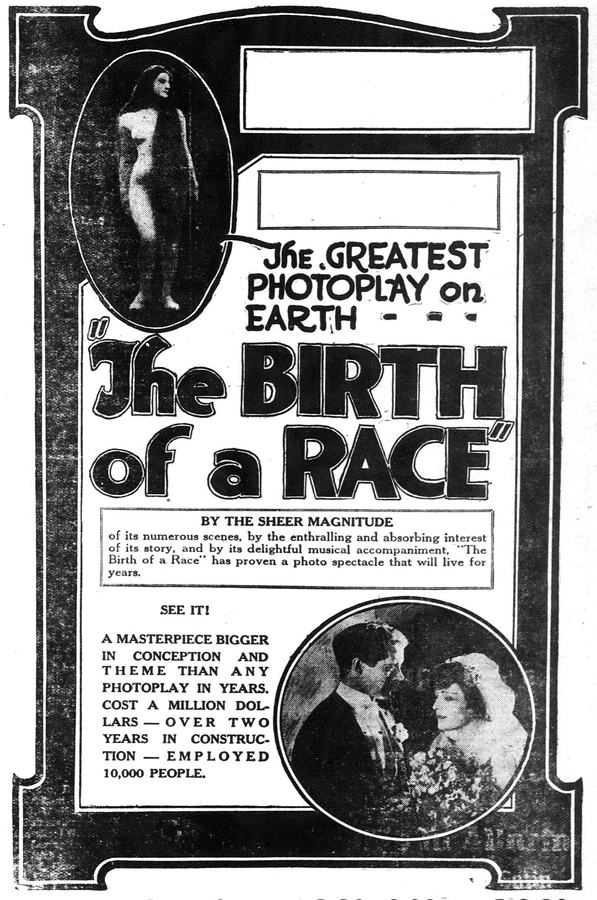
A definitive 5.8/10 rating for a film that redefined the boundaries of cult cinema. The Birth of a Race remains a cornerstone of transgressive art.
Imagine, if you can, a film that opens with the cosmos still cooling, comets scratching the velvet dark, and ends with a widow clutching a telegram while the Star-Spangled Banner drips crimson from the rafters. That is the vertiginous leap The Birth of a Race demands of its audience—an odyssey that wants to be both Sunday-school pageant and newsreel shriek, both patricidal opera and recruitment poster.
Released in the fevered summer of 1918, when influenza and jingoism competed for column inches, the picture positions itself as corrective to D. W. Griffith’s The Birth of a Nation. Yet its rebuttal is so maximalist—biblical plagues, aerial dogfights, crucifixion iconography—that it ends up sprinting past politics into a hallucinated America where democracy itself is a mortal protagonist, bleeding on the operating table.
The first twenty minutes are a delirious flip-book of civilization: clay Adam morphs into marble Caesar; Noah’s flood sloshes against the gunwales of the Mayflower; Lincoln’s stovepipe hat materializes above a trench periscope. Directors John W. Noble and Thomas Bret stitch these vistas with double-exposures so dense they feel like palimpsests—each frame inscribed atop another until cellulite itself gasps for air. The effect is not continuity but premonition: history as cyclical spasm hurtling toward the apotheosis of the American idea.
Cue the Schmidts, our allegorical Every-clan. Fritz (Louis Dean) lords over a Pittsburgh steel empire whose smokestacks hurl soot heavenward like inverted prayers. In parlor conversations shot with cavernous chiaroscuro, he insists that “Kaiserism is order; democracy is entropy.” The line lands with metallic clang, underscored by anvils on the soundtrack—yes, anvils, because by 1918 even silence has to audition for patriotism.
Oscar (David Wall), the eldest, is a study in Expressionist paranoia—hair slicked like oil, eyes twin periscopes scanning for ideological torpedoes. George (John Reinhardt), contrariwise, radiates Griffith-boy earnestness; when he salutes the camera, the iris-in practically sings the Battle Hymn of the Republic. Between them flits Louisa (Belle Seacombe), a Red-Cross Madonna whose uniform is pressed so stiffly it could stand sentry without her.
Their fraternal rupture is staged in a foundry at dusk, furnaces vomiting lava-light onto their faces. Oscar brandishes a miniature Iron Cross he forged from plant scrap; George retorts by unfurling a pocket-sized Declaration, its parchment trembling like a caught bird. The camera pirouettes 360°, a vertiginous stunt for 1918, turning the industrial cathedral into a moral centrifuge. We exit the scene dizzy, unsure which artifact glows hotter.
Mid-film, the narrative plunges into a French field hospital, a cavernous set draped in gauze and fatalism. Here, editing becomes cardiac: cuts arrive like arrhythmia. Louisa, ministering to gassed doughboys, glides between stretchers haloed by Caravaggio chiaroscuro—every lantern a portable Last Judgment. Exterior shells boom in negative space, the sound of absence more terrifying than any boom-track.
The pivotal assault sequence—German storm troopers pouring through shattered stained-glass—owes more to medieval siege than to Verdun realism. In the melee, Oscar, now in Pickelhaube, lunges toward a nurse he mistakes for Belgian resistance. Only after the bayonet has parted fabric does recognition detonate across his face; the moment is hammered home by an intertitle that simply reads “Blood remembers.” George, convalescent nearby, seizes a Colt and fires. The fratricide is framed in silhouette against a burning triptych of Christ, Lincoln, and Lafayette—a trinity that sanctifies the kill.
George returns stateside freighted with guilt and souvenir medals. The domestic showdown unfolds in the Schmidt library, a mausoleum of gilt spines and heraldic shields. Mother Schmidt (Mary Carr) grapples with a hulking spy (Ben Hendricks Sr.) over dossiers meant for German submarines. Fritz, witnessing the melee, experiences a conversion worthy of Paul on the road to Damascus—except the road is paved with steel profits. He clubs the intruder with a bust of Goethe, an act that symbolically murders Teutonic idealism itself.
The film’s denouement is a tableau of forced reconciliation: the Stars-and-Stripes drapes Oscar’s coffin, Fritz salutes, George plants a victory garden atop the family’s slag heap. Democracy, having survived its crucible, ascends in superimposed double exposure—Lady Liberty morphing into Columbia, then into the Statue of Freedom atop the Capitol dome. Fade-out arrives not as closure but as covenant: the viewer drafted into perpetual vigilance.
Louis Dean’s Fritz oscillates between Bismarckian bravado and repentant Lear without the benefit of spoken modulation; instead he weaponizes posture—shoulders squared like battleship prows, then crumbling into a question mark. John Reinhardt’s George channels Fairbanks vigor but undercuts it with thousand-yard stares that anticipate post-war PTSD dramas decades early. Belle Seacombe has the trickiest arc: she must radiate compassion while carrying the film’s moral Geiger counter. Her eyes—wide, wet, unblinking—register every hypocrisy the screenplay smuggles past the censors.
Cinematographer George F. Wheeler opts for a palette of iron-oxide reds and Prussian blues, each reel hand-tinted so that blood resembles molten steel and night scenes exhale cobalt frost. The limited tech becomes aesthetic philosophy: color as moral semaphore. When the hospital burns, amber nitrate flickers like vintage daguerreotype, suggesting memory itself is flammable.
Though released silent, the studio circulated a cue sheet calling for “Ride of the Valkyries” to segue into “Yankee Doodle” immediately after Oscar’s death—Wagner strangled by Foster. Contemporary exhibitors obliged, creating mash-ups so tonally whiplashing that audiences reportedly laughed and wept within the same minute. Today one can reconstruct the effect via playlist, but nothing captures the eerie friction of hearing a zither accompany mustard-gas footage.
Modern sensibilities will bristle at the film’s conflation of German ethnicity and imperial aggression; every umlaut is a harbinger of Hunnic atrocity. Yet the script, penned by committee, exhibits fissures that let nuance seep through. Fritz’s final monologue denounces “the virus of tyranny, not a people,” a line smuggled past the propaganda office by writer Anthony Paul Kelly, an Irish-American skeptic of Anglo jingoism.
Comparative lensing proves illuminating. Where Het geheim van het slot arco domesticates war into drawing-room intrigue, The Birth of a Race detonates the drawing room. Against Kindling’s proletarian melodrama, Schmidt steel millions feel almost like meta-commentary on profiteering.
Box-office receipts were respectable, yet the armistice blunted the film’s urgency; by November 1918 audiences craved escapism, not reminders of fratricide. Prints vanished into warehouse purgatory, resurfacing only in the late ’60s when a mislabeled canister in a Des Moines barn yielded a tinted dupe. Today it circulates among archivists as both curiosity and cautionary tale—an artifact demonstrating how cinema can simultaneously humanize and dehumanize, how every splice is a scalpel on the body politic.
Watch it not as antiquated sermon but as fever dream—an America wrestling its own demons in the fun-house mirror of wartime hysteria. Then ask yourself: in our current age of algorithmic propaganda, are we replaying this same reel, frame by frame, tint by tint?
IMDb 5.1
1936
Community
Log in to comment.