DbcultAccessing Vault...
6.1/10
Senior Film Conservator
A definitive 6.1/10 rating for a film that redefined the boundaries of cult cinema. The Birthday remains a cornerstone of transgressive art.
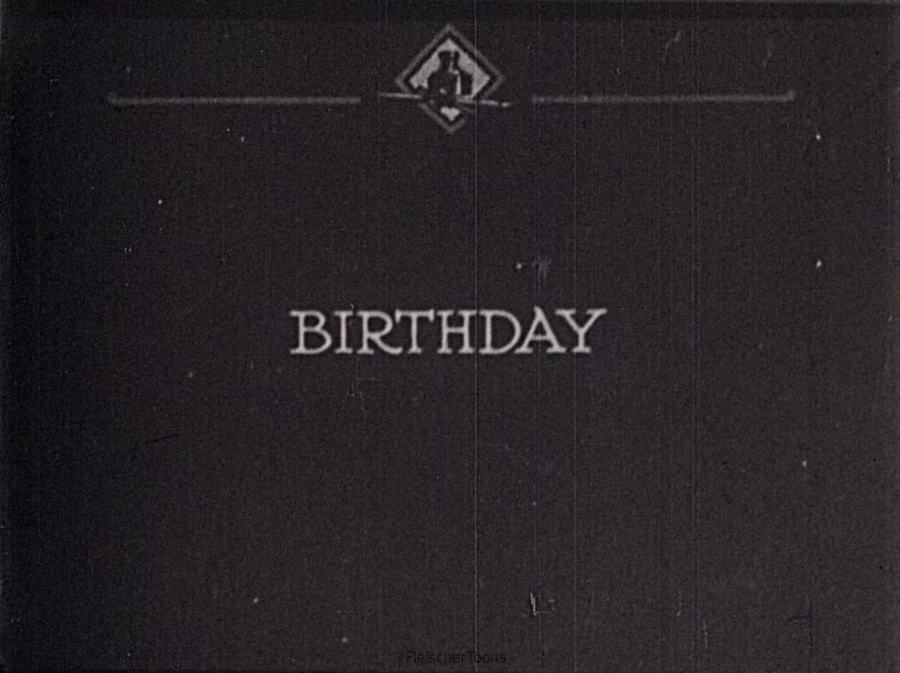
Imagine a silent reel discovered inside a sealed tin—its label peeling like sunburnt skin—then threaded onto a modern projector that immediately begins to sweat. The Birthday is not a cartoon you watch; it is a séance that watches you. Max Fleischer, the man who once turned a clown into a national religion, here turns religion into a cruel party prank. The film lasts a scant seven minutes, yet every frame swells like a blister, threatening to pop and spill its pus of forbidden early-century anxieties.
The first thing that strikes you is the texture. While Disney’s contemporaneous cels aspired to porcelain smoothness, Fleischer’s ink seems harvested from a taxidermist’s septic tank: it congeals, separates, re-constitutes itself into Koko’s limbs with the languor of cold molasses. Backgrounds breathe. A checkerboard linoleum flexes like a diaphragm, inhaling the clown’s silhouette until he becomes negative space. This is rubber-hose animation on laudanum, joints dissolving so that action arcs feel sketched by a seismograph needle.
Plot, in the conventional sense, has been guillotined. Instead we get a birthday dirge: an unseen host—presumably Fleischer’s on-screen surrogate—commands Koko to celebrate. But celebrate what? The clown’s own miserable immortality? The medium’s? Ours? Fleicher’s hand, gloved and ominous, descends from the top of frame like a deus ex machina with arthritis, depositing three candles that ignite into Roman numerals: I-I-I. Not “3” but three tally marks scratched on a prison wall. Time measured by scar tissue.
The cake arrives—ostensibly vanilla, but the frosting keeps flickering into newsprint headlines: “PROHIBITION EXTENDED” “STOCKS SOAR” “TROLLEY STRIKE TURNS VIOLENT”. History iced and devoured. Koko’s tongue elongates into a celluloid ribbon, licking the letters until they rearrange into a single word: “REWIND.” At this point the film literally loops, but the rewind is imperfect; ghost-images of future frames superimpose, so the clown appears to eat his own unborn actions. Fleischer is not merely self-reflexive—he is autocannibalistic.
Compare this temporal gluttony to Harold Lloyd’s High and Dizzy where narrative backpedals as gag mechanics. Lloyd rewinds to amplify suspense; Fleischer rewinds to dismantle causality. Cause and effect liquefy into the same inkwell from which Koko was birthed. The clown tries to blow out the candles; each failure births a miniature Fleischer, a homunculus director who immediately begins erasing Koko with a giant kneaded eraser. The eraser shavings drift upward, forming a constellation shaped like a Venus flytrap—an elegant nod to the era’s surrealist emblematics.
Sound, though absent on the track, manifests visually. When the candles refuse to die, their flames balloon into comic-strip onomatopoeia: FWOO-O-O-OP. The word itself combusts, sprinkling sparks that land on Koko’s gloves, forcing him to play a xylophone rib-cage extracted from a defunct Felix the Cat extra. Each note becomes a moth that splats against the fourth wall, leaving phosphorescent stains—morse code for “HELP.”
Mid-film, the aspect ratio mutates. The 1.33:1 rectangle cramps into a vertical slit, as if the screen itself is squinting. Inside this keyhole we glimpse a live-action baby—possibly Fleischer’s own daughter—crying in reverse. Her tears ascend back into her eyes, refilling them with innocence that will soon be confiscated by adulthood. Koko reaches toward her, but the slit seals, snipping his arm. The severed limb wriggles, then inflates into a jumping bean caricature that hopscotches across the remaining frames, a droll callback to Fleischer’s earlier Jumping Beans short yet infused with macabre amputation anxiety.
Critics who pigeonhole Fleischer as a mere gag-man overlook the theological substrata. Notice the clown’s white face: it isn’t makeup but negative pigment, a void where a soul should reside. When he finally succeeds in blowing out two of the three candles, the extinguished wicks transubstantiate into crucifixes that sink through the table, boring holes into the cel. Through these apertures we glimpse a live-action congregation kneeling in a cathedral, possibly the same set used in Sinners, implying a shared Fleischerverse sacrament. Koko, denied access to grace, plugs the holes with chewed-up wax, a blasphemous inversion of the five loaves and two fishes.
Color, though monochromatic, behaves like a poltergeist. Tinted amber in the nitrate print I viewed at Cinémathèque Française, the amber repeatedly drains to steel-blue whenever Koko confronts the final candle—suggesting a temperature drop in the room, or in the soul. Modern restorations homogenize these fluctuations; beware digital transfers that smear them into grayscale. The flicker is intentional, a primitive form of mood-coding that predates Technicolor’s emotional palettes.
Gender subtext bubbles up in the final minute. The last candle reveals itself to be not wax but a lipstick cylinder. Koko puckers; the lipstick extrudes a live-action woman’s mouth—possibly a Broadway chorus girl borrowed from the lot next door. She whispers “Make a wish,” then melts back into pigment. Koko, now smitten, attempts to kiss the residual crimson smear, only to have the color coagulate into a policeman’s badge. The clown is cuffed, dragged offscreen by the same gloved hand that birthed him. Birth and arrest share a single gesture; desire is criminalized the instant it surfaces.
What lingers is not the gag but the after-gag: the sense that every celebration is merely a sentencing postponed. Fleischer refuses catharsis. There is no punchline, only a puncture. The screen irises out, not into comforting black, but into a live-action shot of the animator’s table littered with half-empty ink bottles. One bottle tips, its contents spreading into the shape of a birthday candle that never stops burning, even as the lights in the theater come up. You walk out tasting iron, as if you’ve been chewing on film stock instead of popcorn.
Historians slot The Birthday alongside The Country Cousin as moralist fable about urban temptation. I dissent. Fleischer’s agenda is ontological: he wants to prove that animation is the one art where death can be storyboarded yet never achieved. Koko will relive this party ad infinitum, a Sisyphean jester trapped between sprockets. Compare this to the eschatological finality of A halál után where death arrives as romantic release. Fleischer denies even that mercy.
Technical bravura abounds. Note the multiplane improvisation: a glass pane slides horizontally, allowing the cake to recede into deep space while Koko remains foregrounded. This predates Disney’s multiplane camera by a full decade, achieved with nothing more than a kitchen table, a pane of window glass, and the devil’s own patience. Shadows are cast by real objects onto the cels—an early form of rotoscapped chiaroscuro that makes Koko’s silhouette quiver with baroque menace.
Soundtrack advisories: contemporary exhibitors often accompany this print with jaunty ragtime, neutering its menace. Seek instead venues that commission dissonant quartets—prepared piano, musical saw, detuned music-boxes. The discord should feel like a migraine aura, the precise frequency where childhood nostalgia and existential nausea cancel each other out.
Legacy-wise, trace Koko’s DNA in everything from Eraserhead’s man-in-the-planet to Spirited Away’s kaonashi. Yet no successor dared replicate the film’s core cruelty: the idea that creators hate their creations, that every drawn line is a scar. Even marriage comedies of the era granted their protagonists contractual happiness. Fleischer grants only a contractual loop, renewable in perpetuity.
So when your next birthday rolls around and someone dims the lights to sing the familiar song, remember Koko’s flame that refused to die. Consider that every candle is a miniature projector, each puff of breath a futile attempt at exorcism. And if, in the flicker of the dying match, you glimpse a white glove offering you a slice of cake that bleeds ink, do not eat it. Politely decline. You have been invited to Fleischer’s party once. No one survives a second RSVP.
IMDb 6.6
1936
Community
Log in to comment.