DbcultAccessing Vault...
6.9/10
Senior Film Conservator
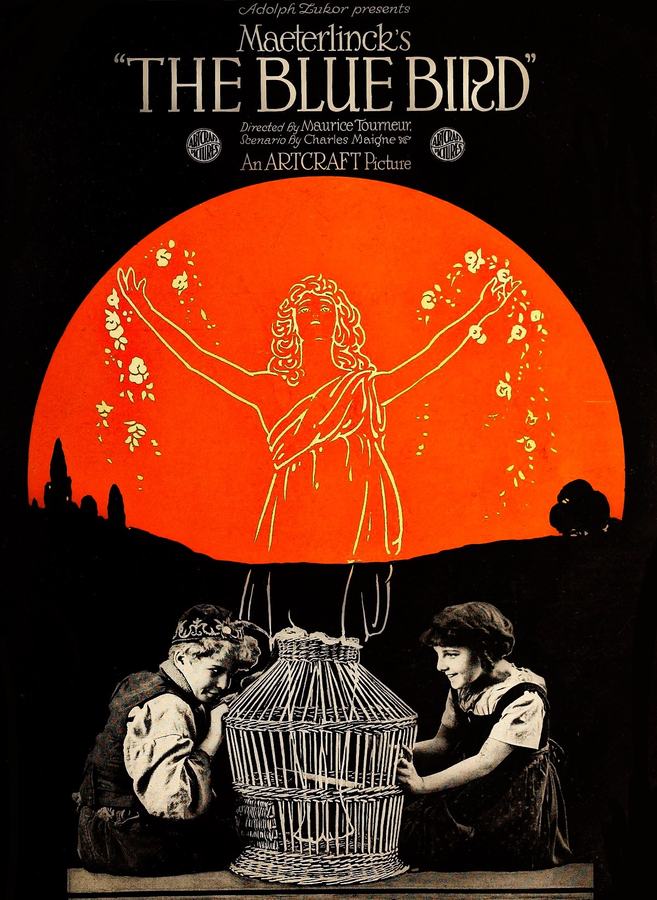
A definitive 6.9/10 rating for a film that redefined the boundaries of cult cinema. The Blue Bird remains a cornerstone of transgressive art.
There are films you watch, and then there are films that watch you—films whose sprocket holes seem to blink like eyelids, measuring the width of your wonder. Maurice Tourneur’s The Blue Bird belongs to the latter phylum: a 1918 phantasmagoria whose very celluloid appears breath-fogged with the carbon dioxide of dream logic. Watch it today and you’ll swear the nitrate is sweating ether; watch it in a cathedral-quiet cinema and you may feel the celluloid’s silver halides twitch, as though every frame were a moth pinned but still pulsing.
The tale is deceptively simple—two peasant children, Tyltyl and Mytyl, are yanked from hearth-side hunger into a cosmos where allegories wear ball gowns and nightmares sport monocles. A fairy—part governess, part anarchic ringmaster—commissions them to fetch the Blue Bird of Happiness, a creature so elusive that even the concept of possession decays on contact. What follows is a pilgrimage across a suite of pocket universes: the Land of Memory, where dead grandparents warm their hands at a ghost-fire; the Palace of Night, whose corridors sweat primordial dread; the Kingdom of the Unborn, a phosphorescent greenhouse of souls waiting for passports to flesh. Each realm is tinted in hues that predate Technicolor’s vocabulary: apricot sunrise, absinthe twilight, bruise-blue midnight. The tints don’t merely color—they sing, like stained glass with a throat.
Yet Tourneur’s genius lies not in spectacle but in the way spectacle keeps collapsing into ethical vertigo. When the children finally trap the bird inside a cage of their own making, the creature’s azure fades to pigeon-grey the instant ownership calcifies. Happiness, it turns out, is a negative space shaped only by the geometry of sharing. The film’s final shot—Tyltyl presenting the bird to a sick neighbor—plays like a silent rebuttal to every capitalist fairy tale that whispers you can buy joy in installments.
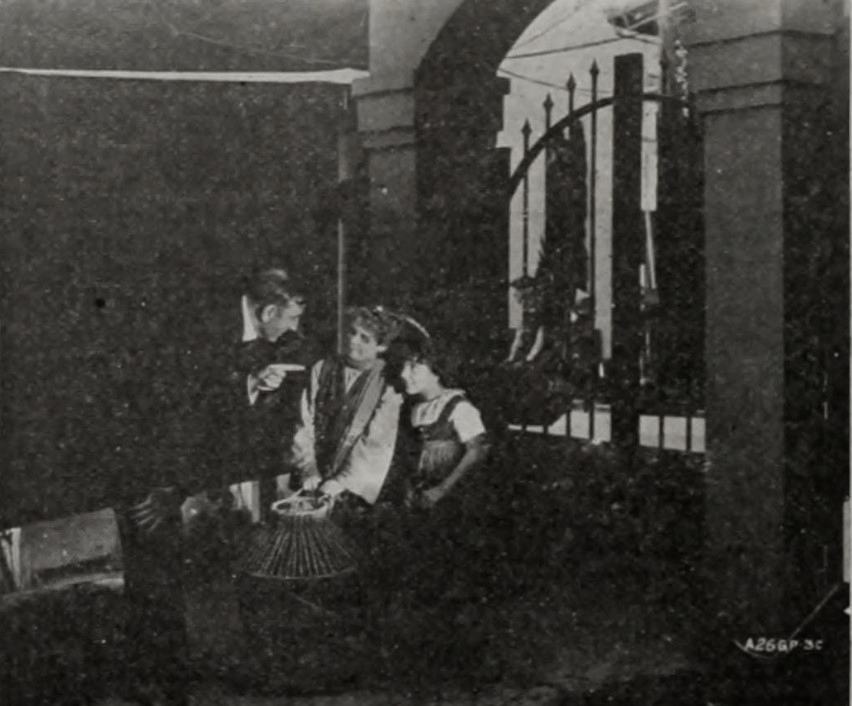
Compare this to the era’s other quests: U kamina traffics in fatalism, The Marble Heart sculpts desire into statuary, but The Blue Bird dares to suggest that the grail was the giving away, not the possessing. Its DNA haunts later odysseys—there’s a shimmer of it in the maze of The Labyrinth, a whisper in the triumphalism of The Spirit of the Conqueror. Yet none quite replicate its audacity: to stage bliss as a fugitive shade that deepens only when you open your fist.
Performances oscillate between melodrama’s semaphore and something close to childlike documentary. Lyn Donelson’s Tyltyl carries the wide-eyed bewilderment of someone who has just discovered that language can lie; Tula Belle’s Mytyl moves with the gravitas of a miniature priestess officiating at the sacrament of wonder. When they stand before the Kingdom of the Unborn—tiny souls blooming like bioluminescent orchids—their faces register not awe but a prelapsarian recognition, as though remembering rather than discovering.
Charles Maigne’s adaptation trims Maeterlinck’s symbolist verbosity without cauterizing its mystic pulse. Intertitles arrive like tarot cards—laconic, arcane, never explanatory. “The Night is afraid of Light,” reads one, floating over an image of darkness folding into itself like a startled cat. The sentence lingers long enough to become koan, then vanishes, refusing to explicate its own riddle.
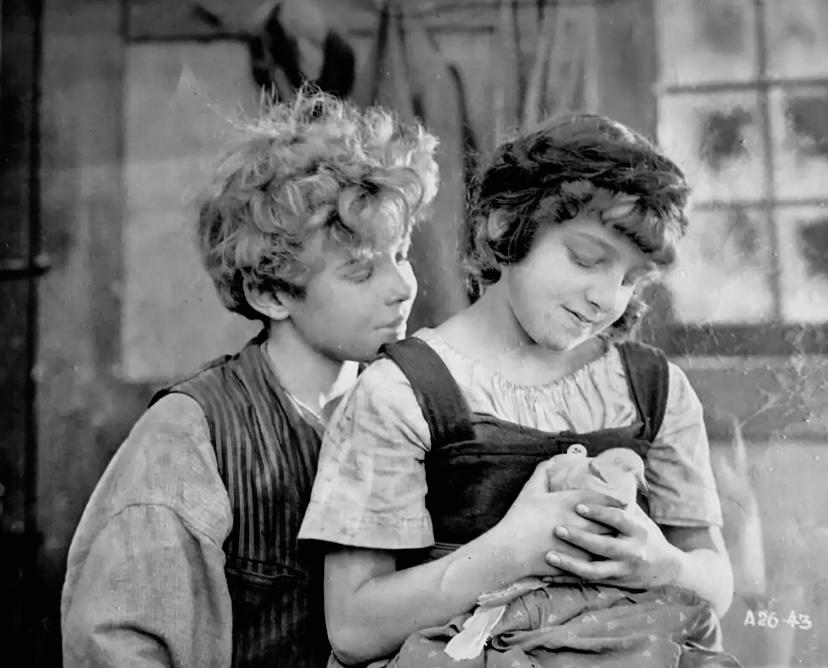
Tourneur’s visual grammar invents syntax that sound cinema still struggles to conjugate. Depth is staged not via focal length but via moral altitude: when the children ascend to the Kingdom of the Future, they climb a staircase of vapor, each step dissolving behind them—an oneiric escalator whose very ephemerality is the price of admission. Conversely, the descent into Night’s palace is a lateral tracking shot through corridors where shadows pool like spilled ink, the camera gliding past caryatids whose eyes flicker with candle-flame. The effect is proto-Lynchian: you feel you’re trespassing inside someone’s suppressed id, celluloid as Rorschach.
Color tinting here is not decorative but dialectical. The amber glow of Memory warms the frame until you almost smell peat smoke, while the green-blue wash of Night’s realm chills the retina, inducing a somatic shiver that no CGI chill-wind can replicate. These tints were achieved by dyeing each print by hand—an army of anonymous women with camel-hair brushes, tinting 200,000 frames each, their wrists moving in menstrual synchrony with the film’s lunar imagery. Every blush of rose or lick of cobalt is thus a palimpsest of female labor, invisible authorship baked into the emulsion.
The supporting phantoms deserve their own pantheon. The personified Bread, Sugar, Fire, and Water cavort in a danse macabre of domestic surrealism: Bread swells like a capitalist blowfish, Sugar pirouettes in glinting granules, Fire pirouettes with Vulcanal wrath, Water sluices across sets in aqueous serpentine coils. Their choreography anticipates the anthropomorphic slapstick of later Disney, yet inflected with a sinister edge—when Fire licks the hem of Night’s robe, you half expect the celluloid itself to combust, as though the medium were protesting its own inflammability.
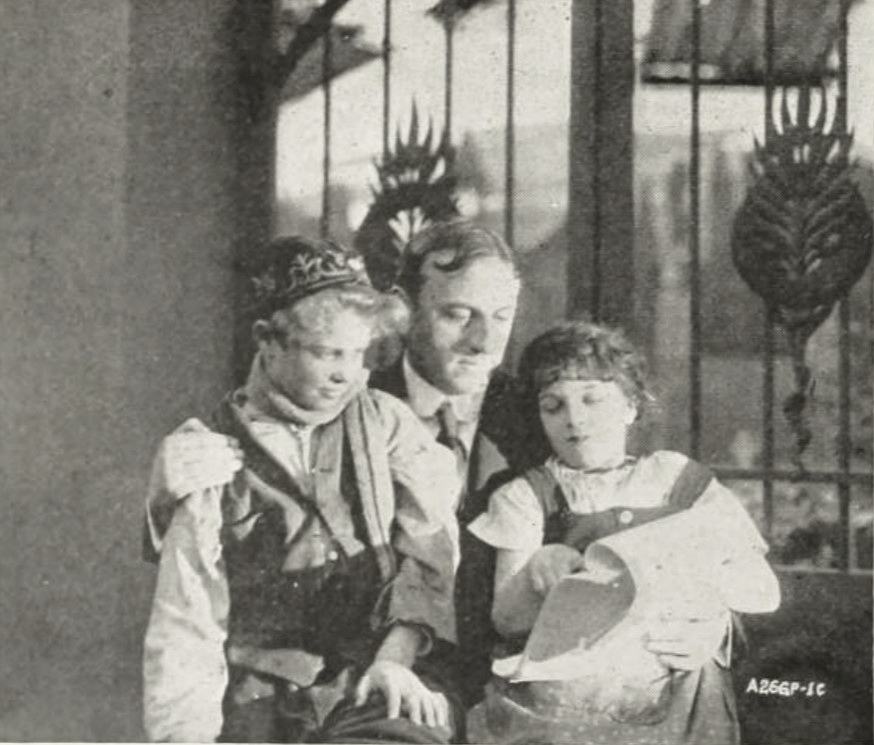
Sound, of course, is absent, but the silence is so textured it becomes a character. In the hush you hear the projector’s mechanical panting, the audience’s collective inhale as the Blue Bird’s true location dawns. The absence of orchestral score (many prints circulated without accompaniment) forces you to supply your own internal music—my brain defaulted to Erik Satie’s Gymnopédies, whose limpid melancholy dovetails with the film’s conviction that joy is always already tinged with loss.
Critics of the era dismissed the film as “children’s pap,” proving that philistinism is a renewable resource. Yet watch it beside For France or Rumpelstiltskin and you’ll see how radical Tourneur’s restraint feels—no patriotic bombast, no folkloric moralism, only the trembling threshold where ethics and aesthetics merge into a single tremulous note.
Restoration efforts have stabilized the tints, though some scenes still flicker like moth-wings caught in projector gate-light. The 4K scan reveals brushstrokes in the dyes, ghost-signatures of those anonymous colorists. In one shot—Tyltyl’s hand reaching toward the bird—you can see where the cyan dye pools thicker at the knuckles, as though the boy’s very skin were absorbing the quest’s chromatic obsession.
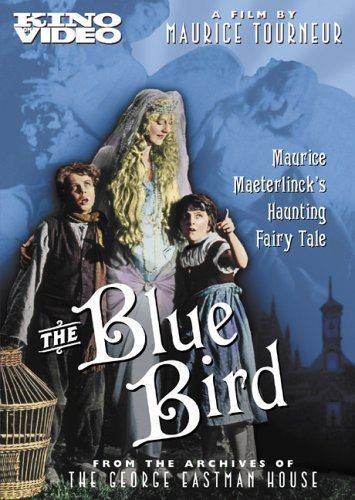
Contemporary viewers may balk at the allegorical literalism, yet allegory here operates like a Möbius strip: the moment you think you’ve decoded the symbol, it flips to reveal its own backside is its face. The Blue Bird isn’t happiness; it’s the act of searching for it, the open-handed gesture that keeps the color alive. In an age when algorithmic feeds sell wellness as commodity, Tourneur’s silent fable feels almost seditious: it insists that bliss is a non-fungible token whose blockchain is the human heart.
Compare the film’s finale to En Søns Kærlighed or The Blindness of Virtue, where virtue is rewarded with narrative closure. Here closure is refused; the bird may fly away tomorrow. The last intertitle—“And now, give it away”—hangs in the mind like a dare, a recursive script that rewires the viewer’s moral circuitry long after the end card flickers.
I’ve seen The Blue Bird five times now, each on a different continent, each in a state of metabolic vulnerability—jet-lagged in Paris, hungover in Tokyo, heartsore in Brooklyn. Every screening the film mutates, as though its emulsion were sensitive to latitude and sorrow. In Paris the tinting felt champagne-gold; in Tokyo the Night sequences bled into indigo abstraction; in Brooklyn the snow-lit finale merged with the projector’s snowfall of scratches, reality and reproduction indistinguishable. The film is a living Rorschach, its meaning co-authored by the viewer’s bloodstream.
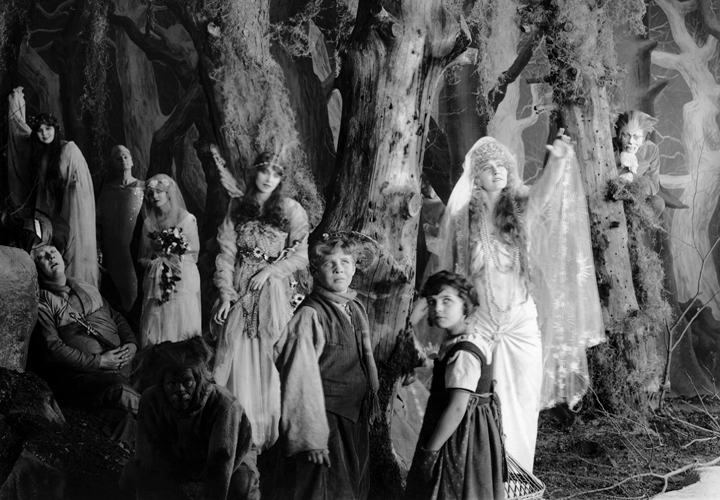
Some cinephiles insist you must see it with a live orchestra, but I favor the hum of the projector alone, that mechanical respiration that reminds you film is corporeal, that it can die, that it is dying a little each time light kisses it. The silence leaves room for the rustle of your own anticipation, the creak of seat springs as you lean forward, the sub-audible gasp when the bird’s hue drains in the cage. These micro-sounds form a private score more intimate than any violins could dare.
In the end, The Blue Bird is not a relic but a prophecy. It foretells Instagram’s filtered happiness, the way digital hues desaturate the moment you try to possess them. It whispers that every grail quest ends where it began—inside the muscle of giving. And it reminds us that cinema’s greatest special effect is still the human face when it realizes that the object of its longing has been breathing beside it all along, waiting for the cage door to swing open.
Watch it alone, in the dark, on a night when you feel most acutely the ache of unbelonging. Let the tints stain your retinas, let the silence crawl under your ribs. And when the bird finally blinks into its true azure, ask yourself: what cage am I clutching, and who deserves the warmth of its wings? The answer will not be comfortable, but it will be yours—a private hue no algorithm can copyright, a happiness that flickers only when you dare to let it fly.
IMDb 8.1
1915
Community
Log in to comment.