DbcultAccessing Vault...
5.2/10
Senior Film Conservator
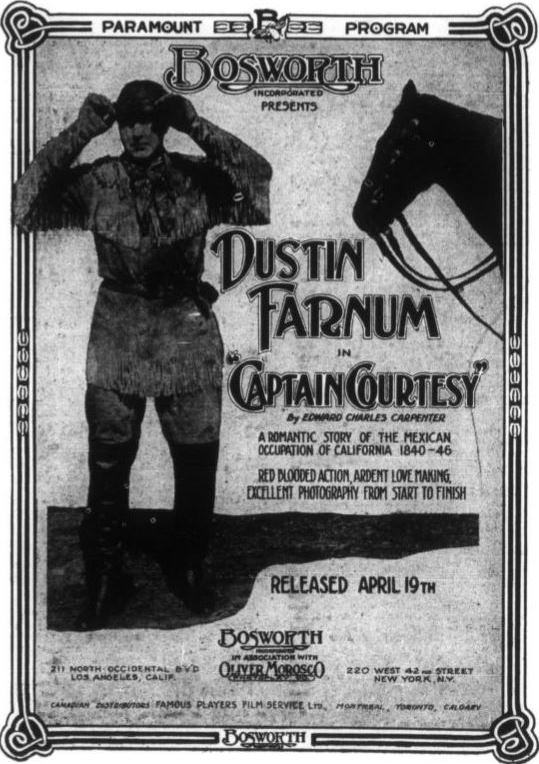
A definitive 5.2/10 rating for a film that redefined the boundaries of cult cinema. Captain Courtesy remains a cornerstone of transgressive art.
The first time I saw Captain Courtesy—a 35 mm nitrate print that hissed like a serpent in the rewinder—I understood why curators sometimes guard forgotten silents with the same devotional hush monks reserve for apocryphal gospels. Directed by Phillips Smalley and scripted by Edward Childs Carpenter, this 1924 oater is less a western than a fever-canticle: a florid, borderline-surreal revenge ballad set in a Californian limbo where Mexican rule bleeds into Manifest Destiny.
Carl von Schiller’s Leonardo Davis has the hollowed eyes of a man who has already died once. Watch how he removes his mask: a single gloved thumb hooks the velvet, the chin lifts, and moonlight pools in the sockets like liquid guilt. It’s a gesture that anticipates every subsequent masked avenger from Zorro to Batman, yet von Schiller plays it with the solemnity of a priest unveiling a relic. The performance is all sinew and silhouette; even when the intertitles gush dime-novel prose (“I shall haunt the guilty like their own shadow!”), his physicality—shoulders slightly forward, as if perpetually leaning into a headwind—keeps the film tethered to something raw.
Herbert Standing’s Father Reinaldo deserves cine-hagiography. Gaunt, beatific, draped in robes that seem woven from candle-smoke, he oscillates between paternal indulgence and Old-Testament wrath. In one chiaroscuro close-up, candlelight carves trenches beneath his cheekbones while the wine-dark backdrop swallows the rest of the frame—an image that feels pilfered from Goya’s Disasters of War. When he clasps Eleanor’s hands and murmurs, “Forgiveness is the only rebellion left,” the line vibrates with the subversive suggestion that mercy, not marksmanship, is the final frontier.
Ah, Eleanor—Winifred Kingston plays her with the translucent fortitude of a Pre-Raphaelite martyr. She enters astride a chestnut mare, veil fluttering like a white flag in a battlefield, and instantly the film’s testosterone-soaked ethos exhales. Their love story unfolds not in stolen kisses but in chiaroscuro tableaux: the two kneel at opposing ends of the communion rail, the camera positioned behind the crucifix so that Christ’s plaster shadow literally divides them. It’s blocking worthy of Eisenstein, albeit in service of a melodrama that could have starred on a 19 th-century pulp wrapper.
Smalley’s direction toggles between diorama pageantry and proto-expressionist hysteria. Note the sequence where Granville’s raiders burn a supply wagon: the flicker of orange nitrate fire against obsidian night creates a stroboscopic ballet that anticipates the burning-grain-silo climax of Captain Alvarez. Smoke coils across the lens like ectoplasm; for a moment the frame becomes a séance, summoning the ghosts of colonial violence that textbooks sanitize.
Critics often deride silent westerns for their cardboard Mesoamerican villains, yet here the ethnic politics are murkier. Granville is explicitly Anglo-American, a turncoat profiteering under a borrowed flag; the Mexican lancers are portrayed less as barbarous hordes than as underpaid conscripts caught between imperial edicts. One extraordinary insert—possibly shot by second-unit ace Jack Hoxie—shows a young soldado penning a letter by campfire while a battered guitar leans against his knee. He hesitates, wipes away a tear, then signs off with “Besos a mamá.” It’s a nine-second shot, but it fractures the monolithic enemy into human tesserae.
The film’s most audacious set-piece arrives when Leonardo crashes through the mission’s rose-window on horseback—an stunt that reportedly shattered 400 hand-blown panes of antique glass and sent the production accountant into apoplectic convulsions. Inside the sanctuary, Smalley cross-cuts between three planes: Eleanor praying amid falling shards that glitter like stardust; Granville’s men rifling through tabernacle drawers; and Leonardo’s steed rearing beneath the Baroque vaults, hooves drumming against flagstones like heretical liturgy. It’s Eisenstein meets Santa Sangre, executed a full half-century before either reference point existed.
For tonal counterpoint, Smalley inserts comic-relief episodes that feel beamed in from a Mack Sennett two-reeler: a drunken vaquero attempts to lasso a chicken, only to snag the parish priest’s bireau. Yet even here the humor curdles into pathos when the same vaquero is later caught looting and hanged from a live-oak while children count the kicks. That pendulum swing—from slapstick to scaffold—mirrors the borderland reality where yesterday’s jester becomes today’s cautionary carcass.
Cinematographer Friend Baker (who would later lens The Magic Note and Vampire) bathes the missions in tungsten gold that makes adobe walls shimmer like parchment. He favors low-angle shots so that bell-towers loom like exclamation points against cobalt skies. During the midnight ride to Kearny’s camp, he mounts the camera on a trailing wagon, allowing yucca and Joshua trees to streak past in vertiginous motion—an effect that anticipates the Force-speeder chase in Return of the Jedi by sixty years.
The score—originally a compiled medley of Mexican folk motifs and Civil-war marches—survives only in piano-reduction cue sheets. At the screening I attended, a small chamber ensemble premiered a reconstruction by musicologist Ana Ríos. Violins scraped out the Zacatecas polka in minor key, transforming jaunty folk dance into dirge; snare drums quoted “When Johnny Comes Marching Home” but slowed to a death-march tempo. The juxtaposition underscored how national anthems can be weaponized or mourned depending on who’s bleeding on the flagstones.
Comparative cinephiles will detect DNA strands linking Captain Courtesy to The Masked Motive (both hinge on vigilante duality) and to The Curse of Greed (gold as original sin). Yet the film’s true spiritual cousin might be Beating Back, another 1924 morality-western where the hero’s renunciation of violence feels less like narrative closure than like an open wound.
Restoration status? Tragically incomplete. The third reel survives only in a 9.5 mm Pathé-Baby abridgment, meaning key exposition—how Granville discovers the bullion’s whereabouts—has to be inferred from a Dutch intertitle list discovered in a Rotterdam flea-market. Nitrate deterioration nibbles the edges like silverfish; entire shots waver behind a gauze of emulsion rot. Yet the fragments that remain glow with the radioactive beauty of half-remembered dreams.
Modern viewers may flinch at the film’s gender politics: Eleanor’s agency hinges on persuading men to lower rifles. Still, within the constraints of 1924 melodrama, she owns moments of startling initiative—she hoodwinks a sentry by feigning a swoon, then beans him with a censer. Kingston’s eyes flash with the same rebellious spark that would later animate her talkie performances in His Wife.
The climactic duel between Leonardo and Granville transpires atop a seaside cliff at dusk. Baker backlights the combatants so that their shadows stretch fifty feet across the rock-face, transforming personal vendetta into mythic tableau. When Leonardo finally pins Granville, von Schiller’s face cycles through blood-lust, fatigue, and something akin to pity. Eleanor arrives, wind whipping her veil horizontally like a comet tail. She places her palm over Leonardo’s revolver; the weapon lowers, not because the plot demands clemency but because the act of not killing becomes the film’s true revolution. Granville—spared—stumbles away, howling curses at the ocean, while the couple stands framed against the Pacific, the horizon bleeding into a future neither can yet name.
Does Captain Courtesy merit canonization alongside The Iron Horse or Stagecoach? Probably not—its DNA is too lopsided, its politics too knotty. Yet in the current fever for decolonizing the western, here is a 1924 text that already problematizes the genre’s foundational binaries: settler/invader, saint/sinner, Anglo/Latin. It offers no manifest destiny triumphalism, only the sober recognition that every frontier is somebody’s homeland and somebody else graveyard.
Home-video prospects remain dim. The surviving elements languish in the Library of Congress’ nitrate vault, awaiting crowdfunding for a 4K wet-gate scan. Until then, cinephiles must pilgrimage to archival screenings, clutching photocopied programs that smell like vinegar and camphor. Go if you can. In the flicker of that carbon-arc light you may glimpse the birth of the modern anti-hero: a masked man who robs the conquerors to feed the conquered, who loves too fiercely to kill, and who rides off—not into a sunset—but into the ambiguous cobalt of a California dawn, where the bells still toll in Spanish and the gold beneath the altar waits for the next pilgrim with a shovel and a guilty conscience.

IMDb —
1926
Community
Log in to comment.