DbcultAccessing Vault...
7.1/10
Senior Film Conservator
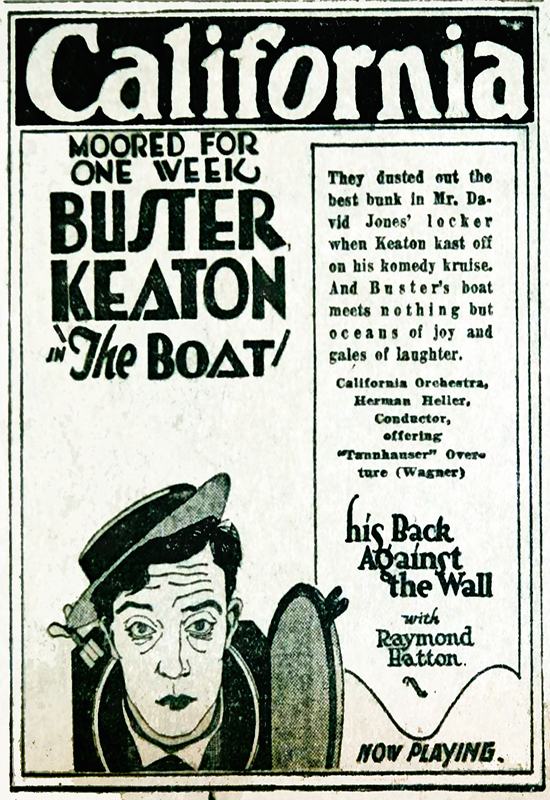
A definitive 7.1/10 rating for a film that redefined the boundaries of cult cinema. The Boat remains a cornerstone of transgressive art.
There is a moment, roughly ninety seconds into The Boat, when Buster Keaton’s self-built skiff slides backward down a sawhorse, kisses the grass, and keeps sliding—serene as a lazy river—until it rams the family sedan. The joke lands less like a pratfall and more like a theorem: man’s ingenuity, once unmoored, obeys only the law of unintended momentum.
From that instant the film is a fugue on flotation: what keeps us bobbing above despair, what betrays us, what turns marriage into ballast and children into periscopes scanning for the next disaster. Keaton, operating as auteur, stunt-viruoso, and hapless patriarch, compresses the entire history of seafaring hubris into twenty-three minutes of nitrate. The result feels less like a comedy short and more like a pocket epic, a Beowulf of buoyancy.
We first meet the boat in utero: skeletal ribs in a suburban garage that doubles as nursery. Keaton shoots it with the hushed reverence of a Victorian father pacing outside a maternity ward. The vessel’s name, Damfinö, arrives like a typographical sneeze—part declaration, part surrender. Once christened, the craft must be wedged through a doorway, down a hillside, across trolley tracks, and finally into the drink. Every inch of transit is a referendum on Newtonian physics, every frame a dare to gravity itself.
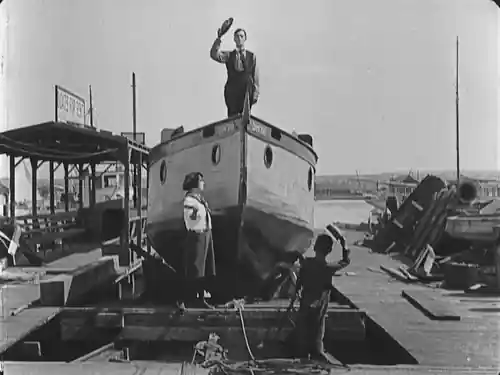
Notice how the director withholds the sea until minute eight. Until then, catastrophe is terrestrial: a misplaced ladder spears a wedding cake, a Model T flirts with a streetcar, a passing parade swallows the family whole. Keaton understands that comedy, like tragedy, requires rising water—first the puddle, then the deluge.
Sybil Seely, luminous and game, plays Wife with the same athletic fatalism Buster brings to Husband. Their dynamic is less romantic than contractual: two people who have agreed to co-star in a home movie titled How to Test the Patience of God. When she boards wearing a sailor-collar dress two sizes too large, the garment flaps like a surrender flag stitched by a child. Later, as bilge water climbs her calves, she strips to a chemise and mans the manual pump—no scream, no swoon, only the grim competence of someone who has discovered that survival is a domestic skill.
The couple’s two nameless children (played by midgets in page-boy wigs) function as living cargo. Keaton never sentimentalizes parenthood; offspring are simply more objects that must be kept topside. Their periodic disappearances below deck play like blackout gags on the Titanic: now you see them, now the brine has them.
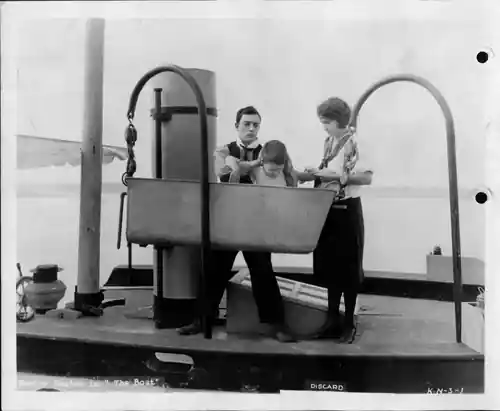
1. The Launch: A hillside becomes bobsled run. The camera locks in medium-wide, refusing to cheat perspective; we feel every shudder as the hull skids across gravel. When the boat wedges beneath a low bridge, Keaton’s hat pops off, pirouettes, and lands back on his skull—an encore that earns a cosmic bow.
2. The Kitchen Sink: A rolling wave slaps the deck. Instead of cutting away, Keaton lets the water slosh forward and retreat like a tongue tasting prey. In its wake: a solitary fork standing upright in the planking, tines buried like Excalibur. The image lasts three seconds yet contains entire dissertations on impermanence.
3. The Storm: A cyclone arrives as rotating set-piece. Rain is sprayed from firehoses off-camera; wind machines rip canvas. Buster lashes himself to the mast—then the mast snaps, pivoting him skyward like a weather vane. The gag peaks when his body, horizontal in midair, becomes compositional diagonal, bisecting the frame into two hostile triangles.

Keaton’s silences are orchestral. Listen to the absence of surf, the vacuum where dialogue should cackle. Each mechanical creak—rope against cleat, board against wave—registers as percussion. When the ship finally capsizes, the soundtrack becomes negative space: an inverted roar that sucks laughter out of lungs and replaces it with salt-stinged awe.
Place The Boat beside Katastrofen i Kattegat and you see two Nordic temperaments: Keaton’s Calvinist slapstick versus Denmark’s dour maritime fatalism. The Danish film treats shipwreck as moral reckoning; Keaton treats it as home improvement gone feral.
Stack it against The Planter and you find mirrored obsessions: men who build private worlds, then watch vegetation or water reclaim them. Both are odes to DIY hubris, though Keaton’s comedy is centrifugal where The Planter’s melodrama is centripetal.
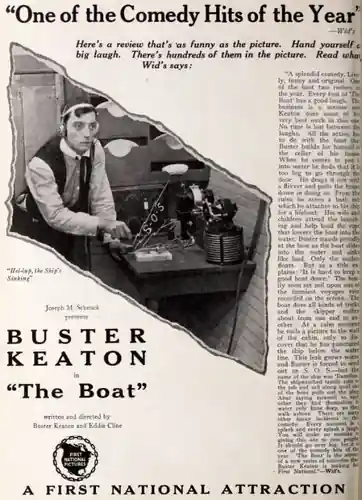
Existentialists will note that Damfinö sinks not because of storm but because of cumulative micro-failures: a mis-measured beam, an absent caulking hammer, a child’s marble lodged in the bilge. Keaton suggests that doom is never epic; it is a mosaic of overlooked minutiae. The sea merely signs the paperwork.
Theological readers may see a post-lapsarian parable: Eden Garage, Fall into Ocean, Baptism by Near-Drowning, Salvation by Lifeboat built from dining-room table. The circular return to shore implies grace, though Keaton’s deadpan refuses to confirm it. He exits frame soaked, hat intact, gaze already scanning horizon for the next impractical vessel.
Seely’s final close-up—hair matted, dress shredded, eyes shining with incredulous victory—flips the gendered rescue trope. She has done as much heavy lifting as Buster, literally hauling children through portholes while he wrestles the tiller. The film ends on her laugh, a bright cymbal crash that dissolves any residual damsel residue.
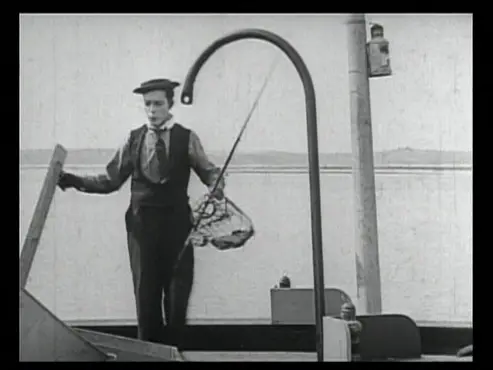
The capsizing sequence required a full-size boat mounted on a gimbled platform inside a studio tank. Cameras were cranked by hand as brackish water sloshed waist-deep. Keaton, insured only by box-office receipts, performed the mast-lash gag without trick wire. Nitrate stock, temperamental as nitroglycerin, survived only because lab techs cooled the bath with chipped ice begged from local fishmongers.
Fast-forward a century: Pixar’s Finding Nemo quotes the underwater silhouette gag; Wes Anderson storyboards lift the symmetrical deck compositions; Jackie Chan cites the frying-pan choreography in Project A. Yet no digital sheen matches the existential shiver of watching actual timber surrender to actual brine. CGI waves apologize; Keaton’s waves testify.
I first saw The Boat at sixteen, projected on a bedsheet in a Midwestern barn. The bulb was underpowered, the piano player drunk, the night air thick with silage. When the vessel disintegrated, I felt something crack inside my ribcage—an unutterable recognition that all my adolescent craftsmanship (model rockets, treehouses, love letters) would likewise founder. Keaton had turned slapstick into prophecy. I left the barn unable to decide whether to build more boats or burn the dock.
Twenty years later, revisiting the film on 4K, I still smell that silage. The restoration’s clarity reveals new micro-gags: a spider escaping rising water via a thread of web, a gull landing on Buster’s hat mid-storm then thinking better of it. Time has not diminished the film; it has merely added footnotes to the humiliation.
So here is my verdict, forged in bilge water and starlight: The Boat is not a comedy about maritime disaster; it is a disaster that permits comedy to ride shotgun. It is also, improbably, a love letter to the persistence of building things—marriages, families, watercraft—knowing full well the ocean always wins. We laugh not because the sinking is funny, but because laughter is the only vessel that never leaks.
★★★★★ Essential viewing for anyone who has ever nailed two boards together and called it tomorrow.
IMDb —
1935
Community
Log in to comment.