DbcultAccessing Vault...
5.5/10
Senior Film Conservator
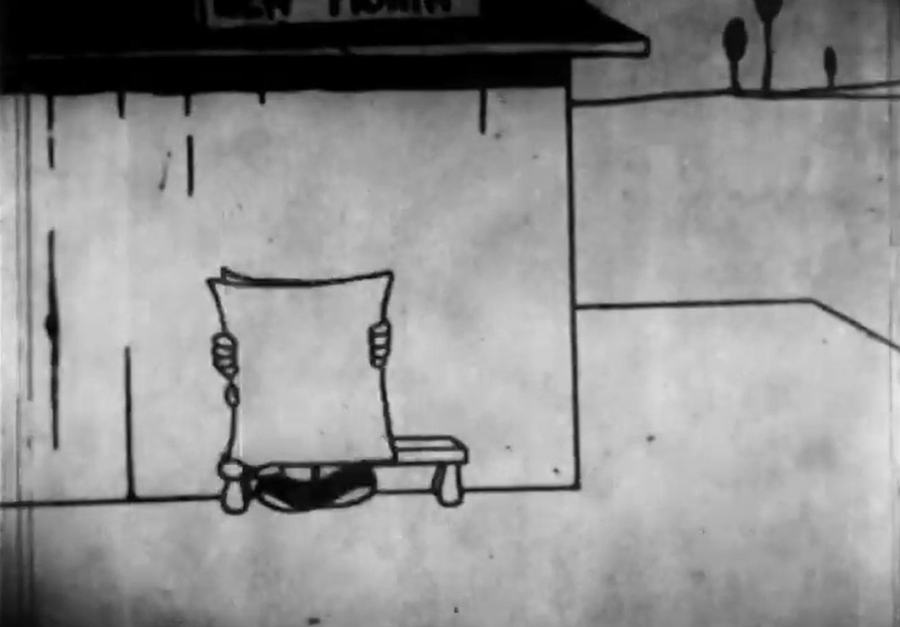
A definitive 5.5/10 rating for a film that redefined the boundaries of cult cinema. The Bomb Idea remains a cornerstone of transgressive art.
Imagine a city whose geography is stitched from nightmares: newsprint storm-clouds, trolley bells that clang like jailhouse doors, and a skyline as jagged as broken gin bottles. Into this fever dream lurches our anonymous hero, a man whose morning paper has already detonated inside his skull. The headline—BOLSHEVIKS LOOSE—detonates in 96-point Gothic, and suddenly every stranger wears the phantom beard of revolution. Walt Hoban, pulling triple duty as writer and star, plays this average Joe like a tuning fork vibrating at the frequency of mass anxiety. His eyes are two nervous moons; his spine seems perpetually surprised by the concept of gravity.
Enter the pipe-smoker: Vernon Stallings, all languid menace and Cheshire creases, clutching a perfectly round object swaddled in brown paper. The moment the camera gloms onto that sphere, Hoban weaponizes Eisenstein-style montage—three frames of the object, three frames of a screaming headline, three frames of a woman fainting in the street—so that the audience itself becomes complicit in the delusion. We feel the fuse hiss even though no wick is visible. The pipe’s ember glows like a traffic light for paranoia, and suddenly every edit becomes a countdown.
What follows is a chase that pirouettes from slapstick to surreal horror. The city transforms into an Escher maze: staircases ascend into brick walls, alleyways exhale steam like dragons, a revolving door spins the hero into a department store where mannequins loom like silent jurors. Hoban’s physicality here is Chaplin-by-way-of-Kafka—elbows flail, coattails sail, yet each pratfall lands with the thud of genuine dread. Meanwhile Stallings glides behind him, never hurried, polishing his metallic egg until it becomes a perverse mirror for the hero’s face: wide-eyed, distorted, consumed by the reflection of his own fear.
The genius lies in the film’s refusal to tip its hand. Intertitles—usually the moral crutch of silent cinema—are sparse, sardonic, sometimes outright deceitful. One card reads, “He who smokes pipe may also smoke civilization.” It’s a koan that lodges under the ribs. Is this agitprop? Reefer-madness for the red peril? Or a lampoon of the very newspapers that sold the panic? The ambiguity crackles louder than any fuse.
And then, the pier. A cathedral of fog where gulls wheel like shrapnel. The hero corners his nemesis, fists clenched, ready to pummel the apocalypse. Stallings, unblinking, strikes a match. The sizzle is deafening in the vacuum of suspense. But instead of shrapnel, a magnesium bloom erupts overhead—a chrysanthemum of cerulean, magenta, canary-yellow sparks that drift downward like post-war snow. Children laugh. A brass band, previously hidden behind crates, strikes up Sousa. The bomb was merely a celebratory orb, a proto-Pinwheel firework smuggled in by some reveler too drunk to notice the terror it birthed.
Hoban’s face—scream, blink, dawning sheepish grin—deserved its own Oscar in a world that hadn’t invented the statuette yet. The camera lingers on the pipe-smoker tipping his bowler, sauntering off as though fear itself were just another dance partner he’s grown bored of twirling. It’s a punchline that punches up, mocking not the naive hero but the industrial complex that monetizes his panic.
Technically, the film is a marvel of 1920 craftsmanship. Double exposures let the metallic orb hover like a malevolent moon over sleeping rooftops; under-cranked footage turns bustling avenues into torrents of humanity that threaten to wash the hero away. The tinting—amber for daylight dread, cobalt for nocturnal hallucinations—survives in the Library of Congress print with only minimal vinegar bleed. A restored 2K scan reveals grain patterns that swirl like cigarette smoke, reminding us celluloid itself is an explosive medium: combustible, fragile, capable of blowing minds a century on.
Compare it to Stranded in Arcady (1919), whose child-abduction paranoia curdles into moralistic mush, or Hate (1917) where racial animus is exploited for melodrama rather than exposed for farce. The Bomb Idea stands apart by weaponizing absurdity against authority itself. Even The American Consul (1921), with its diplomatic intrigue, ultimately kneels to flag-waving closure. Hoban refuses catharsis; he hands us the explosive laughter and walks away whistling.
Yet the film is not without scars. Its gender politics are period-typical: women appear as fainting props or giggling chorus, never as agents. A modern restoration could reframe one shopgirl’s glance—currently a cutaway gag—into a knowing wink that she too is in on the joke. And at 14 minutes, the narrative skips so briskly that post-war audiences may crave more psychological residue. But brevity here is part of the gag; the film itself is a fuse—short, sizzling, designed to burn out before reflection catches up.
Contemporary resonances? Choose your poison: anthrax letters, weapons of mass destruction, suitcase nukes, “see something say something.” Hoban’s comedy detonates the moment we realize fear is the cheapest commodity on any market. Social media algorithms, cable news chyrons, algorithmic doom-scrolls—they’re all polishing their own spherical objects, convincing us the sky is always one spark away from falling. The pipe-smoker isn’t a Bolshevik; he’s every influencer who monetizes apocalypse.
Criterion or Kino should rescue this from archival limbo. Commission a new score—think prepared piano, typewriter percussion, sampled ticking geiger counters—and pair it with Virtuous Sinners (1918) for a double bill on moral panics. Let film students dissect the match-cut from newspaper headline to polished orb as a masterclass in associative propaganda. Hell, screen it on Capitol Hill every time a new -ism gets trotted out to justify another invasion.
Ultimately, The Bomb Idea survives because it refuses to comfort. It hands us a lit explosive, lets us sprint blindfolded through cityscapes of our own making, then douses us in confetti and says: “See how silly you look when dread is the only thing you let define you?” A century on, that punchline still explodes with uncomfortable clarity.
IMDb —
1922
Community
Log in to comment.