DbcultAccessing Vault...
Cult Review
Senior Film Conservator
The early 20th century, particularly the nascent years of feature filmmaking, was a crucible for cinematic expression, a period where the foundational grammar of storytelling on screen was being meticulously, and often experimentally, forged. Amidst this vibrant, if still rudimentary, landscape, Dzieje grzechu, or 'The Story of Sin,' emerges not merely as a historical artifact but as a compelling testament to the ambitious narrative aspirations of Polish silent cinema. This adaptation of Stefan Żeromski's notoriously controversial 1908 novel, brought to the screen by Marian Tatarkiewicz, is a work steeped in the dense moral philosophy and psychological intensity characteristic of its literary source. It's a film that, even a century later, still resonates with a raw, unflinching honesty regarding human frailty and societal judgment.
From its very inception, the film plunges the viewer into a world governed by rigid religious strictures and the suffocating weight of social expectation. We are introduced to Ewa, portrayed with a poignant vulnerability by Maria Mirska, in a scene that immediately establishes her predicament: a confession, a warning against 'impure thoughts.' This opening gambit is more than a mere plot device; it is a foundational statement, inscribing the narrative with an indelible sense of preordained struggle. The visual language of the confessional, with its inherent power dynamics and the unseen presence of judgment, sets the stage for a saga where every emotional flicker, every nascent desire, is tinged with the potential for transgression. Mirska’s performance here, relying on subtle facial expressions and restrained gestures, already hints at the internal turmoil that will define her character’s tragic arc.
The narrative truly ignites with the arrival of the boarder, Łukasz, embodied by Wojciech Brydzinski. His presence in Ewa’s family home is the catalyst, the spark that ignites a conflagration of forbidden passion. The film masterfully portrays the insidious creep of attraction, the stolen glances, the hushed conversations, and the unspoken understandings that build between two individuals destined for a calamitous entanglement. Brydzinski imbues Łukasz with a certain roguish charm, a magnetic allure that stands in stark contrast to Ewa's sheltered existence, making their mutual gravitation not just believable, but tragically inevitable. The filmmakers, working within the constraints of silent cinema, rely heavily on close-ups and dramatic intertitles to convey the burgeoning intensity of their relationship, effectively communicating the emotional landscape without the aid of dialogue.
Their love affair, blossoming under the very roof of Ewa's pious household, is a direct challenge to the moral fabric of her world. It is a love born of desperation and illicit longing, a stark defiance of the initial religious warnings. The film does not shy away from depicting the consequences of such a transgression. Ewa’s journey is one of increasing isolation, as her choices gradually sever her ties to family, community, and ultimately, her own sense of self-worth. This descent is portrayed with an almost operatic sensibility, each dramatic beat amplified by the expressive acting style prevalent in early silent films. Mirska, in particular, carries the weight of Ewa's suffering with an arresting intensity, her eyes often conveying volumes of unspoken anguish and regret.
Adapting a dense literary work like Żeromski’s novel for the screen in the early 20th century presented formidable challenges. The novel is renowned for its psychological depth and societal critique, elements that are inherently difficult to translate into a visual medium still finding its voice. However, Tatarkiewicz and his team demonstrate a remarkable understanding of cinematic potential. They utilize visual symbolism, dramatic staging, and the emotive power of their performers to convey the novel’s complex themes. While the narrative necessarily simplifies some of the literary intricacies, the film retains the core tragic essence, focusing on the human cost of moral transgression and the relentless pursuit of an unattainable ideal.
Comparing this film to other narrative features of its era provides valuable context. While films like The Story of the Kelly Gang (1906) were pioneering in their epic scope and narrative length, often focusing on action and adventure, Dzieje grzechu distinguishes itself by its profound engagement with internal, moral conflict. It’s less about external spectacle and more about the landscape of the soul. Similarly, while early cinematic depictions of religious narratives, such as Life and Passion of Christ (1905), explored themes of sin and redemption, they often did so through allegorical or instructional lenses. The Story of Sin, by contrast, grounds its moral struggle in the intensely personal and devastatingly human choices of its protagonist, offering a more nuanced, albeit bleak, exploration of individual culpability and societal hypocrisy.
The cast, despite the stylistic conventions of silent acting, delivers performances that are remarkably affecting. Maria Mirska’s Ewa is a figure of immense pathos, her transformation from pious innocence to tormented desperation etched vividly across the screen. Her ability to convey complex emotional states through gesture and expression alone is a testament to her skill and the directorial guidance. Wojciech Brydzinski’s Łukasz is equally compelling, presenting a character whose charm is intertwined with a dangerous selfishness, ultimately contributing to Ewa’s downfall. Even the supporting players, like Teodor Roland and Stanislaw Knake-Zawadzki, manage to create distinct impressions, adding to the film’s rich tapestry of characters who either condemn or are complicit in Ewa’s fate.
The film’s thematic concerns are vast and intertwined. At its core, it is a searing critique of a society that offers little mercy to those who stray from its rigid moral path. The concept of 'sin' is explored not merely as a religious transgression but as a societal construct, an unforgiving label that traps individuals in a cycle of condemnation. The narrative highlights the hypocrisy often inherent in such rigid systems, where outward piety can mask a lack of genuine compassion. The relentless progression of Ewa’s suffering, her repeated attempts at redemption met with further despair, paints a bleak picture of a world unwilling to forgive or understand. This is a story that, much like literary adaptations such as the various early versions of Hamlet or Anna Karenina from around the same period, grapples with grand human themes, often with a tragic inevitability.
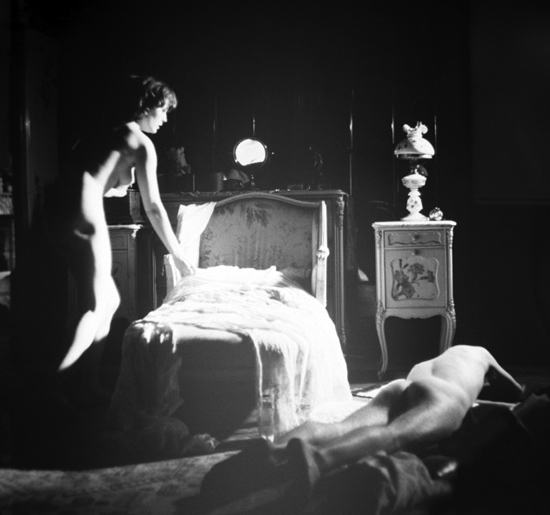
Technically, Dzieje grzechu demonstrates a developing sophistication in cinematic language. The use of natural light, the framing of shots to emphasize isolation or intimacy, and the pacing of the narrative all contribute to its dramatic impact. While perhaps not as flashy or technically groundbreaking as some contemporary European productions, its strength lies in its ability to harness the nascent power of the moving image for emotionally resonant storytelling. The film’s visual style, while often straightforward, effectively underscores the emotional arc of its characters. The stark contrasts, the shadow play, and the dramatic compositions serve to heighten the sense of impending doom and the protagonist’s growing despair.
The enduring legacy of The Story of Sin lies in its courageous tackling of complex moral questions within the burgeoning framework of cinematic narrative. It stands as a significant marker in Polish film history, showcasing an early commitment to adapting serious literature and exploring profound human dilemmas on screen. For aficionados of silent cinema, it offers a fascinating glimpse into a period of immense artistic ferment and a powerful example of how compelling storytelling could be achieved with limited technical means. The film doesn't just present a story; it presents a moral quandary, forcing the audience to confront uncomfortable truths about judgment, compassion, and the often-brutal consequences of societal norms. Its very existence, alongside other early narrative features, underscores the global ambition of filmmakers to move beyond mere spectacle towards profound dramatic engagement.
In conclusion, Dzieje grzechu is far more than a historical curiosity. It is a powerful, if melancholic, cinematic experience that speaks to the timeless themes of love, sin, and redemption. Its place in the pantheon of early Polish cinema is well-deserved, not just for its pioneering spirit but for its enduring emotional resonance and its unflinching portrayal of a woman caught in the relentless grip of fate and societal condemnation. It reminds us that even in the earliest days of film, storytellers were capable of crafting narratives of immense power and psychological depth, leaving an indelible mark on the canvas of cinematic art.

IMDb 5.9
1931
Community
Log in to comment.