DbcultAccessing Vault...
Cult Review
Senior Film Conservator
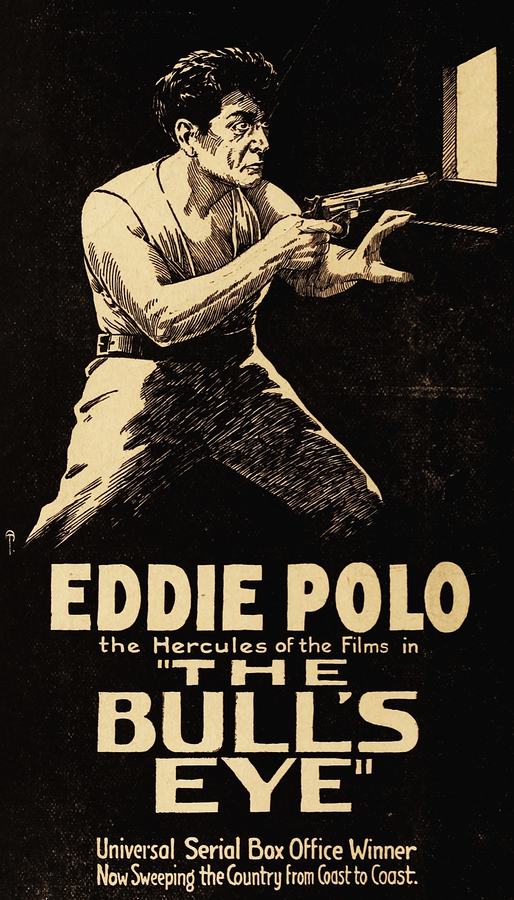
A Wanted Poster That Learns to Talk Back
There is a moment—roughly twelve minutes in, if you’re counting by the flicker—when William Welsh’s craggy lawman pins a dog-eared reward placard to a pine slab and the wood grain underneath begins to crawl, as though the trees themselves object to summary judgment. It is the first shiver that The Bull’s Eye is not content to be merely another oater galloping out of Universal’s backlot corral; instead, it wants to chew the gristle of American myth-making until the bones of genre show through, bleached and accusatory.
Director James W. Horne, moonlighting from his customary slapstick unit, treats every frame like a ledger of unpaid debts: debts of blood, of land, of story. The camera—hand-cranked, breathless—tilts up from boot heels to scaffold beams, translating fiscal panic into vertical lines that feel borrowed from German Expressionism before Expressionism had even cleared customs. Meanwhile, six credited writers hurl plot shurikens so rapidly that exposition becomes a stroboscopic barrage: today we’d call it pulp cubism, nickelodeon-style.
Begin with a murder you never see, only hear: a gun-cough echoing off canyon walls, a body collapsing like a sack of ore. Cut to a banker (Hallam Cooley) who can’t stop laundering ore-shares into political favors, his spectacles fogging as though the very air is complicit. Enter the marshal, framed by a doorway shaped suspiciously like a coffin lid; exit the audience’s certainty about who deserves the rope.
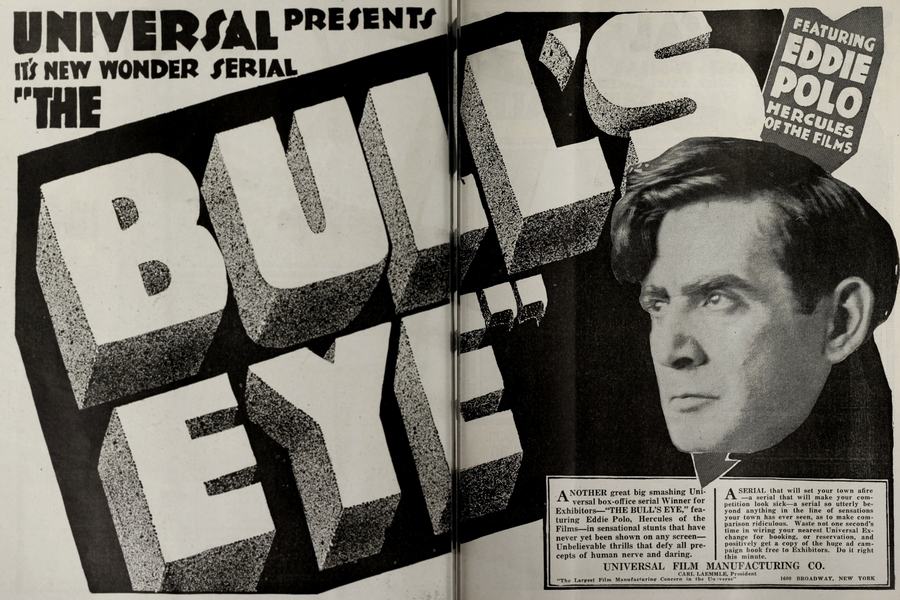
The narrative ricochets between three frontiers—geographical, judicial, moral. In the desert, Noble Johnson’s outlaw philosopher quotes Job while burying silver bullion beneath a Joshua tree; in the clapboard courthouse, Vivian Reed’s cowgirl-turned-star-witness testifies in pantomime so precise you can lip-read the commas. Out on the range, Eddie Polo—cinema’s first human cannonball—rides a horse off a cliff, transfers mid-air to a hanging vine, swings onto a moving train, and somehow lands seated at a poker table, all without losing his Stetson. The stunt is pointless to plot yet essential to ethos: survival as vaudeville.
Notice how the titular bull’s eye migrates: a target painted on a barn door, a bullet hole in a wanted sheet, a birthmark on the shoulder blade of an innocent man. By the time the symbol settles, you realize the film’s true quarry is not a fugitive body but the spectator’s own moral certainty—an optic nerve to be punctured.
William Welsh, face like a topographical map of every hardship the continent devised, modulates between granite authority and hairline fracture. Watch him listen: the corner of his mouth twitches, a tiny semaphore that guilt has boarded the bloodstream. Opposite him, Noble Johnson—an African-American actor granted a dignity rare in 1917—imbues his renegade with Shakespearean rue; when he mutters “The country needed villains, so I volunteered,” the line vibrates across a century of stereotype demolition.
Eddie Polo’s kinetic clowning could have capsized the tone, yet Horne weaponizes it: every pratfall is a distraction that allows evidence to vanish, turning slapstick into plot larceny. Meanwhile, Vivian Reed’s sharpshooter flips the gender script so nonchalantly you almost miss the radicalism—she fires not to impress men but to edit them out of her narrative, each muzzle-flash a copy-editor’s strike-through.
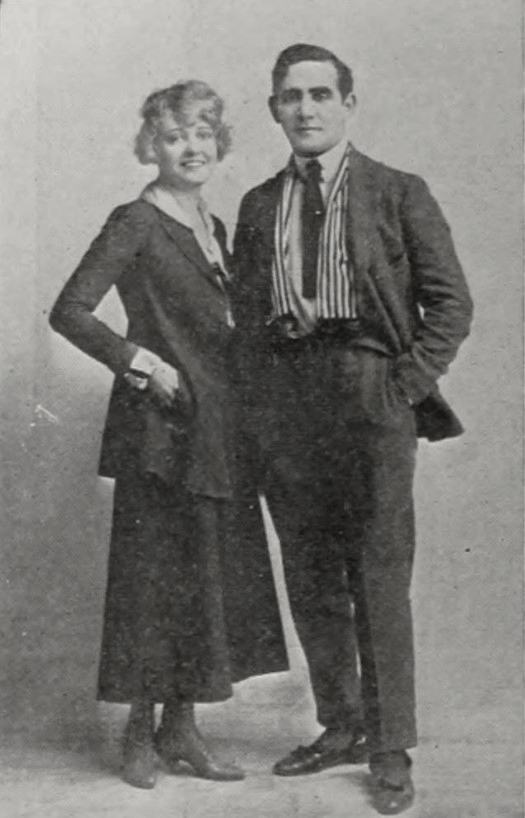
In support, Jack Hoxie, Leo Willis, Frank Lanning, Ray Hanford, and Wallace G. Coburn constitute a Greek chorus of sweat-stung faces, each carrying the burden of back-story in a single prop: a rusted spur, a subpoena folded into a love letter, a child’s marble cupped like prayer bead.
Cinematographer unknown (Universal rarely signed its camera magicians) paints the Mojave not in picturesque ochres but in bruised violets and gangrenous greens—tinted prints that suggest the desert is one vast hematoma under the skin of Manifest Destiny. Interior scenes tilt sets at oblique angles so ceilings slope toward the viewer like judgment days. When gallows rise, they are shot from below, their crossbeam bisecting the horizon—an unholy union of state power and cosmic indifference.
Compare this to Behind the Lines’ documentary sobriety or The Footlights of Fate’s stagey melodrama, and you see how The Bull’s Eye weaponizes space itself, turning landscape into jurisprudence.
Horne’s editorial background manifests in text cards that detonate between images like shrapnel: “Guilt rode beside him—wearing his own badge.” “Silver under the sand, blood atop the soil—America keeps her books in two currencies.” “He prayed for rain; the sky reloaded.” These aphorisms, penned by the committee of scribes, flirt with purple excess yet land like slugs in the viewer’s ribs precisely because they overreach; silent cinema, robbed of voice, must speak in exclamation points.
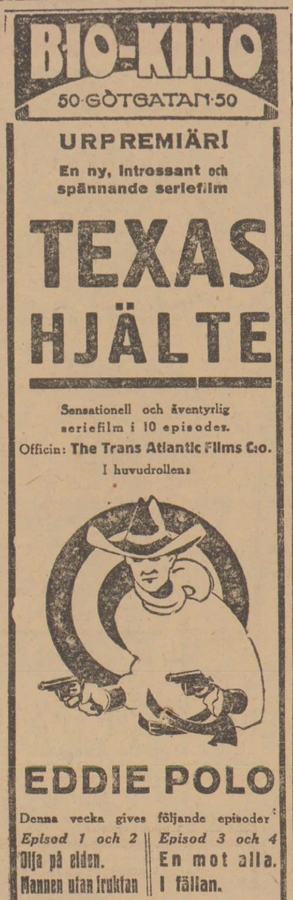
Archival records suggest original road-show screenings featured a live score mixing Salvation Army hymns with atonal fiddle drones. Contemporary festival restorations often substitute Ennio-esque whistles, but the true soundtrack is the rustle of unease: every cut feels like a cocked hammer, every iris-in a gasp held too long. The absence of foley paradoxically amplifies ambient dread; you hear your own heart guessing who’s guilty.
Scholars hunting for proto-noir signposts point to 1940s shadows, but The Bull’s Eye offers chiaroscuro in broad daylight: a morality play where morality files for bankruptcy. The investigator is tainted, the criminal possesses the clearest ethical lens, and womanhood opts for firepower over fragility. Swap six-guns for snub-nosed revolvers and sagebrush for asphalt, and you’ve mapped the genealogy of Out of the Past.
Yet the film also sires the revisionist western, predating Liberty’s patriotic bombast or The Hoosier Schoolmaster’s pastoral nostalgia by insisting that frontier justice is merely banking with bullets.
Stack it beside A Wall Street Tragedy and you witness two opposing economic parables—rural versus urban graft, mineral versus paper wealth. Pair it with The Little American and you chart how gendered heroism shifts from sacrificial sweetheart to pistol-packin’ dame. Contrast it against The Unfortunate Marriage’s domestic claustrophobia and you appreciate how open spaces can imprison more savagely than walls.
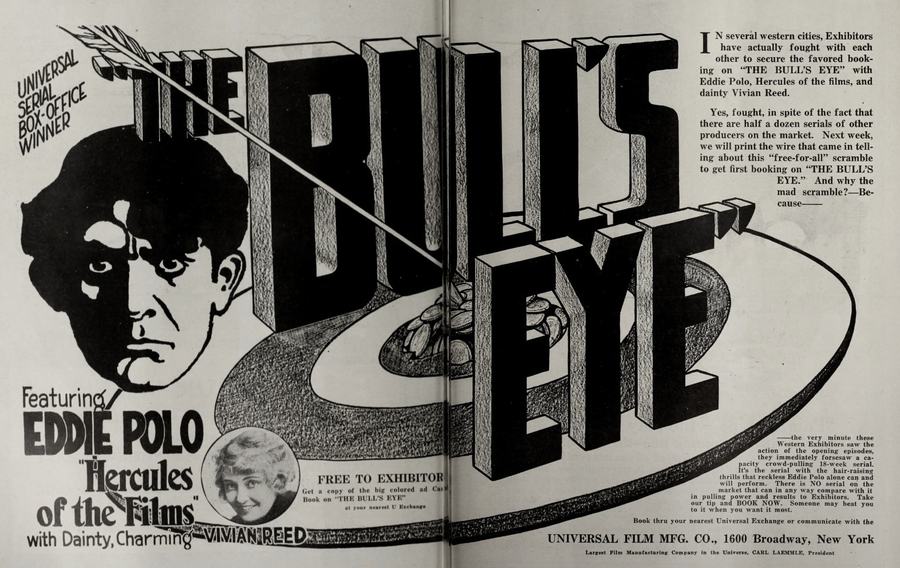
For all its formal bravura, The Bull’s Eye cannot escape the racial optics of its era; Johnson’s layered performance is undercut by intertitles that occasionally lapse into plantation dialect, yanking modern viewers out of the spell. The climax, a triple-cross too labyrinthine for 28 minutes, resolves with a deus-ex-stagecoach that feels hurried even by 1917’s breakneck serial standards. And the suffragist undertones, revolutionary for their moment, still frame female empowerment through the barrel of a gun—liberty as marksmanship.
No complete 35 mm negative survives; what circulates is a 16 mm show-at-home abridgement discovered in a Butte, Montana church basement, its emulsion scarred like a lynching rope. Digital cleanup by University of Nevada in 2019 restored tinting tables, but roughly five minutes remain lost—vanished like the silver vein that motivates the plot. The gaps are bridged with stills and translated intertitles, creating a stroboscopic viewing experience that ironically mirrors the film’s obsession with partial visions and missing evidence.
Contemporary trade sheets dismissed it as “a rattler of thrills for the unpicky,” yet by 1950 Henri Langlois screened a duped fragment at Cinémathèque Française, proclaiming it “a primitive ballet mécanique of American guilt.” The 1978 Pordenone Silent Festival positioned it as a bridge between Griffith’s moral absolutism and von Sternberg’s amorous nihilism. Today Reddit threads dissect its meta-ending with Talmudic fervor, while TikTokkers overlay its bullet-ballet with synthwave, proving that velocity always finds a new host.
I stumbled across The Bull’s Eye on a mildewed reel during college, projected against a dormitory wall stained with beer ghosts. Halfway through, the bulb died; in the darkness I could still feel the images—afterimages burned not on retina but conscience. Years later, standing in the actual Mojave at dusk, I heard the wind echo the film’s final intertitle: “The desert never forgets a name—it only buries it deeper.” I looked down; beneath my boot was a rusted marshal’s star, five points sharp as accusation. I left it there—some excavations are best left to the sands.
Verdict: Imperfect, incendiary, and indispensable—The Bull’s Eye aims for the heart of American myth, shoots clean through, and hands you the bleeding hole as souvenir.
IMDb 7.1
1936
Community
Log in to comment.