DbcultAccessing Vault...
Cult Review
Senior Film Conservator
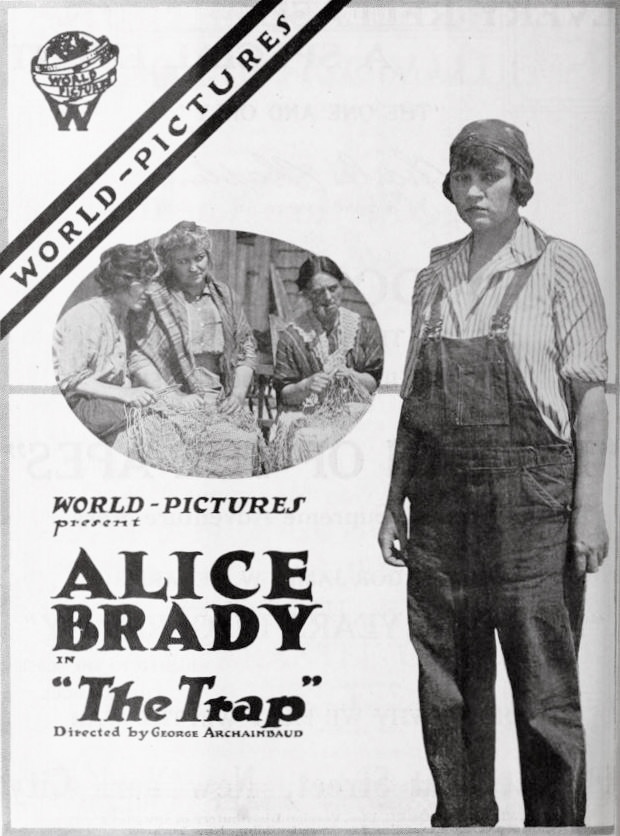
In the pantheon of early American cinema, few performers captured the ethereal yet grounded struggle of the 'persecuted maiden' with as much nuance as Alice Brady. In The Trap, directed with a keen eye for social stratification by Robert F. Hill, we are presented with a narrative that transcends its melodramatic roots to become a scathing critique of how male ego consumes female autonomy. The film begins not in the bustling metropolis, but in the suffocating confines of a New England fishing village, a setting where silence is a weapon and gossip is the primary currency. Here, the sea is less a source of life and more a witness to the petty cruelties of man.
The opening act of The Trap establishes a dichotomy that would define much of silent cinema: the purity of the rural landscape versus the inherent corruption of those who inhabit it. Doris, portrayed by Brady with a luminosity that borders on the divine, is a victim of the 'small-town gaze.' When she engages in a harmless dalliance with Stuart Kendall (the quintessential urban interloper), the village’s collective imagination transforms a conversation into a catastrophe. Unlike the more overt tragedies found in The Stain in the Blood, the violence here is social, a slow-acting poison that renders Doris an outcast in her own home.
This segment of the film functions as a masterclass in visual storytelling. Hill uses the rugged coastline to mirror Doris's internal isolation. The waves crashing against the jagged rocks serve as a metonym for the relentless pressure of public opinion. When Doris is eventually driven out, the film shifts its palette, trading the gray-blue hues of the Atlantic for the sepia-toned grit of New York City. This transition is reminiscent of the stylistic shifts in Ludi i strasti, where the environment is an active participant in the protagonist's psychological unraveling.
Arriving in New York, Doris is the archetype of the 'penniless waif,' yet Brady avoids the clichéd sentimentality that often plagued such roles. Her employment in a Greenwich Village café introduces us to a different kind of trap—one of economic dependency and aesthetic commodification. It is here that she reconnects with Stuart Kendall. Kendall, played with a chilling, effortless entitlement by Crauford Kent, views Doris not as a human soul in distress, but as raw material for his canvas. This dynamic echoes the themes of artistic exploitation explored in The Dumb Girl of Portici, though Hill’s approach is more intimate and claustrophobic.
The scenes in Kendall’s studio are bathed in a soft, deceptive light. The 'trap' of the title becomes literal; Doris is living at his expense, a bird in a gilded cage that she doesn't even realize is locked. Her innocence is her shield, yet it is also her greatest vulnerability. The film cleverly uses the act of modeling to discuss the male gaze. Kendall captures her image, but he cannot capture her spirit, leading to a simmering resentment that eventually boils over into malice. The tension is palpable, far exceeding the standard romantic conflicts of the era, such as those seen in A Royal Romance.
The introduction of Jack Masterson (Curtis Cooksey) provides a stark contrast to the effete and manipulative Kendall. Masterson represents the 'frontier ideal'—a man of action and simple truths. His obsession with Doris begins with a poster, a piece of mass-produced art that manages to convey a fragment of her true essence across the continent. This plot point is a fascinating commentary on the power of the image in the early 20th century. While Kendall uses art to dominate Doris, Masterson uses it to find her. The film’s treatment of the West as a place of moral clarity is a recurring motif in silent cinema, often seen in works like The Border Legion or The Boundary Rider.
Masterson’s journey to the East is not just a romantic quest; it is a collision of two Americas. The rugged sincerity of the rancher acts as a solvent to the meretricious layers of New York high society. When he proposes to Doris, it isn't just a marriage offer; it’s an exit strategy from the moral quagmire Kendall has constructed. However, the film refuses to give us an easy resolution. The 'trap' has one final mechanism to spring.
The climax of The Trap is centered around a party thrown by Kendall on the eve of Doris’s wedding. In the parlance of 1919 cinema, this is described as an 'orgy,' though by modern standards it is a display of decadent revelry and moral loosening. Kendall’s intent is clear: if he cannot possess Doris, he will destroy her value in the eyes of the man who can. This sequence is a masterwork of editing and mise-en-scène. The chaotic movement of the party-goers, the smoke, the flowing liquor—all contrast sharply with Doris’s stillness and mounting horror.
When Kendall summons Masterson to witness this 'debauchery,' the film reaches its emotional zenith. The denunciation scene is played with a theatricality that feels earned. Masterson’s initial rejection of Doris is a crushing blow, reflecting the fragile nature of trust when confronted with curated appearances. It reminds one of the visceral misunderstandings in Blodets röst, where blood and reputation are inextricably linked. The resolution—where Doris finally finds her voice and denounces her tormentor—is a cathartic moment of self-actualization that was ahead of its time.
Technically, The Trap benefits immensely from Robert F. Hill’s direction. Hill avoids the static camera placements common in lesser productions, opting instead for dynamic framing that emphasizes the physical distance between characters. The use of lighting to differentiate the 'pure' light of the coast and the 'corrupt' shadows of the city is subtle but effective. This visual sophistication is comparable to the high-water marks of European silent cinema, such as Il fornaretto di Venezia.
Alice Brady’s performance is the film’s heartbeat. She manages to convey a vast internal landscape with minimal gesture. Her eyes, often the focal point of Hill’s close-ups, tell the story of a woman who has been pushed to the edge of the abyss but refuses to fall. Whether she is evading Kendall’s advances with a forced smile or standing tall in the face of Masterson’s accusations, Brady exhibits a range that explains why she was one of the most sought-after actresses of her era. Her work here is far more complex than the roles found in more standard fare like Betty and the Buccaneers or Cohen's Luck.
Ultimately, The Trap is a film about the reclamation of narrative. Doris begins as a woman whose story is told by others—by the jealous villagers, by the predatory Kendall, and even by the poster that brings Masterson to her door. By the end, she is the one speaking her truth. The 'trap' of the title is not just the situation she finds herself in, but the societal expectations that seek to define her worth based on male perception. The film’s happy ending, while traditional, feels like a hard-won victory rather than a convenient plot device.
For scholars of silent film and fans of early melodrama, The Trap is an essential text. It occupies a unique space between the pastoral tragedies of the 1910s and the urban noir sensibilities that would emerge in the decades to follow. It shares a certain DNA with The Desire of the Moth in its exploration of yearning and social barriers, yet it remains distinctly its own creature. In an age of digital noise, there is something profoundly moving about the silent, focused intensity of Alice Brady’s Doris—a woman who walked through the fire of public shaming and came out the other side with her dignity intact.
As we revisit this work, we must acknowledge the contribution of writer Robert F. Hill, whose script balances the requirements of a commercial thriller with the depth of a character study. The film avoids the simplistic morality of The Question or the overt sentimentality of A Maid of Belgium, opting instead for a gritty realism that still resonates. The Trap is a reminder that the themes of reputation and exploitation are as old as the medium itself, and that the struggle for autonomy is a story that never truly goes out of style.
Director:
Robert F. Hill
Key Cast:
Alice Brady, Frank Mayo, Robert Cummings, Curtis Cooksey, Crauford Kent
IMDb 6.1
1932
Community
Log in to comment.