DbcultAccessing Vault...
6.2/10
Senior Film Conservator
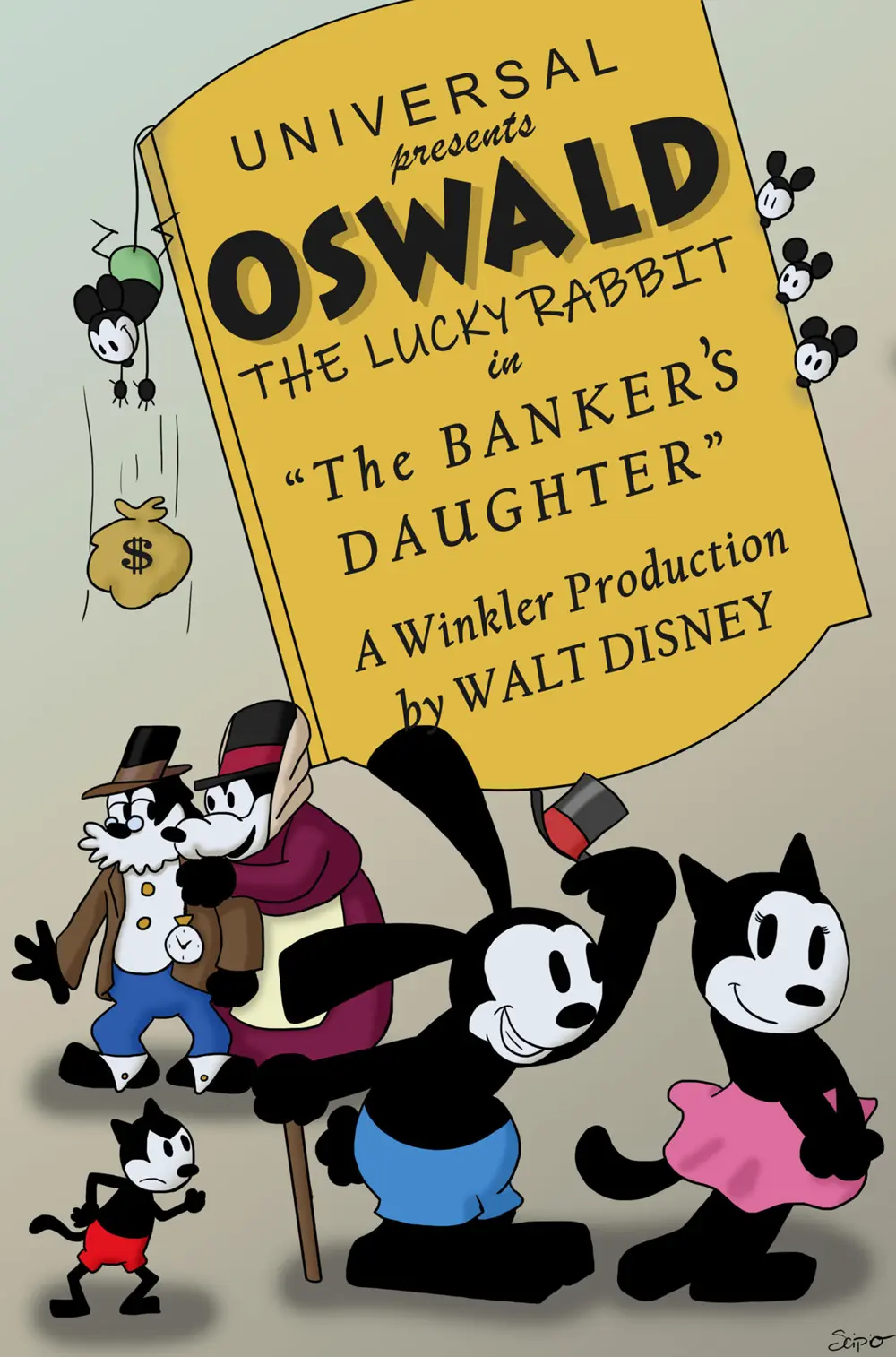
A definitive 6.2/10 rating for a film that redefined the boundaries of cult cinema. The Banker's Daughter remains a cornerstone of transgressive art.
Is The Banker's Daughter worth your attention nearly a century after its release? Short answer: yes, but primarily as a historical artifact of early animation evolution.
This film is for animation purists and fans of the 'rubber hose' era who appreciate the raw energy of early Disney. It is NOT for those who require complex narratives or modern visual fidelity to remain engaged.
This film works because it distills the essence of early Disney slapstick into a lean, mean comedic machine that prioritizes movement over logic.
This film fails because the redemption arc is predictably shallow, relying on a convenient crime to reset the social status quo.
You should watch it if you want to see the DNA of the animation industry before Mickey Mouse became a global corporate icon.
Yes, if you view it through the lens of a historian. The Banker's Daughter is a frantic, high-energy short that showcases Oswald the Lucky Rabbit at the peak of his creative powers before the character was famously lost to Universal.
The film provides a fascinating look at the 'working man' archetype that Walt Disney favored in his early years. It’s a simple story of a driver, a daughter, and a thief, but the execution is surprisingly sophisticated for its time.
In 1927, Walt Disney wasn't just a producer; he was a pioneer experimenting with the boundaries of the frame. In The Banker's Daughter, we see a mastery of visual timing that rivaled the live-action comedies of Buster Keaton.
Take, for instance, the scene where Oswald is fired. The transition from the flirtatious interaction with Sadie to the banker’s explosive reaction is handled with a rhythmic precision that makes the animation feel musical, despite being silent.
Unlike the more grounded drama seen in films like The Pride of New York, Disney’s direction here leans into the impossible physics of the medium. Characters stretch and squash in ways that emphasize their emotional states.
The 'cinematography' of a silent cartoon is really about the layout and the use of white space. The Banker's Daughter utilizes the contrast of its black-and-white palette to guide the eye toward the center of the action.
A standout moment occurs during the bank robbery. The way Pete is framed—looming over the counter—creates a sense of genuine threat that is quickly undercut by Oswald’s frantic intervention. It’s a masterclass in shifting tone through visual scale.
We see similar explorations of visual depth in contemporary works like The Illustrious Prince, but Disney applies it to a world where the laws of gravity are merely suggestions.
Oswald is a far more mischievous and aggressive character than the later, more sanitized Mickey Mouse. In this short, his flirtation with Sadie isn't just cute; it feels slightly rebellious, a rabbit punching above his weight class.
The animation of Sadie herself is somewhat limited, a common issue in this era where female characters were often relegated to being the 'prize.' However, her presence is the catalyst for the entire plot, much like the stakes in The Cigarette Girl.
Pete, the antagonist, is the quintessential heavy. His movements are lumbering and slow, providing a perfect visual foil to Oswald’s lightning-fast, jittery responses. Their confrontation is the highlight of the film’s second act.
The pacing of The Banker's Daughter is relentless. At roughly six minutes long, there is zero room for filler. Every gag leads directly into the next, creating a snowball effect of chaos.
Compare this to the slower, more deliberate pacing of Mary Moves In or Polly Redhead. While those films focus on character development through dialogue cards, Disney lets the action speak for itself.
The transition from the chauffeur scenes to the bank robbery feels a bit abrupt, but in the context of 1920s shorts, this was standard. The audience expected a shift from situational comedy to high-stakes action.
There is a subtle undercurrent of class struggle here that is often overlooked. Oswald is the help. The banker is the gatekeeper of both wealth and the daughter. The rabbit’s only way back into the fold is through a display of utility.
This theme of the 'underdog' proving his worth is a recurring trope in films of the time, such as The Forfeit. It reflects a post-war society obsessed with meritocracy and upward mobility.
Yet, the film never feels heavy-handed. It stays light, using the class divide as a springboard for gags rather than a lecture. It’s effective. But it’s flawed in its simplicity.
The animation in The Banker's Daughter was handled by a small team, yet the fluidity is remarkable. The use of repeating backgrounds during the chase scenes was a clever way to save time without sacrificing the sense of speed.
If you look closely at the scene where Oswald stops Pete, you can see early attempts at layering movement. There is action in the foreground and the background simultaneously, a technique that would later be perfected with the multiplane camera.
While films like The Bar Sinister were pushing boundaries in live-action storytelling, Disney was proving that animation could be just as expressive and technically demanding.
Pros:
Cons:
When compared to other 1927 releases like The Innocent Lie, The Banker's Daughter feels significantly more modern in its energy. While live-action was often bogged down by theatrical conventions, animation was free to be purely cinematic.
Even in the realm of comedy, shorts like Grab the Ghost or Short Change often lacked the specific character-driven humor that Disney was beginning to cultivate with Oswald.
There is a level of personality in the way Oswald moves—a cocky, ear-twirling confidence—that was rare in 1927. It’s the reason the character was so successful and why the loss of the rights was such a blow to Disney.
This film represents a turning point. It’s one of the last major successes before the industry shifted toward sound. Watching it today, you can almost hear the frantic piano score that would have accompanied it in theaters.
The tropes established here—the heroic underdog, the looming villain, the frantic chase—became the blueprint for decades of animation. It’s a foundational text, albeit a chaotic one.
It also highlights the limitations of the time. The treatment of the female character as a plot device is a stark reminder of the era's social norms, much like the themes in Kan Kvinder fejle? or Where Is My Wife?.
The Banker's Daughter is a high-octane relic that deserves more than a passing glance. It’s not just a cartoon; it’s a demonstration of how much can be achieved with a pen, some ink, and a relentless sense of timing.
"A frantic, rubber-boned masterpiece of the silent era that proves Oswald was always more than just a Mickey precursor."
While the story is as thin as the paper it was drawn on, the sheer joy of the animation carries it through. It is a vital piece of the Disney puzzle. It works. But it’s flawed. And that’s exactly why it’s worth watching.
For those looking for more from this era, exploring the works like Molly of the Follies or the whimsical Chris and His Wonderful Lamp can provide further context to the creative explosion of the late 1920s.
IMDb 6.2
1925
Community
Log in to comment.