DbcultAccessing Vault...
Cult Review
Senior Film Conservator
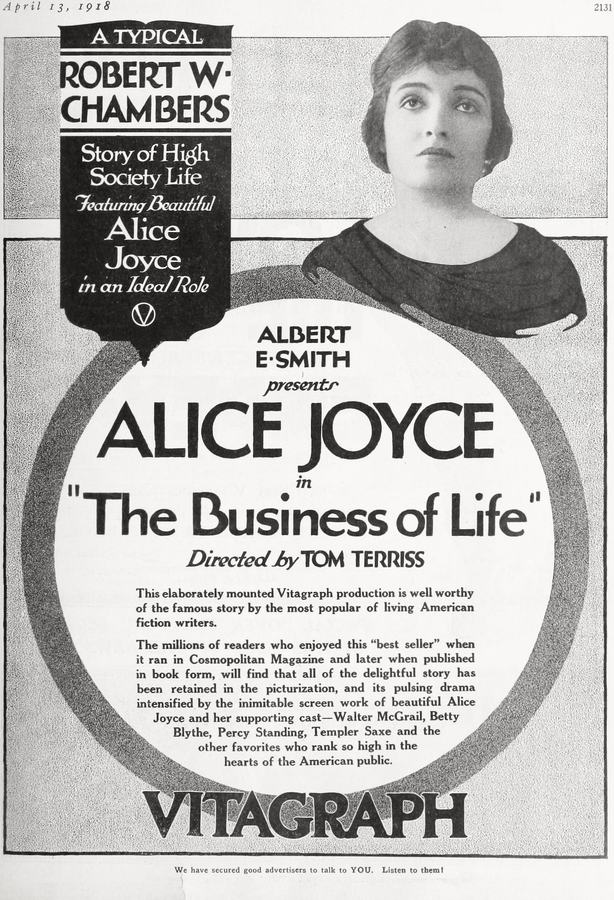
The Business of Life, a 1921 silent film, is a masterful exploration of the human experience, delving into the intricacies of love, jealousy, and relationships. Against the backdrop of the antique business, Jacqueline Nevers, played by the talented Alice Joyce, navigates a complex web of emotions, as she falls deeply in love with James Desboro, portrayed by Walter McGrail. Their whirlwind romance is threatened by the burning jealousy of Elena Clydesdale, a married woman who is also smitten with James, leading to a tangled mess of relationships and deceit.
As the story unfolds, Jacqueline and James tie the knot, but their happiness is short-lived, as Elena's malicious intentions come to the forefront. The tension builds, and the audience is left on the edge of their seats, wondering how the situation will resolve. Will Jacqueline and James's love prevail, or will Elena's destructive behavior tear them apart?
The film's writer, Katherine S. Reed, in collaboration with Robert W. Chambers, weaves a rich tapestry of characters, each with their own distinct personality and motivations. The cast, comprising Nellie Parker Spaulding, Templar Saxe, and Betty Blythe, among others, delivers stellar performances that bring the story to life. The cinematography is equally impressive, with a keen attention to detail that transports the viewer to a bygone era.
In comparison to other films of the era, such as Sins of the Parents and Business Is Business, The Business of Life stands out for its nuanced exploration of human relationships. While Satana likuyushchiy and Lost in Transit may share similar themes, The Business of Life is distinct in its thought-provoking commentary on the human condition. Other notable films, such as The Turn of the Wheel and Dødsklokken, may offer similar insights, but The Business of Life remains a timeless classic in its own right.
The film's cultural significance cannot be overstated, as it provides a fascinating glimpse into the social norms and values of the early 20th century. The portrayal of women, in particular, is noteworthy, as Jacqueline Nevers is depicted as a strong-willed and independent individual, defying the conventions of her time. This is evident in her determination to succeed in the male-dominated antique business, as well as her unwavering commitment to her relationship with James.
Furthermore, the film's technical aspects are also deserving of praise. The cinematography, handled by H.H. Pattee, is superb, with a keen eye for detail that captures the essence of the era. The use of lighting and shadows is particularly noteworthy, as it adds depth and atmosphere to each scene. The score, while not explicitly mentioned, is likely to have been expertly composed, given the era's propensity for live musical accompaniment.
In addition to its technical merits, The Business of Life is also notable for its historical context. Released in 1921, the film provides a unique window into the social and cultural landscape of the time. The film's portrayal of the antique business, for example, offers a fascinating glimpse into the era's commercial practices and values. Similarly, the film's depiction of relationships and romance provides a thought-provoking commentary on the social norms of the era.
The Business of Life is a must-see for anyone interested in the silent film era or the history of cinema. Its timeless themes and universal appeal make it a film that will continue to captivate audiences for generations to come. As such, it is essential to preserve and restore these cinematic treasures, ensuring that they remain accessible to future generations. By doing so, we can appreciate and learn from the past, while also celebrating the art of filmmaking in all its forms.
In conclusion, The Business of Life is a masterful film that transcends time and cultural boundaries. Its rich characters, engaging storyline, and historical significance make it a compelling watch for audiences of all ages. As such, it is our responsibility to preserve and promote this cinematic treasure, ensuring that it remains a vital part of our shared cultural heritage. By doing so, we can honor the legacy of the filmmakers and appreciate the art of silent cinema in all its glory.
IMDb 6.1
1935
Community
Log in to comment.