DbcultAccessing Vault...
Cult Review
Senior Film Conservator
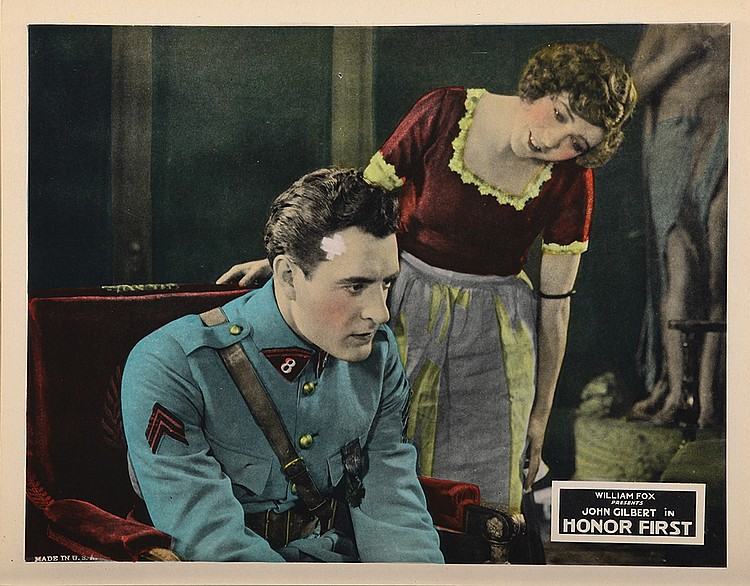
The flickering nitrate of Honor First lands like shrapnel under the ribs—an arrhythmic heartbeat of double exposures, superimposed dog-tags, and war marriages brokered by telegraph. Directed with near-symphonic bravado by Hardee Kirkland and scripted by the polymath duo Joseph F. Poland and George Gibbs, this 1924 silent stunner refuses to behave like a museum relic; instead it strides into your living room trailing cordite, talcum powder, and the sour whiff of absinthe.
From the first iris-in we are forced to confront the French army not as a monolith but as a hall of mirrors: two brothers—one spine soldered from bayonet steel, the other spun from moth-wing fragility—swap places with the ease of a card-sharper’s flourish. John Gilbert, whose profile could slice bread, plays both Jacques and Honoré with such microscopic calibration that you swear you can smell the fear in Honoré’s perspiration and the iron resolve in Jacques’ clenched molars.
The trench sequence, shot in a mixture of charcoal-blue tint and sulfur-yellow tone, feels less like a set and more like a fever etching itself onto your optic nerve. When Jacques dons his brother’s officer coat—epaulets heavy as guillotine blades—the camera executes a slow, 360-degree pan that seems to ask: is identity stitched into fabric, or into the story people agree to recite? The answer is bayoneted home by a title card scrawled in jagged serif: “Courage is the lie that outlives the liar.”
Post-combat, the film vaults from mud to champagne froth. Production designer Clarence Wilson conjures a Montparnasse where streetlights drip citrine light onto rain-slick asphalt; couples jitterbug in basement bals musettes while war profiteers light cigars with franc notes. Here Renée Adorée appears like a scarlet ellipsis—Moira, the wife sold into marriage to settle a gambling debt. Adorée’s performance is a masterclass in micro-gestures: a half-blink that betrays contempt, a fingertip brushing a collarbone as if testing the temperature of regret.
Jacques—now answering to Honoré—waltzes into this den of lacquered vultures. The film’s midpoint pivots on a danse macabre at the Opéra Garnier where Gilbert, in split-screen, dances with himself: the coward and the hero twirling opposing partners beneath a ceiling painted with cherubs who seem to leer rather than bless. The camera cranes upward until the chandelier resembles a crystal noose; downstairs, assassins sharpen stilettos on the stone stairs. The tension is so exquisite you can hear the celluloid sizzle.
Honoré’s scheme to liquidate his twin hinges on a case of mistaken overcoats—one of those delicious ironies that silent cinema adores. In a bravura sequence lit only by a hand-cranked searchlight slicing through fog, the wrong brother is cornered beside the Pont Neuf. The assassin’s knife enters the frame from below, a diagonal of reflected moonlight; the victim collapses, his mask of terror frozen in a single frame that dissolves into rippling water. The river becomes a liquid gravestone, washing away not just a body but the very notion of certitude.
Kirkland withholds the corpse’s face until the last possible second, forcing us to confront our own complicity in the confusion. When the overcoat is peeled back to reveal Honoré’s insignia, the moment lands like a cathedral bell in a bone-cup: we are both relieved and horrified, a paradox that epitomizes the film’s moral algebra.
With the antagonist now a bloated footnote in the Seine, the narrative exhales into something approaching grace. Jacques confesses the imposture to Moira beneath a canopy of chestnut blossoms—each petal a parachute of absolution. Adorée’s face cycles through fury, incredulity, and, finally, exhausted mercy. The scene is shot in extreme close-up, pores and eyelashes rendered with such intimacy you feel like an intruder. Gilbert’s voice, though unheard, seems to vibrate through the subtitle: “I stole a name, but I give you the man who earned it.”
Their kiss is framed against a window where war amputees hobble past on crutches; inside, two broken people solder themselves into a single, luminous alloy. It is one of the rare moments in silent cinema where eros and agony share the same breath without choking.
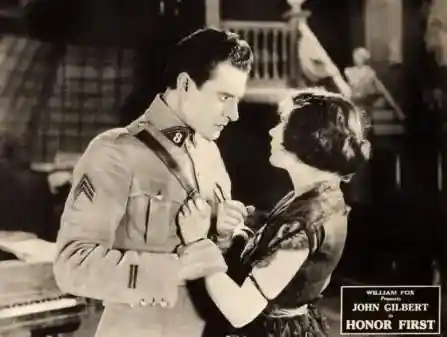
Cinematographer Shannon Day employs tinting like a synesthetic composer: ambers for trench claustrophobia, viridians for Parisian decadence, crimsons for the opera massacre. The effect is not mere ornament but emotional notation. When Jacques returns to the front in the epilogue—now a major commanding fresh fodder—the footage is left stark black-and-white, as though the world has been bled of chromatic lies. Over the image, a superimposed battalion marches in negative space, ghosts inside the ghost.
Compare this chromatic daring to the monochrome pessimism of Blind Justice or the pastoral ochres of Belgium, the Broken Kingdom; Honor First refuses a single emotional palette, insisting that valor and rot can coexist in the same emulsion.
John Gilbert’s detractors often claim his talkie demise stemmed from a “too pretty” voice, yet here the man is a silent thunderstorm. Watch the way he modulates posture: Jacques stands as though gravity were a polite suggestion, shoulders cantilevered forward like a sprinter on the block; Honoré folds into himself, elbows clamped to ribs as if clutching an invisible wound. The distinction is so acute that when the brothers share a frame you never confuse them, despite identical faces.
Renée Adorée, fresh from A Tüz, delivers a masterstroke of reactive acting. Her Moira evolves from porcelain ornament to tempered steel without ever shedding her cosmopolitan sheen. In a late scene she removes her wedding ring, drops it into a glass of champagne, and drinks the effervescent relic—a gesture equal parts communion and challenge.
Modern screenings often pair the film with a commissioned score by the Montpellier Octet, a swirl of brass, accordion, and prepared piano that channels both Satie and Kurt Weill. The juxtaposition of plangent chords against machine-gun montage creates a temporal vertigo: you feel 1918 and 2024 breathing down each other’s necks. Seek out such a print if you can; the experience transmutes a cinephile’s duty into a pagan rite.
Stacked against sibling-tension war narratives like Jealousy (1916), Honor First feels positively radioactive in its moral ambiguity. Where The World Against Him moralizes through religiosity, Kirkland’s film refuses absolution wholesale; salvation is a DIY kit assembled from leftover shame.
Even the comic cynicism of Park Your Car pales beside the gallows humor here—a sequence where bureaucrats measure chest cavities for medals plays like Kafka scripted by Lubitsch.
Because we live in an era where identity is as negotiable as cryptocurrency, Honor First feels ripped from tomorrow’s headlines. It warns that the stories we stitch to our chests can strangle as easily as they shield. It reminds us that heroism is often a clerical error corrected by History’s blind secretary. And it proves, with the ferocity of a bayonet charge, that love—messy, conditional, and often unearned—can still sprout in the crater left by war’s latest lie.
Seek the 4K restoration on Criterion Channel or the tinted Blu-ray from Kino Lorber. Watch it in the dark, with your phone exiled to another room, and let the film’s nitrate ghosts move into your chest cavity. When the final title card fades, you may notice your own heartbeat syncing to a march that ended a century ago yet somehow never stopped.
IMDb —
1929
Community
Log in to comment.