DbcultAccessing Vault...
Cult Review
Senior Film Conservator
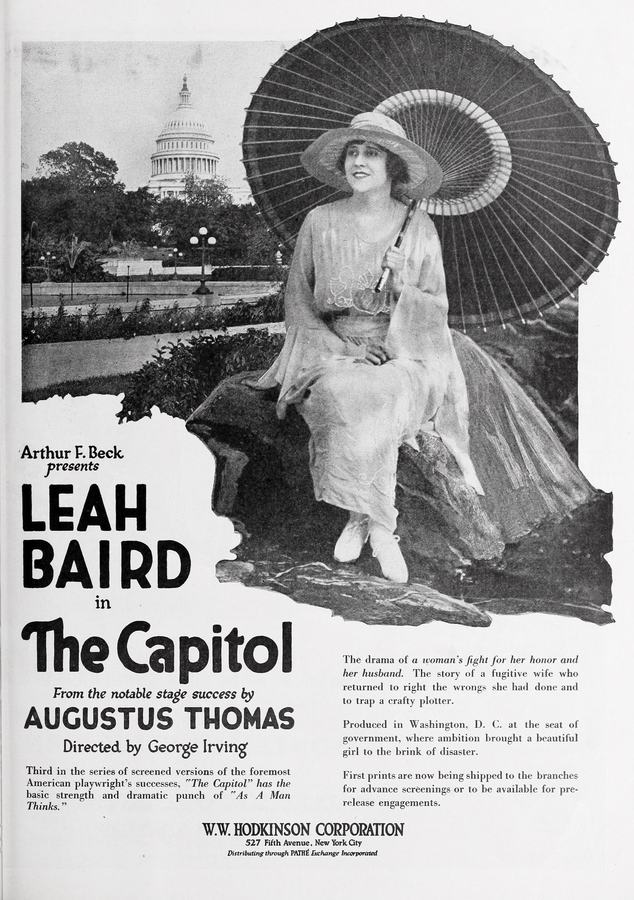
In the annals of silent cinema, few works attempt to bridge the chasm between the intimate domestic drama and the sprawling machinations of national governance as ambitiously as The Capitol (1919). Directed with a keen eye for the theatrical traditions of its screenwriter, Augustus Thomas, the film is a fascinating artifact of a world reeling from the Great War, grappling with the burgeoning power of the lobbyist and the enduring sanctity of the family unit. It is not merely a story of a 'fallen woman' finding redemption; it is a sophisticated exploration of how the sins of the past are codified into the laws of the future.
To understand the structural integrity of The Capitol, one must acknowledge the pedigree of its writer. Augustus Thomas was a titan of the American stage, and his transition to the silver screen brought a certain gravitas—and perhaps a penchant for the coincidental—that defined the era's prestige productions. Unlike the more visceral, rugged landscapes found in The Squaw Man, Thomas’s work here is architectural. He builds a world where the private sphere of the home and the public sphere of the legislative chamber are inextricably linked by the threads of individual morality.
The film begins with a rupture. Margaret Kennard’s flight from Eustace is portrayed not with the lurid sensationalism of lesser silents, but with a palpable sense of desperation. Leah Baird delivers a performance of remarkable nuance, capturing the transition from a woman blinded by the illusory promise of James Carroll to a mother hollowed out by the realization of his criminality. This is the first of many pivots that define the film’s rhythm—a movement from the personal to the spiritual, and finally to the political.
When Margaret joins the Salvation Army, the film enters a fascinating sociological space. In 1919, the Salvation Army was more than a charity; it was a symbol of post-war moral reconstruction. By placing Margaret in this environment, the film suggests that her personal redemption is a microcosm of the nation’s own healing process. However, the true emotional weight lies in her sacrifice of Agnes. The convent serves as a static, preserved space where the child is shielded from the 'theft' that Carroll represents. This thematic duality—active service versus cloistered protection—sets the stage for the second act’s dramatic tension.
This narrative strategy echoes the moral complexities seen in The Foolish Virgin, where the consequences of a woman's choices ripple across decades. However, The Capitol elevates the stakes by introducing the machinery of the state. The twenty-year jump is handled with a confidence that prevents the viewer from losing the emotional thread, transitioning from the dusty streets of reform to the polished marble of Washington D.C.
As the story shifts to the adult Agnes and her husband, Congressman Blake, the film takes on a surprisingly modern edge. The central conflict revolves around an anti-profiteering bill. In the wake of World War I, the American public was deeply concerned with those who had enriched themselves through the suffering of others—a theme also explored with varying degrees of cynicism in The Food Gamblers. Here, James Carroll returns not as a common thief, but as something far more dangerous: a lobbyist.
The evolution of Carroll from a petty criminal to a power-broker is a brilliant stroke of characterization. It suggests that the criminality Margaret fled has not been extinguished but has merely evolved into a more socially acceptable, yet far more corrosive, form. Carroll’s attempt to sabotage Blake’s bill is the engine that drives the final act, forcing the characters into a collision course that is as much about legislative ethics as it is about familial reconciliation.
Perhaps the most poignant character arc belongs to Eustace. The transformation of the jilted husband into a man of the cloth provides the film with its moral compass. His presence in the final confrontation acts as a bridge between the secular world of the Capitol and the spiritual world Margaret sought years prior. It is a testament to the film's complexity that Eustace is not merely a figure of pity, but a man who has found a different kind of power through his faith. His journey mirrors the broader cinematic trend of the time, where religious figures were often the only ones capable of navigating the murky waters of political and personal corruption, a trope also utilized in The Crisis.
The final sequence at Carroll’s house is a masterclass in tension. The way Thomas brings together the Congressman, the Priest, the Mother, and the Daughter in the home of the Villain is, admittedly, a bit of a stretch in terms of realism, but in terms of thematic resonance, it is perfect. It is here that the film sheds its political skin and returns to its core as a family drama. The revelation of Margaret’s identity to Agnes is handled with a restraint that is surprising for 1919. Instead of histrionics, we see the quiet realization of a daughter meeting the ghost of her past.
The aesthetic of this scene, with its deep shadows and sharp contrasts, highlights the moral ambiguity of Carroll’s domain. It stands in stark contrast to the earlier scenes in the convent or the Salvation Army mission. This visual storytelling helps to ground the somewhat improbable coincidences in a world that feels emotionally authentic. The reconciliation of the family is not a simple 'happy ending' but a hard-won peace that acknowledges the twenty years of lost time.
When comparing The Capitol to its contemporaries, one can see the influence of the burgeoning 'social message' film. While The Catspaw dealt with similar themes of manipulation, The Capitol feels more grounded in the specific anxieties of the post-war American legislative process. It lacks the experimental whimsy of something like Paz e Amor, but it makes up for it with a rock-solid narrative foundation.
The film’s focus on the 'scoundrel' lobbyist would become a staple of American cinema for decades to come, foreshadowing the more cynical political thrillers of the 1930s and 40s. Yet, its heart remains in the 19th-century tradition of the 'well-made play.' The cast, featuring stalwarts like Robert T. Haines and William B. Davidson, performs with a dignity that elevates the material above the standard pulp of the era.
Technically, the film is a product of its time, but with flourishes of brilliance. The framing of the Capitol building itself—often looming in the background—serves as a constant reminder of the weight of the law. The cinematography during the Salvation Army sequences has a gritty, almost documentary-like quality that contrasts sharply with the opulent, stagnant air of Carroll’s residence. This visual dichotomy reinforces the film’s central theme: the struggle between the selfless and the selfish.
It is also worth noting the pacing. While many films of the era struggle with the middle act, The Capitol maintains a steady momentum by alternating between the domestic stakes of Agnes’s marriage and the high-stakes maneuvering of the anti-profiteering bill. This dual-track narrative keeps the viewer engaged, ensuring that neither the personal nor the political feels secondary. It’s a balance that even modern filmmakers often struggle to achieve.
Revisiting The Capitol in the modern era is a revelatory experience. We often think of silent films as being preoccupied with simple binaries of good and evil, but here we see a world of gray. Margaret is a hero who abandoned her child; Eustace is a man of God who was forged in the fire of bitterness; Carroll is a villain who operates within the legal framework of the state. It is this complexity that makes the film endure.
As the family reconciles in the final frames, there is a sense that the 'Capitol' of the title refers not just to the building in Washington, but to the capital we invest in our relationships—the emotional debts we owe and the interest we pay over a lifetime. It is a powerful, evocative piece of storytelling that deserves its place in the pantheon of early American cinema. Whether you are a fan of political intrigue or classic melodrama, this film offers a rich, multi-layered experience that rewards careful viewing.
In the end, The Capitol is a reminder that while laws may change and political tides may turn, the fundamental human need for connection and forgiveness remains the most powerful force in any society. It is a film that speaks across the century, reminding us that even the most fractured family can find its way back to center if they are willing to confront the ghosts of their past.
For those interested in other explorations of moral reform and societal shifts, we recommend checking out The Sentimental Lady or the fascinating industrial commentary of The Twinkler.
IMDb 5.4
1924
Community
Log in to comment.