DbcultAccessing Vault...
Cult Review
Senior Film Conservator
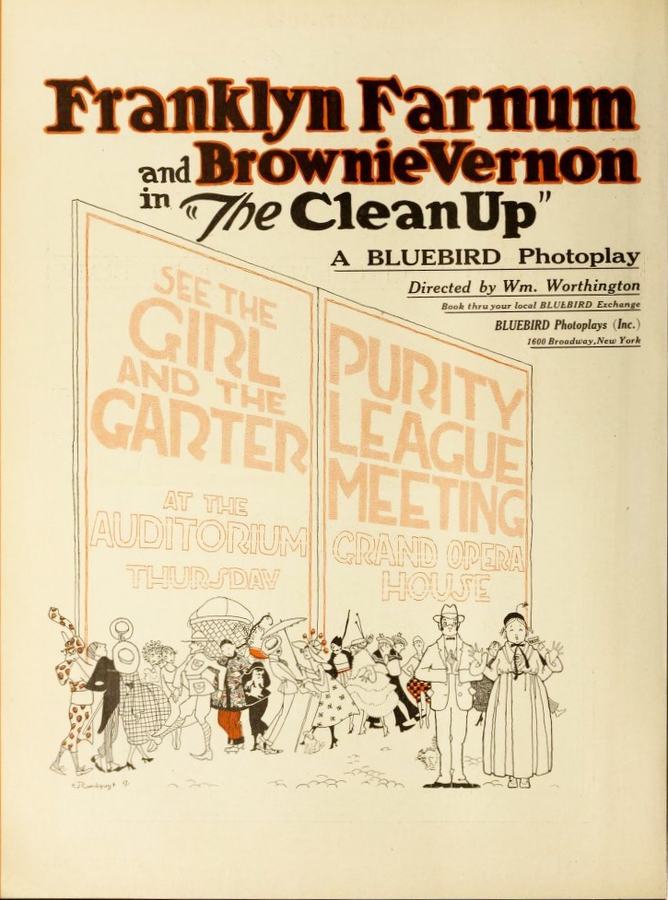
Ah, the silent era! A time when storytelling relied not on spoken dialogue, but on the potent ballet of gesture, expression, and the rhythmic cadence of intertitles. It was an art form that, in its purest manifestations, transcended mere entertainment, offering profound glimpses into the human condition, often through the lens of social commentary, romance, or outright farce. And then there are films like The Clean-Up, a delightful cinematic confection from 1923 that, while perhaps not reaching the epic scope of a The Broken Coin or the intense drama of a The Master Key, nevertheless masterfully crafts a narrative rich in wit, charm, and a surprisingly incisive look at small-town hypocrisy. It’s a film that reminds us that even without sound, a story well-told, with characters vividly brought to life, can resonate across the decades, speaking volumes about timeless human foibles and aspirations.
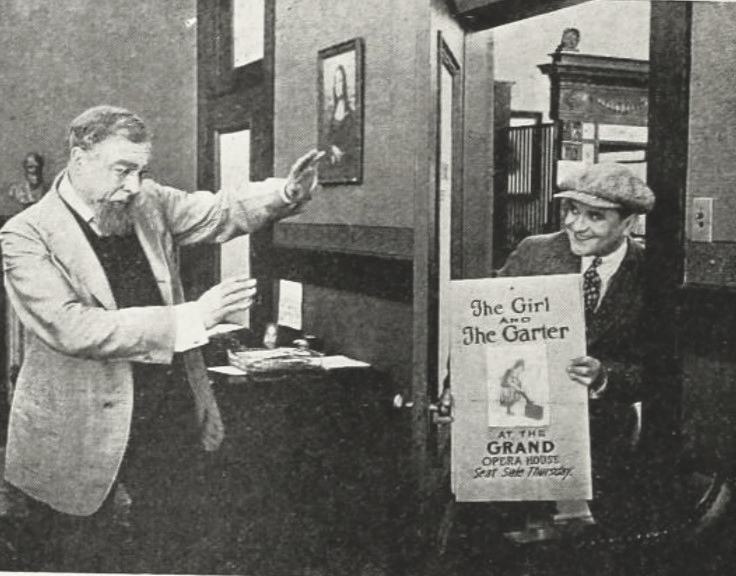
Our narrative unfolds in Weston, Illinois, a town that, on the surface, epitomizes quaint American provincialism. But beneath its veneer of quiet piety, a storm is brewing, or rather, a theatrical spectacle is about to make landfall. Enter Stuart Adams, portrayed with an infectious, roguish charm by Clyde Benson. Stuart isn't merely an advance-agent; he’s a theatrical provocateur, a maestro of publicity whose mission is to prime the local populace for the arrival of 'The Girl and the Garter,' a burlesque troupe promising an evening of risqué entertainment. His return to his hometown, however, is less a nostalgic homecoming and more an audacious invasion, immediately setting him on a collision course with the town's self-appointed moral guardians: the formidable Purity League. This staunch collective, a bastion of conservative values, is spearheaded by none other than James Richards, a prominent banker and, perhaps more inconveniently for Stuart, the father of his sweetheart, Hazel.
From the moment Stuart steps off the train, the air crackles with an almost palpable tension. His objective is clear: generate buzz, stir curiosity, and perhaps, delightfully, ruffle a few feathers. His methods are anything but conventional, demonstrating a shrewd understanding of human nature and the power of public spectacle. One of his initial, and most audacious, moves involves Hazel, played with a captivating blend of innocence and burgeoning defiance by Agnes Vernon. In a bold display of affection and calculated rebellion, Stuart publicly kisses Hazel. This seemingly innocuous act, framed within the rigid social mores of the era, is a seismic event, sending shockwaves through the Purity League members who witness it. Their outrage, far from dampening Stuart's spirits, only fuels his strategic machinations. He understands that condemnation, when skillfully manipulated, can be the most potent form of advertising. It’s a classic tactic of the underdog, brilliantly executed, reminiscent of the clever stratagems seen in films where protagonists must outwit more powerful, entrenched adversaries, though often with a lighter touch here than in, say, a more serious drama like The Fringe of Society.
Stuart's campaign of calculated mischief doesn't stop there. He masterfully leverages the local newspaper, not with conventional advertisements, but with a piece of seemingly damning evidence against the very man leading the charge against him. He orchestrates the printing of James Richards' admission that he had, in fact, viewed 'The Girl and the Garter' in New York. The crucial nuance, of course, is Richards' justification: he saw it 'to see how shocking it was.' Stuart's genius lies in presenting this 'confession' as a scandalous revelation, knowing full well that the public's imagination would fill in the salacious blanks, effectively turning Richards' moral crusade into an unwitting endorsement. The irony is delicious, a testament to Waldemar Young's sharp writing. This move is a stroke of satirical brilliance, exposing the inherent hypocrisy that often underpins moralistic posturing. It's a delightful subversion of expectations, a thematic thread that runs through many silent comedies that dared to poke fun at societal norms.
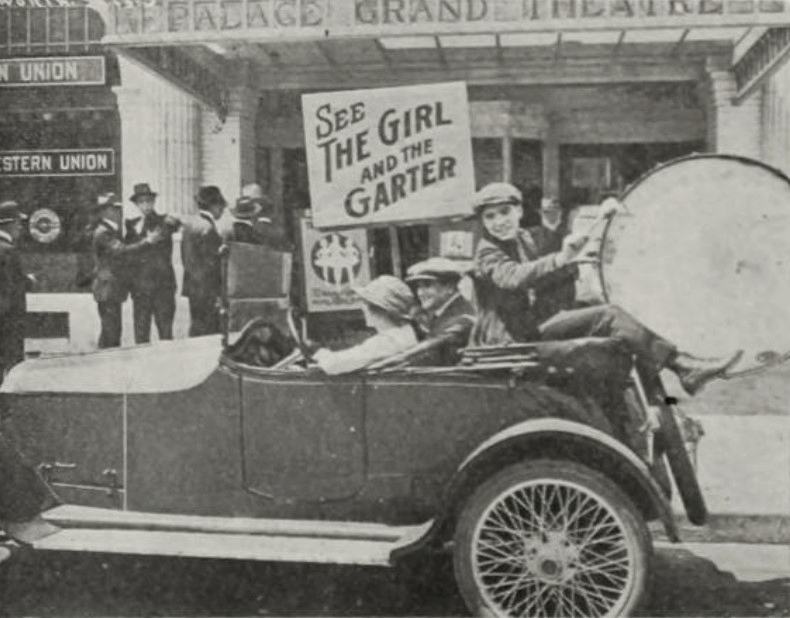
The climax of Stuart's initial publicity blitz arrives during a Purity League parade, an event designed to showcase the town's virtuous solidarity. In a move that is both audacious and uproariously funny, Stuart covertly attaches a banner advertising 'The Girl and the Garter' to Hazel's roadster. As the parade solemnly proceeds, Hazel's vehicle, unwittingly transformed into a mobile billboard for the very entertainment her father condemns, becomes a symbol of Stuart's irreverent triumph. The visual gag is superb, eliciting chuckles even today, demonstrating the enduring power of silent film comedy when executed with such precise timing and clever staging. It’s a moment that perfectly encapsulates the film's playful spirit, highlighting the clash between rigid social expectations and the burgeoning desire for more liberal forms of expression.
The escalating feud between Stuart and Richards inevitably leads to a proposed public debate, a theatrical showdown designed to settle the moral dispute once and for all. Before this intellectual gladiatorial contest, however, a crucial subplot intertwines with the main narrative. Stuart, having previously met detective Vera Vincent (portrayed by Mae Talbot) on the train to Weston, finds himself in a position to assist her. In a moment of unexpected heroism, he helps Vera capture two nefarious crooks attempting to rob Richards' very own bank. This interlude, while seemingly a diversion, serves multiple purposes. It showcases Stuart's quick thinking and bravery, adding another dimension to his character beyond mere trickery. It also, somewhat ironically, places him in a position of civic virtue, earning him a modicum of respect, perhaps even from his adversaries, thereby subtly shifting the perception of his character from mere scoundrel to a more complex, albeit still mischievous, hero. This element of unexpected heroism, often involving a protagonist proving their worth through action rather than just words, is a common and effective trope in early cinema, adding layers to characters who might otherwise be one-dimensional.
The much-anticipated debate arrives, a forum for Weston's moral compass to be publicly tested. The stage is set for a verbal duel, a clash of ideologies between the conservative establishment and the representative of modern entertainment. However, Stuart, ever the strategist, has one more trick up his sleeve. Unknown to Richards and the Purity League, 'The Girl and the Garter' show has been canceled. With this knowledge, Stuart, in a brilliant stroke of magnanimity that is entirely calculated, offers to end the bickering and withdraw the show. This move completely disarms Richards, who, having prepared for a battle of wills, finds himself facing an opponent who has seemingly conceded. The tables are turned; Stuart has not only won the moral high ground but has also subtly outmaneuvered his rival without firing a single shot, so to speak. It’s a masterclass in psychological warfare, a testament to the power of perception and timing.
The resolution of the public conflict, however, immediately sets the stage for a private romantic dilemma. Richards, perhaps feeling a newfound, albeit grudging, respect for Stuart, or simply relieved that the burlesque controversy has dissipated, insists that Stuart come to dinner. This invitation, seemingly a gesture of reconciliation, throws a wrench into Stuart’s meticulously laid plans. He and Hazel had intended to seize this very evening to elope, meeting at the train station to escape the confines of Weston and her father's watchful eye. The irony is palpable; Stuart's very success in 'cleaning up' the public perception inadvertently threatens his private happiness. Yet, fate, or perhaps simply good comedic timing, intervenes. Hazel, it turns out, has been locked in her room by her vigilant aunt, Martha Mattox, ensuring she is still at the house. This last-minute twist provides a charming save, allowing the romantic subplot to maintain its trajectory, hinting at a future where Stuart and Hazel might yet find their happily ever after, free from the prying eyes of the Purity League.
The performances in The Clean-Up are uniformly engaging, bringing to life characters that, despite the lack of spoken dialogue, convey a remarkable range of emotions and intentions. Clyde Benson as Stuart Adams is the undeniable anchor, embodying the spirit of the charming rogue who uses his wits to navigate a world of moralistic rigidity. His expressions are fluid, his gestures precise, making his schemes and triumphs feel genuinely earned. Agnes Vernon, as Hazel, perfectly captures the sweet innocence of a young woman caught between filial duty and burgeoning love, her eyes often conveying more than any intertitle could. Albert MacQuarrie as James Richards embodies the stern, often hypocritical, authority figure with a believable gravitas, making his eventual discomfiture all the more satisfying. The supporting cast, including William Human, Martha Mattox, Mae Talbot, Franklyn Farnum, Mark Fenton, and Claire McDowell, each contribute to the rich tapestry of Weston's eccentric inhabitants, adding depth and humor to the proceedings. Their collective efforts ensure that the film remains vibrant and relatable, even a century after its initial release. This ensemble's ability to communicate complex character dynamics without dialogue is a testament to the unique craft of silent film acting, where every glance, every posture, and every exaggerated reaction became a crucial part of the storytelling.
Waldemar Young's screenplay, while adhering to the typical comedic structures of the era, distinguishes itself through its sharp observational humor and its willingness to gently satirize societal norms. The plot is intricately woven, with each of Stuart's schemes building upon the last, creating a sense of escalating comedic tension that resolves in a satisfying, if slightly ironic, manner. The pacing is brisk, a hallmark of effective silent comedies, ensuring that the audience remains engaged without feeling rushed. The film’s direction—whether it was handled by a credited director or a collective effort typical of early studio productions—demonstrates a clear understanding of visual storytelling, utilizing clever camera angles and staging to maximize both the comedic impact and the emotional resonance of key scenes. The visual gags are well-timed, and the character reactions are precisely calibrated to elicit laughter or sympathy. It's this careful balance of elements that elevates The Clean-Up beyond a simple farce into a genuinely clever piece of filmmaking that stands the test of time.
The thematic undercurrents of The Clean-Up are surprisingly relevant even today. The clash between freedom of expression and censorship, the exposure of hypocrisy in moralistic circles, and the age-old battle between tradition and progress are all explored with a light touch that never feels preachy. Stuart Adams, in his own way, is a champion for a more open, less judgmental society, even if his methods are unorthodox. The film subtly critiques the idea that morality can be legislated or enforced through public shaming, suggesting instead that genuine virtue lies in tolerance and understanding. The romance between Stuart and Hazel, while a classic trope, is handled with a charming sincerity that grounds the more farcical elements of the plot. Their love story provides an emotional core, a reminder that amidst the societal squabbles, personal happiness and genuine connection remain paramount. It's a sentiment that resonates deeply, making the film more than just a period piece, but a timeless commentary on the enduring human desire for authenticity and connection.
In conclusion, The Clean-Up is a delightful discovery for anyone with an appreciation for silent cinema, clever storytelling, and a good laugh. It's a testament to the ingenuity of early filmmakers and writers like Waldemar Young, who could craft narratives that were both entertaining and subtly profound without the benefit of spoken words. Clyde Benson and Agnes Vernon, along with the entire cast, deliver performances that are both nuanced and perfectly suited to the medium, making their characters instantly likable and relatable. While it may not possess the sprawling ambition of a historical epic or the gritty realism of a social drama, its strength lies in its focused wit, its charming romance, and its gentle yet incisive social satire. This film offers a refreshing reminder that the battles against narrow-mindedness and hypocrisy are as old as society itself, and that sometimes, the most effective weapon is a well-placed joke, a strategic banner, or a perfectly timed public kiss. It’s a film that cleans up nicely, leaving the viewer with a smile and a renewed appreciation for the enduring magic of the silver screen's earliest days. If you're looking for a film that combines cleverness, romance, and a touch of rebellious spirit, then The Clean-Up is an absolute must-watch, a hidden gem that shines brightly in the vast landscape of silent film history.
IMDb 3.4
1932
Community
Log in to comment.