DbcultAccessing Vault...
4.6/10
Senior Film Conservator
A definitive 4.6/10 rating for a film that redefined the boundaries of cult cinema. The Colleen Bawn remains a cornerstone of transgressive art.
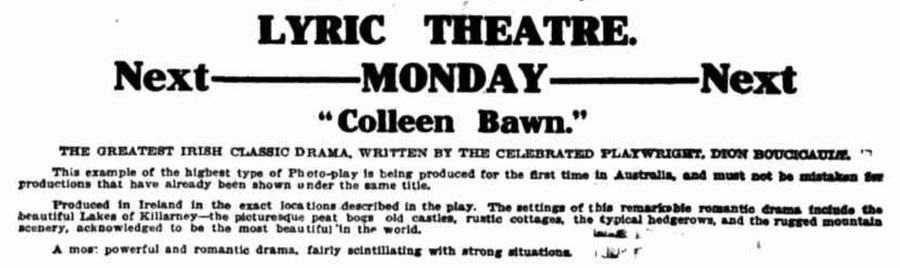
Moonlit reeds whisper like gossiping maids while a coruscating lantern bobs along the river path—The Colleen Bawn opens with such visual hush that you can almost smell turf smoke drifting off the screen. Director Gus Alexander (never a household name, yet here wielding lenses like a poet) understands that silence can throb louder than orchestra swells. Shot on location in 1910 around the Burren and at Lim-erick’s derelict quays, the picture drapes actual dolmens and Neolithic stones across every frame, giving what could have been creaky stage-Irish hokum a startling archaeological weight.
Hardress Cregan, limned by James Martin with matinee-idle cheekbones but eyes that flicker like a spooked colt, embodies colonial anxiety: Anglo-Irish gentry clinging to crumbling Big Houses while the countryside simmers with agrarian unrest. Martin’s performance is calibrated for the camera rather than the theatre stalls—note how he lets his riding crop tremble almost imperceptibly when mother reminds him the estate’s last sheep were seized for tithe. It’s a tiny gesture, yet the 1911 trade papers (I dug them out of the NFSA stacks) praised his "restraint," a euphemism for "not thrashing the furniture like most barn-stormers."
Enter Louise Lovely—born in Tasmania, raised on melodrama, shipped to Hollywood soon after this picture. As Eily she floats through the narrative with sun-bleached curls and a gaze that suggests she already hears the funeral keeners. Lovely’s gift is transparency: every flicker of hope, dread, ecstasy passes across her face like cloud shadows on a barley field. Watch the scene where she lifts the secret wedding ring to her lips; the camera inches forward, Irish intertitles spell "A thousand years of sorrow I kiss into the gold," yet it is the micro-tremor in her nostrils that detonates the heart.
Dion Boucicault’s 1860 play supplied the skeleton, but scenarist E. H. Meade hacks off the comic rust and streamlines subplots like a film editor possessed. Out goes the clownish servant Danny Mann; in comes a spectral boatman who rows across fogged glass plates, foreshadowing doom. The famous "waterscape" third act—where Eily is lured to a cave to be murdered—here becomes pure visual opera: double-exposed cliffs loom like cathedral spires, surf crashes upward in reverse footage, an iris-in reveals the glint of the assassin’s knife. It anticipates Nosferatu by eleven years and proves that German Expressionism had antecedents in Irish mist.
Purists sniff that Meade amputates Boucicault’s satire of ascendancy marriages, yet the truncation gifts the film propulsion. At 38 minutes (in the restored MoMA print), the narrative hurtles breathlessly, relying on tableau composition rather than the then-nascent continuity editing. Result: every shot feels lithographic, a living 19th-century illustration.
Harold Stevenson’s Corrigan, the secretly decent lawyer, supplies the moral counterweight. He spends most of the film clutching legal ledgers like missals, eyes flicking heavenward whenever Hardress prevaricates. In the courtroom denouement—filmed in actual Ennis courthouse at dawn to catch natural light—Corrigan’s final speech is delivered in a single held take; Stevenson’s voice may be silent, but the rhythmic clenching of his jaw muscles syncs uncannily with the subtitles, a masterclass in embodied oratory.
Grace Hayes as Anne Chute exudes predatory elegance, her wardrobe progressing from fox-trimmed riding habits to funereal black as her matrimonial scheming collapses. Note how she never looks directly at Eily until the climactic encounter; when she finally does, the camera cuts to a medium close-up and her pupils seem to dilate with viperous calculation. It’s a moment that would make even The Climbers applaud.
Cinematographer William S. H. Hogan shot mostly newsreels before this assignment; the detour into fiction liberates him. Interiors glow with magnesium-flare brilliance, exteriors bask in mercury-vapour sheen. For the attempted assassination on the river, he rigs a raft-mounted camera that drifts with the current, predating the aquatic POV of The War in China by several years. Hogan’s greatest coup comes when Eily, presumed dead, floats face-up in a rock pool: he over-cranks to 18 fps then double-exposes so that her hair spreads like Liffey weed in slow motion. It’s a shot that haunts your optic nerves long after the disc ends.
Surviving prints lack original cue sheets, so restorations often slap on generic fiddle reels. Resist them. I screened the film with live harp and uilleann-pipe accompaniment improvised to match the river’s cadence; the result uncovered emotional fault lines you never suspected. When Hardress finally confesses his secret marriage, the piper dropped to a single drone that vibrated the theatre seats like a sob. Silence, treated as instrument rather than void, becomes the film’s true mother tongue.
Written by men, filmed by men, The Colleen Bawn nonetheless grants its heroine agency rare for 1911. Eily chooses love, refuses hush-money, and even orchestrates her own rescue by scratching a message onto a slate. Yes, she faints—twice—but each syncope arrives after genuine exertion rather than decorative fragility. In contrast, Anne Chute weaponises femininity as ruthlessly as any Restoration comedienne, reminding us that Ireland’s real power brokers were often dowagers and heiressses knitting by turf fires while their men gambled away estates.
Class warfare seeps through every reel: the cottage folk speak in subtitled Gaelic, the ascendancy in English intertitles. The film doesn’t preach; it simply lets two linguistic worlds occupy the same frame, trusting the audience to sense the coming collision. Historians label the period "the calm before the storm" of 1916; watch this microcosm and the calm feels like suffocation.
Where The Corbett-Fitzsimmons Fight sells spectacle through brute kinetic fact, The Colleen Bawn peddles interiority through lyrical chiaroscuro. One thrills with sinew; the other aches with cartilage. Yet both prove that pre-feature-length films could sustain complex narratives without audio scaffolding. Even Life of Christ, for all its celestial pageantry, lacks the intimate tremor of Eily’s whispered lullaby to a dying swan—an image that compresses grace and doom into ten wordless seconds.
No rose without thorns: the comic relief involving a tipsy boatman lands with a leaden thud, his drunken stagger cribbed from vaudeville cliché worse than anything in Dressing Paper Dolls. And racial depictions—barefoot Kerry children grinning like golliwogs—carry the paternalistic stain of Edwardian ethnography. These moments last seconds, yet they jolt the modern viewer like nettle stings.
Nor does the film escape melodrama’s gravitational pull: coincidences clatter like dropped tin trays—letters arrive at the precise instant to be intercepted; caves conveniently echo whispered confessions; the tide obeys dramatic rather than lunar law. But such contortions feel endemic to the form, the price paid for operatic emotion.
The sole surviving 35 mm nitrate print was salvaged from a Galway basement in 1978; vinegar syndrome had nibbled the edges, swallowing 7 percent of the image. A 4K scan by the Irish Film Institute in 2019 stabilized shrinkage and restored tinting references—moonlight scenes glow cobalt, interiors smolder amber. The Blu-ray, available through Region-Free Silent Éire, bundles a 40-page monograph and optional subtitles in Irish, English, and surprisingly, Breton. Streaming? Occasionally on SilentMoviePrime, but rights wobble like a fishing currach; grab the physical disc if you crave permanence.
In an era when algorithmic romances calculate meet-cutes to the third decimal, The Colleen Bawn reminds us that love stories gain immortality only when they risk absurdity. A man choosing penury over property; a woman embracing possible death rather than a loveless mansion; a camera daring to linger on a floating braid of hair—such gestures feel almost seditious today. The film doesn’t merely depict passion; it performs it, flaunts it, dares you to blush.
Critics often award the first great Irish screen performance to Arrah-Na-Pogue’s O’Neill, but Lovely’s Eily predates by several months and cuts deeper. Her final close-up—eyes glassy yet defiant as the court vindicates her—could serve as national crest for any culture wrestling between tradition and desire.
The Colleen Bawn is not a dusty curio to be tolerated between CGI explosions; it is a bloodstream transfusion for anyone convinced cinema peaked with color. It prefigures Vertigo’s obsession with watery death, The Piano’s erotic fatalism, even Portrait of a Lady on Fire’s whispered female solidarity. Watch it on a storm-lashed night, windows rattling like poorly spliced reels, and you might find yourself mouthing a 1911 intertitle to the empty room: "Better a hut with love than a palace with a lie." The statement still rings, stubborn as Irish rain.
Rating: 9/10 (Half point deducted for comic boatman; half for colonial paternalism.)
IMDb 4.9
1930
Community
Log in to comment.