DbcultAccessing Vault...
Cult Review
Senior Film Conservator
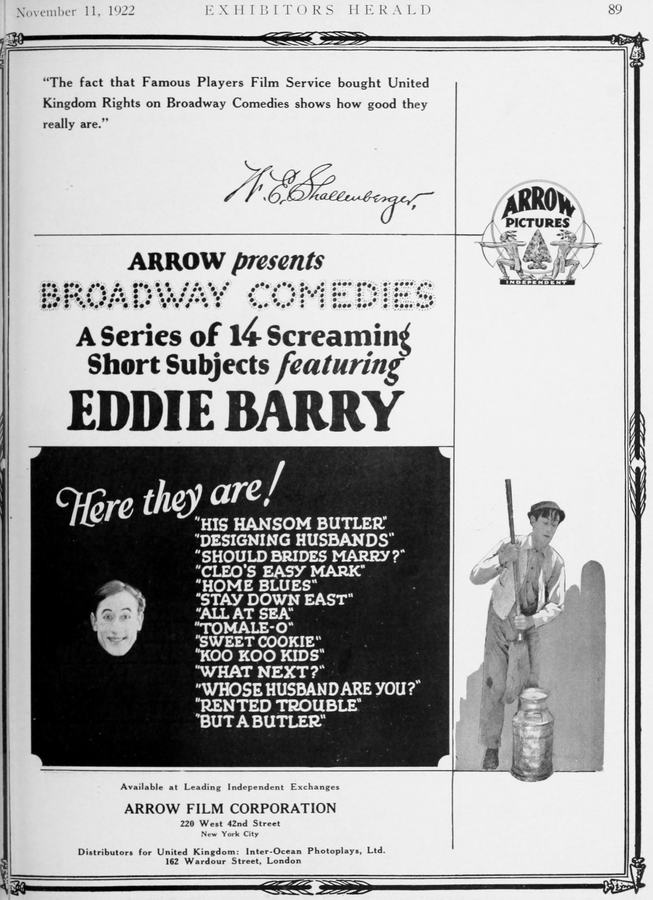
The silent era was not merely a precursor to modern cinema; it was a distinct, vibrantly alive language that spoke through the poetry of gesture and the rhythm of the edit. In the 1920 short Whose Husband Are You?, we find a quintessential example of the domestic farce—a genre that thrived on the anxieties of a rapidly urbanizing society. Unlike the sweeping romanticism found in Trailin', this film trades in the currency of claustrophobic confusion and the fragility of the nuclear family unit.
The narrative structure of Whose Husband Are You? functions like a Rube Goldberg machine of social embarrassment. The premise—a man finding himself erroneously identified as the spouse of multiple women—is a trope that predates the silver screen, yet here it is infused with a frantic, celluloid energy. Eddie Barry, a veteran of the Christie Comedies, navigates the screen with a rubber-faced desperation that perfectly encapsulates the 'little man' archetype. His physicality is a masterclass in the art of the 'slow burn' and the 'sudden realization,' techniques that would later be refined by the likes of Keaton and Lloyd.
The film’s pacing is relentless. From the opening title cards, we are thrust into a world where the domestic sphere is not a sanctuary but a minefield. This stands in stark contrast to the more contemplative or dramatic tones seen in contemporary works like The Cost. Where that film seeks to explore the weight of consequence, Whose Husband Are You? revels in the weightlessness of the absurd. The stakes are simultaneously high—social ostracization and physical violence—and utterly trivial, as the entire conflict could be resolved with a single honest conversation. But in the world of silent comedy, honesty is the enemy of the gag.
One cannot discuss this film without acknowledging the magnetic presence of Vera Reynolds. Long before she became a Cecil B. DeMille regular, Reynolds was honing her craft in these short-form comedies. Her performance here is nuanced; she is not merely the 'wife' or the 'object of desire.' She possesses a sharp, reactive intelligence that often makes her the most competent person on screen. Her ability to convey suspicion, relief, and exasperation without a single spoken word is a testament to the sophisticated visual literacy of the era's performers.
When compared to the more ethereal or stylized performances in Neptune's Daughter, Reynolds feels remarkably modern. She operates within a realistic register that makes the surrounding slapstick feel even more chaotic. The chemistry between her and Phil Dunham provides the film’s necessary friction. Dunham, often cast as the antagonist or the 'other man,' brings a pompous rigidity that serves as the perfect anvil for the film’s comedic hammers.
While modern audiences might dismiss Whose Husband Are You? as simple fluff, there is a subtextual critique of the institution of marriage. The film posits that the identity of a 'husband' is not an intrinsic quality but a social mask that can be slipped onto anyone. This theme of identity as performance is a recurring motif in 1920s cinema, perhaps most notably explored in the dual-role drama of The Masquerader. However, while The Masquerader treats identity theft with gravitas, our comedy short treats it as a hilarious inevitability.
The supporting cast, including the inimitable Dorothea Wolbert, adds layers of texture to the production. Wolbert’s face is a landscape of comedic history; her expressions carry the weight of a thousand vaudeville sketches. She represents the older generation, the watchful eye of societal judgment that the younger characters are constantly trying to evade. This intergenerational conflict is a staple of the era, mirroring the real-world tensions of the Roaring Twenties.
Technically, the film is a product of the Christie Film Company’s efficient yet creative studio system. The sets are designed for maximum kinetic potential—doors that open at the wrong time, hallways that become racetracks, and living rooms that transform into arenas of combat. The cinematography, though functional, utilizes the depth of the frame to keep multiple gags running simultaneously. It lacks the expressionistic shadows of Die Schmuggler von San Diego, but it replaces atmosphere with clarity and speed.
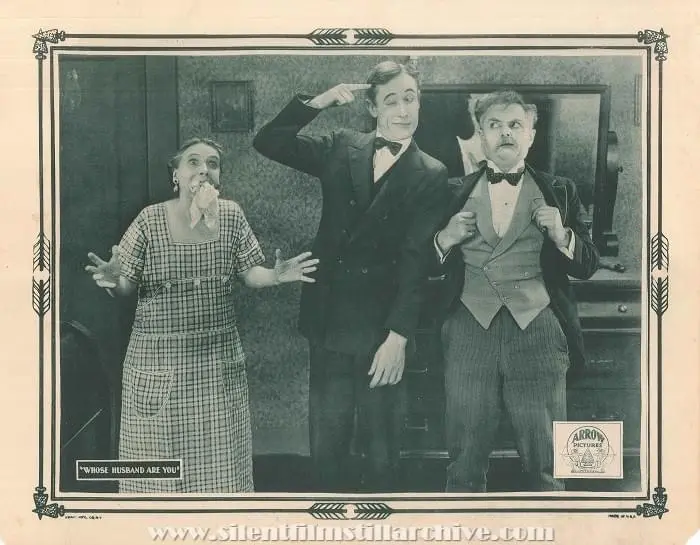
Consider the sequence involving the 'mistaken bedroom.' It is a masterclass in blocking. The camera remains static, allowing the actors to move through the space like dancers. This reliance on the wide shot preserves the physical comedy’s integrity, showing the audience that there are no camera tricks—only the raw skill of the performers. This is a far cry from the more experimental or propagandistic framing found in For the Freedom of the World, where the camera is often used to manipulate emotion rather than document action.
To understand Whose Husband Are You?, one must understand the Christie Comedies' place in the hierarchy of silent film. While Mack Sennett was the king of the 'pie-in-the-face' and the Keystone Cops, Al and Charles Christie focused on 'situation' comedies. Their films were often more grounded, focusing on the foibles of the middle class. This film is a bridge between the broad slapstick of the 1910s and the more sophisticated romantic comedies of the late 1920s. It shares DNA with His Matrimonial Moans, yet it possesses a more refined sense of narrative propulsion.
The film also echoes the thematic concerns of The Very Idea, which tackled the then-controversial topic of eugenics through a comedic lens. While Whose Husband Are You? isn't as overtly political, it participates in the same cultural conversation about the 'science' of domesticity and the unpredictability of human nature. It suggests that no matter how much we try to organize our lives into neat, matrimonial boxes, the reality will always be a messy, hilarious tangle.
When we place this film alongside international works like the Irish epic Knocknagow or the French action-serial Protea II, we see the sheer diversity of the silent medium. Whose Husband Are You? is distinctly American in its obsession with social mobility and the 'embarrassment of riches.' It lacks the pastoral sentimentality of My Wild Irish Rose or the gritty realism of Bought, choosing instead to live in a heightened, neon-lit (metaphorically speaking) version of reality.
Even within the realm of comedy, it occupies a unique space. It is less surreal than The Fotygraft Gallery and more plot-driven than The Galloper. It is a film that understands its own limitations and works perfectly within them. It doesn't aim for the tragic heights of A Petal on the Current; it aims for the gut-laugh, and in that, it is overwhelmingly successful.
Watching Whose Husband Are You? today is a bittersweet experience. Many of these shorts have been lost to time, victims of nitrate fires and neglect. The fact that we can still witness Eddie Barry’s frantic gestures and Vera Reynolds’ knowing glances is a minor miracle. The film serves as a reminder that comedy is often the most fragile of genres, tied so closely to the cultural zeitgeist of its time that it can easily become anachronistic. Yet, the core of this film—the fear of being 'found out,' the chaos of a misunderstanding—remains universally relatable.
The film’s resolution is as swift as its beginning. There are no long-winded explanations, only the restoration of the status quo—or at least, a version of it. It leaves the viewer breathless and perhaps a bit more skeptical of the next person who claims to be their spouse. In the grand tapestry of 1920s cinema, Whose Husband Are You? is a bright, jagged thread, a testament to the power of a well-timed fall and a perfectly placed title card. It is a exuberant celebration of the messiness of being human, wrapped in a twenty-minute package of celluloid joy.
A masterpiece of the domestic miniature, this film remains a vital watch for any serious student of the silent era's comedic pulse.
IMDb —
1934
Community
Log in to comment.