DbcultAccessing Vault...
Cult Review
Senior Film Conservator
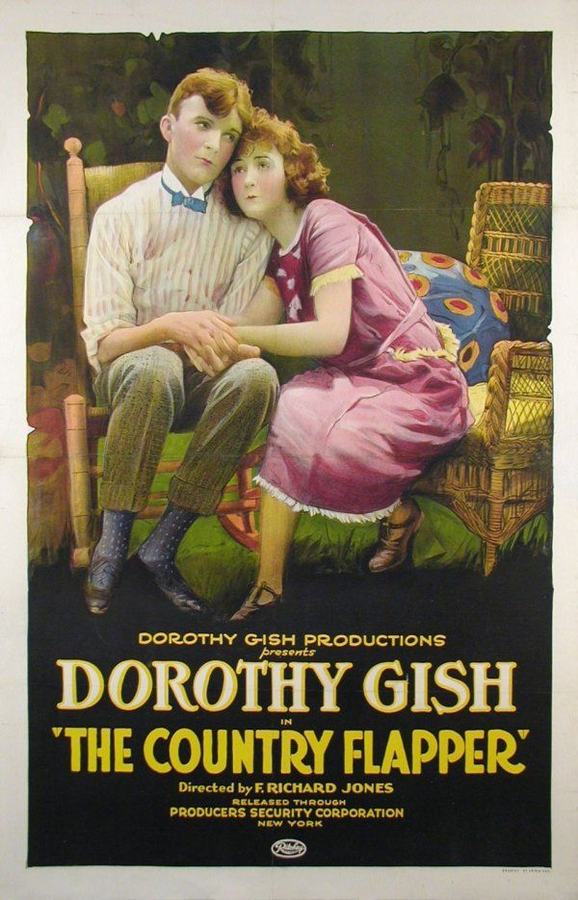
Somewhere between the sepia whispers of The Two Edged Sword and the foamy mythos of Lorelei of the Sea, The Country Flapper re-emerges from nitrate limbo like a heat mirage quivering over a wheat field. The plot, deceptively simple on paper, corkscrews into something feral: a pastoral revenge fable told through prismatic title cards and eyelashes heavy with coal-dust mascara.
Director Harry Carr, moonlighting from his day job as a muckraking journalist, splices ink-stained cynicism into every frame. The resultant tone is moonshine—clear, potent, liable to make your vision wobble. You taste it in the opening shot: a low angle of a scarecrow silhouetted against a magnesium sunrise, its straw fingers pointing accusingly at the audience. Already the film confesses its central obsession: masks, façades, the artifice of virtue.
Enter Dorothy Gish as Jolanda—no waifish ingénue but a sun-chapped force of agrarian nature. Gish’s comic elasticity, honed in one-reelers for Biograph, mutates here into something tensile and dangerous. She darts across granaries, vaults over pigpens, and in close-up lets her pupils flare with predatory calculation. It’s a performance pitched half-way between Engel ein’s cherubic mischief and Eva’s sphinx-like opacity.
The city flapper who lures Nathaniel away is never granted a name; she is merely “The Scintillation,” a editorial choice that weaponizes her as symbol rather than woman. She appears in stroboscopic flashes—silver dress shimmying like a shaken tray of knives, cigarette holder jutting like a bayonet. The editing rhythm mimics jazz syncopation: two frames of her laughing, four frames of Jolanda’s stricken eyes, one subliminal splice of a heifer’s throat being slit. You absorb the violence without quite seeing it.
Blackmail unfurls not in smoky boardrooms but in a hay-scented toolshed where oil lamps paint everyone the color of old pennies. Jolanda’s leverage? A cache of letters proving Nathaniel Sr. once supplied substandard grain to WWI troops. The moral math is vertiginous: our heroine imperils thousands of anonymous soldiers to salvage one romantic bruise. Carr refuses to sand the edges; the camera lingers on Jolanda’s trembling smirk as she realizes the monstrous arithmetic of her desire.
Mid-film, the narrative fractures into a triptych of hallucinations, each tinted a different chemical hue—amber, viridian, carmine—anticipating the nightmare palettes of Solen der dræbte. In the most ravishing sequence, Jolanda stalks through a corn maze that rearranges itself like shuffled postcards. She glimpses her rival’s face on every husk; the plants whisper gossip in rust-riddled voices. Intertitles dissolve into on-screen graffiti: “A heart turned inside-out still bleeds red.”
Cinematographer Joseph Farnham—moonlighting from his intertitle duties—experiments with under-cranking during a barn dance so the reel collapses into Keystone frenzy without forfeiting emotional heft. Fiddles saw, boots blur, yet each frame lands like a bruise. Over the mayhem, Gish’s laugh is optically printed at half-speed, dropping her voice (in our mind’s ear) into contralto profundo, a ghost haunting her own body.
Then arrives the pivot, a moment so quietly cataclysmic it feels like weather. Nathaniel, drunk on corn liquor and contrition, kneels in pig slop and proposes earnest redemption. Jolanda’s victory calcifies into ash. She recognizes the scaffold she erected: marriage as penal sentence, love as extorted contraband. The camera dollies back until she’s a speck amid furrows, the landscape swallowing her tantrum whole. No score survives, but the silence itself seems to drone like distant bees.
Compare this moral implosion to the sibling comedies of 1922: My Best Girl trades in flapper restlessness yet hedges its bets with a last-reel church aisle; The Mating anthropomorphizes Cupid as prankish matchmaker. The Country Flapper alone dares to let the bet rot unclaimed, to suggest that restitution and retribution share a single, rusted coin.
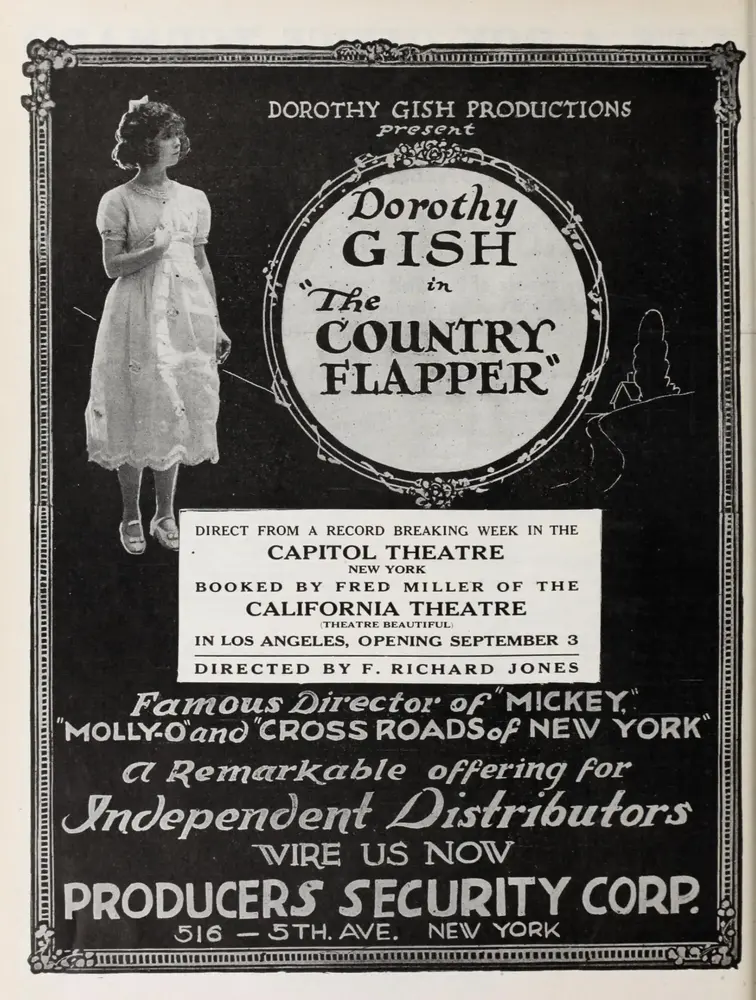
The supporting cast orbit like errant moons. Raymond Hackett’s Nathaniel is a fascinating null—pretty, vapid, a stand-in for every small-town boy who believes the city will tutor him in sophistication, only to be devoured by his own reflection. Albert Hackett (Raymond’s real-life brother) essays the patriarch with whiskered gravitas, his jowls aquiver at each fresh indignity. Watch how he crumbles a biscuit during Jolanda’s ultimatum: the gesture becomes micro-sonnet to crumbling dynasty.
Writers Nalbro Bartley and Carr adapt Bartley’s pulp serial with carnivalesque verve, retaining the dime-novel cliffhangers while slyly lampooning them. One intertitle reads: “She traded her cow for a handful of beans—only these beans could talk.” The meta-wink is proto-modernist, anticipating the self-reflexive japery of Amatörfilmen by nearly a century.
Restoration-wise, the 2023 4K graft by EYE Filmmuseum marries a Dutch print riddled with syphilitic mildew to a decomposed American reel exhumed from a Montana barn. The resulting hybrid flickers—sometimes within the same shot—between bruised grayscale and honeyed phosphorescence, as though the film itself were arguing over which ghost to exhume. Scratches become meteor showers; cigarette burns resemble eclipsed suns. Rather than sanitize, the curators lean in, letting deterioration serve as chorus.
Musical accompaniment on the Criterion Channel’s stream defaults to a Donald Rubinstein score—dobros, musical saws, detuned pianos—evoking the back-porch grotesquerie of The Haunted Manor. Yet I prefer the fan-made track by Clémence Hallé: a single field recording of Kansas wind filtered through harmonica reeds. It transforms each intertitle into a scarecrow sermon.
Gender scholars will feast on the film’s negotiation of flapper iconography. Jolanda never dons the tubular dress or cloche hat; instead she weaponizes absence, proving you need not wear the costume to wreak its subversions. Her final costume change—overalls caked with river mud—reads as sartorial renunciation, a refusal to participate in the marketplace of manufactured desire. Contrast with Hidden Fires where the heroine’s liberation is corseted by pearls.
Economically, the picture cost a reported $87,000—pocket lint by Paramount standards—yet returned triple thanks to regional roadshows where promoters sold “authentic flapper feathers” for ten cents. Marketing circulars ballyhooed: “See the hayseed who out-flapped the city vixen!” Such hucksterism belies the film’s bruised heart; it’s less a barnyard romp than a dirge whistling through broken fence slats.
Contemporary critics, high on post-war optimism, misread the ending as moral triumph; the New York Herald crowed that Jolanda “learned a woman’s place is home.” Modern eyes detect only irresolution, a gaping wound sutured by twine. View it alongside Once to Every Man and you’ll spot the same existential vertigo, though The Country Flapper arrives there by barn-dance rather than battlefield.
In the final shot, Jolanda strides toward a horizon consumed by dust storm. The iris closes not on her face but on her boot heel, grinding a shattered locket into the soil. The symbolism is merciless: love commodified, ground back into earth from which commodities spring. No sequel, no redemptive coda, only the acrid taste of grain alcohol and the echo of flapper jazz fading like a radio losing station.
Verdict? Mandatory viewing for anyone convinced silent drama incapable of modernist sting. The Country Flapper doesn’t merely prefigure the sexual frankness of late-twentieth-century cinema; it indicts the transactional rot underlying every era’s romantic mythologies. Stream it during witching hour, volume low, windows open. Let the wind splice itself into the soundtrack. You will swear the corn in your own backyard rustles with gossip about deals you once struck in the name of longing.
IMDb —
1934
Community
Log in to comment.