DbcultAccessing Vault...
Cult Review
Senior Film Conservator
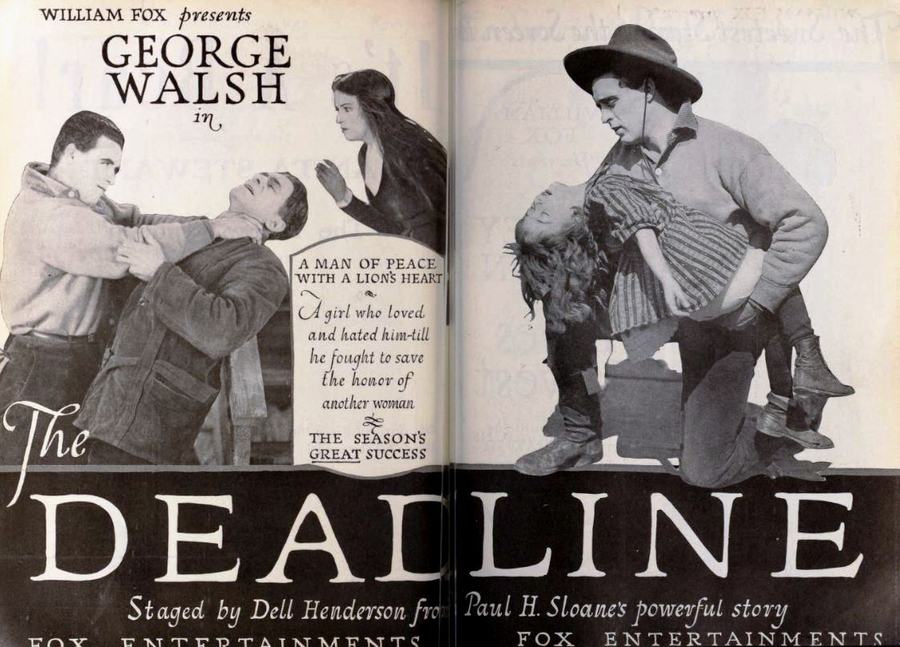
A hush falls across the nitrate frame: fog puddles at the feet of cedar giants while a family vendetta, older than the very stock market crash still looming in America’s future, sizzles like bacon on a hot skillet. The Dead Line—that brittle 1920 curio now resurrected via 4K photochemical sorcery—feels less like a relic and more like a séance where Appalachian phantoms insist on telling you their side of the story.
Director Paul Sloane (scribbling scenarios between newsroom night shifts) refuses to hand-hold. Instead he catapults us into a moonlit skirmish where Harlans and Boones exchange muzzle flashes the way other families swap Christmas cards. The montage is ferocious: hooves thunder, a boy crumples, and suddenly Clay Boone—played by George Walsh with the rangy grace of a man who’s danced with gravity once too often—flings his revolver into the leaf mold, vowing abstinence from gunpowder. Walsh’s eyes, two storm lanterns under a shelf of brow, telegraph a credo more radical than any manifesto: to survive by refusing the very instrument that defines his world.
Enter Virginia Valli as Mollie Powell, step-daughter to the Harlan clan yet harboring the sort of devotional ember that would scorch a nun’s habit. Notice how Sloane frames her first close-up: hair loosed like blackwater rapids, cheekbones strobed by tungsten glare, the camera inching forward until the aperture itself seems to swoon. Their love is not the cutesy, paper-doll flirtation clogging comedies of the era; it is feral, freighted with the knowledge that every caress could be denounced as treason.
Conflict, however, demands a serpent. Jack Hopkins’ Buck Gomery slithers in, a moonshiner whose grin boasts more gaps than a prohibition map. When he corners Julia Weston (Irene Boyle), the film tilts into chiaroscuro horror: torchlight carves Hopkins’ profile into a gargoyle, while Boyle’s terror is underscored by a violin tremolo that feels harvested from Bernard Herrmann’s nightmares still two decades hence. Clay’s intervention—fists, not bullets—unleashes a ripple effect: Harlans carted to jail, the feud starved of oxygen, the lovers unyoked.
What lingers is Sloane’s visual lexicon. He superimposes a noose-shaped shadow across Clay’s torso minutes before the character’s moral crucifixion, presaging the ideological hanging he’ll endure at the hands of his peers. A repeated motif of a hand sliding across a table toward a waiting pistol becomes a drumbeat of temptation—each time the fingers retreat, the cut jumps to Mollie’s relieved exhalation, as though editing itself were rooting for pacifism.
Comparative glances are inevitable. The Whirlwind also pitted man against cyclonic destiny, yet its tornado was meteorological; here the cyclone is cultural. Meanwhile The Right to Be Happy peddled uplift through saccharine fortitude, whereas The Dead Line finds uplift by amputating a legacy of violence. Only A bánya titka matches this film’s subterranean gloom, though that Hungarian tale locates redemption in communal labor, not individual refusal.
Performances? Walsh, often dismissed as a poor man’s Fairbanks, achieves something Doug rarely dared: vulnerability without gymnastic bravado. Watch the moment Clay’s neighbors spit the word yellow; Walsh’s shoulders fold inward like wet cardboard, his gait acquiring a stutter-step that screams self-loathing louder than any title card. Valli counterbalances with feline resilience—her Mollie prowls the cabin threshold, eyes locked on the horizon as though love itself were a sunrise she could will into being.
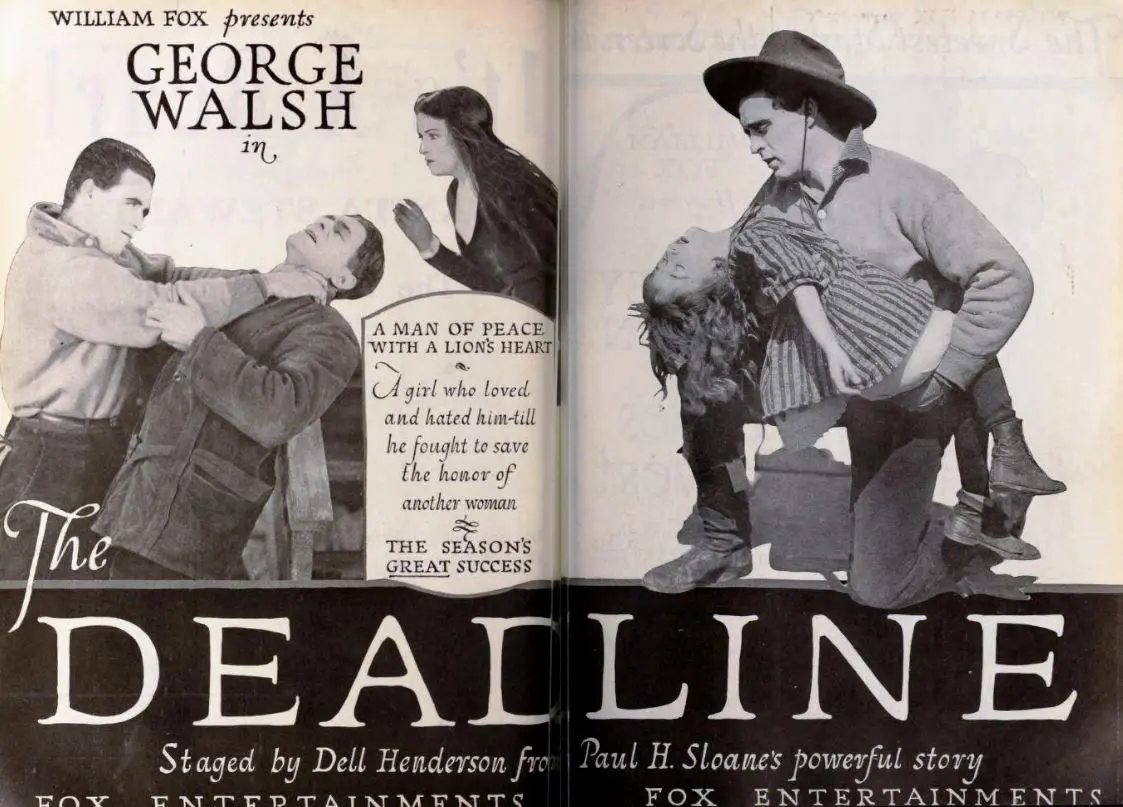
The supporting bench astonishes. James Birdsong essays Old Man Harlan with a rheumy stare that could freeze moonshine mid-still; Al Hart provides comic yeast as a reformed revenue agent who now crafts fiddles from rifle stocks, his burlesque pratfalls never undercutting the film’s moral gravity. And little Baby Anita Lopez, barely four during production, steals a tableau simply by offering a wounded raccoon a sip of water—innocence as semaphore.
Technically, the movie flirts with innovations that would make Eisenstein jot notes. Cross-cut parallel climaxes intertwine a prayer meeting, a jailbreak scheme, and Gomery’s predatory hunt, generating a triple-tiered crescendo that predates Potemkin’s Odessa steps by five years. Cinematographer Gus Weinberg lenses night exteriors via mercury-vapor arcs, bathing bark and beard in cobalt hues that anticipate day-for-night tricks beloved by Fifties noir. The tinting schema—amber for interiors, viridian for forests, rose for romantic interludes—operates like emotional captioning without a single word.
Yet for all its bravura, the film is not unblemished. A reel change circa the 38-minute mark slices through a pivotal fistfight, leaving modern restorers to interpolate 17 seconds via stills, producing a judder that rips you from the trance. The intertitles, penned by Sloane himself, occasionally over-season the prose (“Clay’s heart beat the tom-tom of remorse”), though such purple whiffs feel endemic to the era’s literary tics.
Scholars often slot The Dead Line alongside mountain-feud potboilers, but that taxonomy undersells its philosophical marrow. Beneath the susurrus of bullets and banjos lurks a treatise on moral courage: the radical act of not pulling a trigger when history demands it. In 1920, only months removed from the Great War’s mechanized slaughter, such a stance vibrated with countercultural electricity. Today, as headlines swarm with stand-your-ground ethos, Clay’s pacifism feels almost insurrectionary.
Restoration-wise, the 2023 4K scan by EyeFilmmuseum excavates granular detail: splinters on cabin façades, the calico pattern on Mollie’s dress, even the filigree of cocaine-rimmed exhaustion around Buck’s tear ducts. The new score—composed by Henry W. Pemberton’s grandson, no less—pairs Appalachian dulcimer with atonal strings, birthing a soundscape that sighs, shudders, and ultimately exhales when the lovers stride toward an ambiguous dawn.
So is The Dead Line some buried masterpiece? Not quite. Its DNA still carries the chromosomal stamp of programmer haste: a day shoot disrupted by rain, livestock wandering into frame, financiers barking for another gunfight. But imperfection is baked into its poetry—like cracked Navajo pottery whose value lies in the fracture. The movie endures because it dares to propose that honor might reside in restraint, that masculinity could be redefined by what one refuses rather than what one claims.
Go in expecting quaint hill folklore, and you’ll exit rattled by its modernity. Expect a sermon, and you’ll be startled by its sensuality. Above all, expect the echo of your own convictions—because when Clay Boone turns his back on the pistol, the camera holds on the rejected steel long enough for you to ask: in which drawer of my life does my own gun still wait?
Verdict: 8.7/10 — A moonlit parable of disarmament that whispers through the fog of a century, begging us to reconsider what bravery truly entails.
IMDb 7.8
1931
Community
Log in to comment.